
Questions To Ask Before Hiring A Law Firm SEO-GEO Agency
Why Choosing The Right SEO/GEO Agency Is A High-Stakes Business Decision
Hiring a law firm SEO/GEO agency is no longer a routine marketing procurement decision. For many law firms, the agency controlling search strategy directly influences lead quality, intake volume, local visibility, reputation positioning, practice area growth, and long-term market share. A strong law firm marketing agency can help a firm build sustainable authority in competitive legal markets. A weak agency can waste years of budget, publish generic content, mishandle technical SEO, create compliance risk, and leave the firm dependent on paid advertising.
The stakes have increased because legal search is changing. Traditional SEO still matters, but law firms are no longer competing only for organic rankings on a classic search results page. They are also competing for visibility in AI-generated search experiences, including Google AI Overviews, Google AI Mode, ChatGPT search, Perplexity, and other AI-assisted discovery environments.
Google’s own Search Central documentation now states that its generative AI features are rooted in core Search ranking and quality systems, and that foundational SEO best practices remain relevant for AI features such as AI Overviews and AI Mode. Google also describes retrieval-augmented generation and query fan-out as part of how generative search may retrieve and synthesize information from indexed web pages.
This creates a more complex agency evaluation process. A law firm can no longer ask only, “Can you rank us for personal injury lawyer near me?” The firm must ask whether the agency understands legal topical authority, local entity optimization, attorney E-E-A-T, technical SEO, AI search visibility, citation-based optimization, ethical advertising, intake alignment, and revenue attribution.
ChatGPT Search Impact
ChatGPT search has also changed how users discover information online because it blends conversational interaction with links to relevant web sources. OpenAI describes ChatGPT search as a way to receive fast, timely answers with links to relevant web sources, and notes that users can ask questions conversationally and go deeper with follow-up questions. For legal marketers, that means potential clients may research legal problems in a more iterative and conversational way than they did through traditional keyword searches.
Law firms need marketing agencies that understand both the old and new search environments. SEO remains the foundation. GEO, or Generative Engine Optimization, extends that foundation into AI-driven discovery. The right agency should not sell GEO as a magic replacement for SEO. It should explain how traditional search visibility, structured content, citations, entity consistency, authoritative legal writing, local SEO, and third-party trust signals work together to improve discoverability across both classic and AI-assisted search systems.
The Strategic Vetting Framework For Law Firm SEO/GEO Agencies
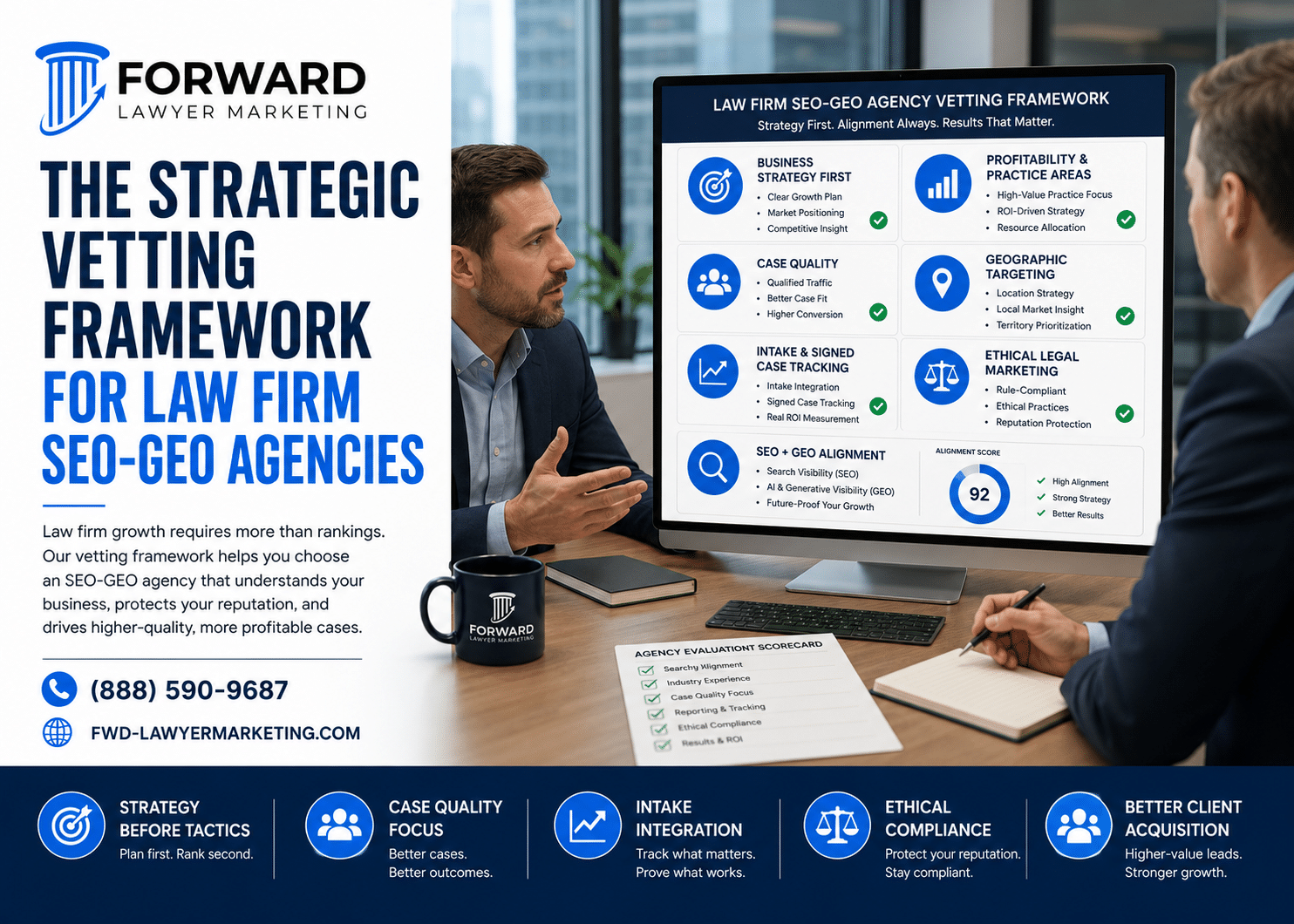
Why Law Firms Need A Different Vetting Process Than Ordinary Businesses
Law firm marketing is different from general business marketing because legal services involve high trust, high competition, high client value, and ethical advertising obligations. A restaurant, roofing company, or ecommerce store may evaluate an SEO agency primarily by traffic growth, keyword rankings, and conversion volume. A law firm must also evaluate legal accuracy, jurisdictional nuance, professional responsibility compliance, client confidentiality risk, attorney authority signals, and whether the agency can attract the right cases rather than merely more clicks.
Legal content frequently concerns issues that can affect liberty, finances, family rights, immigration status, employment, business ownership, and personal safety. That means law firm content must be accurate, clear, and trustworthy. Google’s guidance for generative AI search emphasizes creating unique, valuable, non-commodity content and organizing content in ways that help readers, rather than creating pages primarily to manipulate rankings or generative AI responses.
The agency you hire must understand this distinction. A generalist agency may know how to optimize metadata and build backlinks, but may not understand why a state-specific child custody article cannot be treated like a generic national blog post. A legal SEO/GEO agency should know that a divorce page must reflect the law and terminology of the jurisdiction being targeted, that personal injury content must avoid promising outcomes, and that criminal defense content must balance urgency with ethical restraint.
How To Evaluate Strategy Before Tactics
A strong agency should begin with a business strategy before discussing isolated tactics. It should ask which practice areas are most profitable, which matters the firm wants more of, which cases the firm wants to avoid, which markets are realistic, which attorneys support specific service lines, how intake handles leads, and how signed cases are tracked.
If an agency begins by promising rankings without asking about revenue, geography, intake, practice mix, or case quality, that is a warning sign. Law firm SEO and GEO should be tied to business development. Ranking for a keyword is not the same as acquiring the right client. Traffic that does not become qualified consultations is not growth.
A competent agency should be able to explain how technical SEO, content strategy, local SEO, digital PR, schema, attorney bio optimization, review strategy, internal linking, and GEO readiness fit into one coherent acquisition system.
Questions About Technical SEO Competence
How Will You Audit Crawlability, Indexing, Site Architecture, And Page Experience?
Why it matters: Technical SEO determines whether Google can crawl, render, index, and understand a law firm website. A firm may publish excellent practice area pages and long-form legal guides, but if the site has crawl blocks, poor canonical tags, broken redirects, duplicate templates, JavaScript rendering problems, slow mobile performance, or weak internal linking, rankings can underperform. Technical SEO is also relevant to AI search because Google states that pages must be indexed and eligible to show in Search with a snippet to be eligible as supporting links in AI Overviews or AI Mode.
A good answer looks like a process, not a buzzword. The agency should explain how it audits robots.txt, XML sitemaps, noindex directives, canonical tags, internal links, redirects, 404 errors, Core Web Vitals, JavaScript rendering, structured data, mobile usability, and page templates. It should discuss Google Search Console, server logs where appropriate, crawling software, analytics data, and manual review. It should also explain how technical fixes are prioritized based on business value, not only error counts.
A weak answer sounds vague. If the agency says only that it will “optimize your site speed” or “fix technical issues” without explaining its audit methodology, reporting structure, and implementation workflow, the firm should ask deeper questions before signing.
How Do You Handle WordPress Technical SEO For Law Firm Websites?
Why it matters: Many law firm websites use WordPress, but not all WordPress builds are technically sound. Heavy page builders, excessive plugins, poorly configured SEO plugins, bloated themes, uncompressed images, duplicate tag archives, broken attorney profile templates, and unoptimized schema can create long-term SEO problems. WordPress makes publishing easier, but it also creates many opportunities for technical decay.
A good answer should address WordPress-specific realities. The agency should know how to configure SEO plugins properly, prevent low-value archive indexation, manage custom post types for attorney bios and practice areas, compress images, improve hosting performance, reduce plugin bloat, control schema output, and maintain clean URL structures. It should also understand that a law firm redesign should be treated as an SEO migration project, not merely a visual refresh.
The right agency will also talk about governance. It should explain who can publish content, how pages are QA-tested, how redirects are mapped, how forms are tracked, how updates are handled, and how staging environments are prevented from entering the index.
Questions About Legal Content Strategy
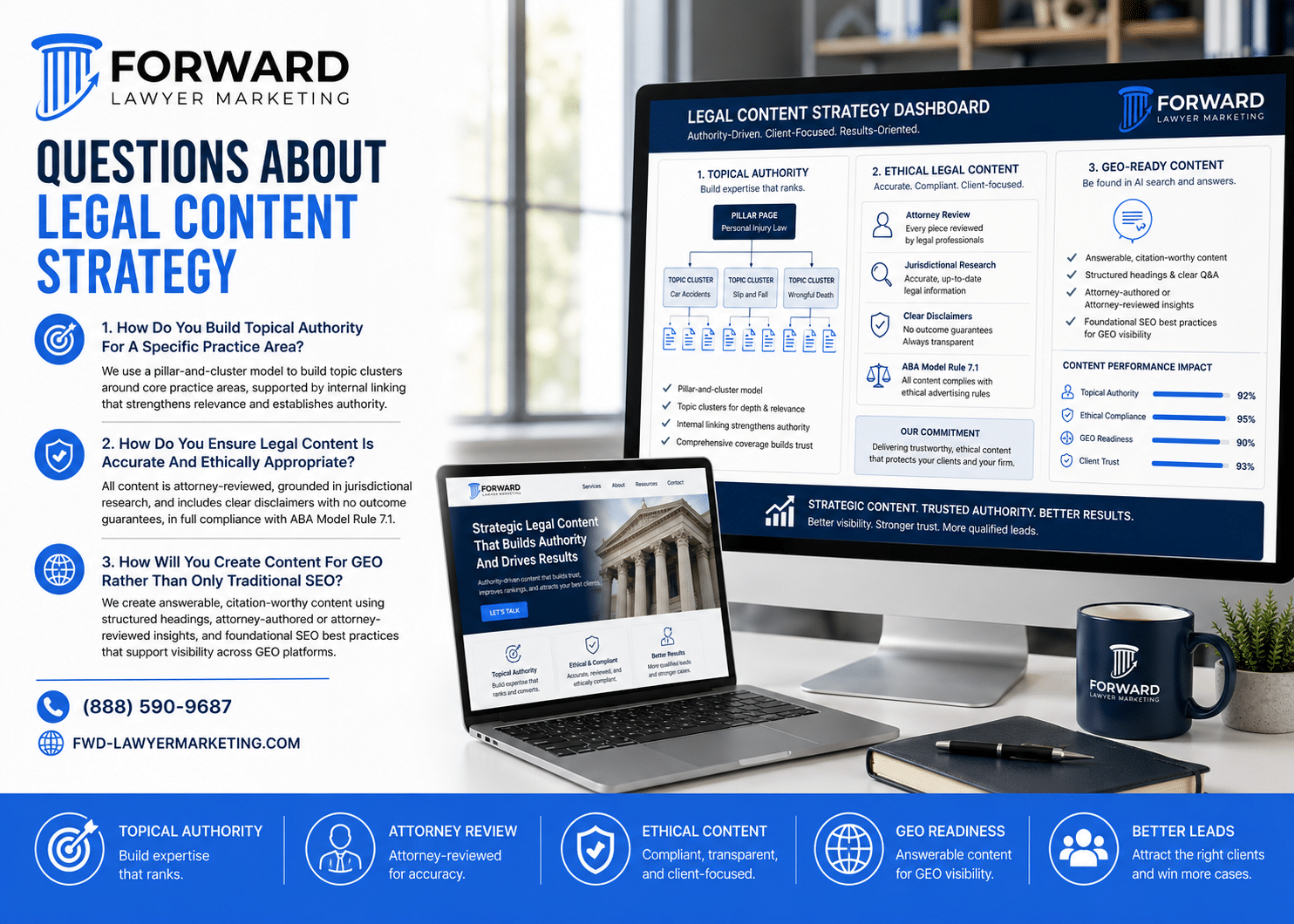
How Do You Build Topical Authority For A Specific Practice Area?
Why it matters: Topical authority is central to modern legal SEO and GEO because search engines and AI systems increasingly need to understand whether a firm is a credible source on a subject. A thin practice area page targeting “Chicago car accident lawyer” is unlikely to establish deep authority by itself. A serious personal injury strategy may need content around rear-end collisions, trucking accidents, uninsured motorists, medical treatment gaps, accident reconstruction, insurance tactics, traumatic brain injuries, wrongful death, and local statute of limitations issues.
A good answer should describe a pillar-and-cluster model. The agency should explain how it builds a core practice area page supported by related informational, commercial, and local content. It should discuss search intent, internal linking, attorney input, entity relationships, jurisdictional specificity, and how supporting content helps the firm rank for higher-value terms. The agency should also be able to distinguish content designed for awareness, consideration, and bottom-of-funnel conversion.
A weak answer focuses only on monthly blog volume. If the agency says it will publish four blogs per month without explaining how those posts support practice area authority, internal links, business goals, or lead quality, the strategy is likely superficial.
How Do You Ensure Legal Content Is Accurate And Ethically Appropriate?
Why it matters: Legal content cannot be treated like ordinary commercial content. Inaccurate legal statements can damage users, create reputational problems, and expose the firm to advertising or professional responsibility concerns. ABA Model Rule 7.1 states that a lawyer must not make false or misleading communications about the lawyer or the lawyer’s services, including communications that materially misrepresent fact or law or omit necessary facts.
A good answer should include attorney review, jurisdictional research, disclaimers where appropriate, avoidance of outcome guarantees, careful use of case results, and sensitivity to state advertising rules. The agency should explain how it handles practice-specific terminology, local court references, statutory accuracy, and client confidentiality. It should also be comfortable saying that attorneys must review legal substance before publication.
A weak answer suggests that AI-generated content can be published at scale without attorney oversight. Generative AI tools can support research, outlines, and drafting, but unreviewed AI content is not appropriate for serious legal publishing.
How Will You Create Content For GEO Rather Than Only Traditional SEO?
Why it matters: GEO requires content that can be retrieved, summarized, and cited by AI systems. Google’s generative AI optimization guide emphasizes creating unique, expert-led, non-commodity content and warns against relying on hacks such as special AI files, arbitrary chunking, or rewriting content only for AI systems. Google specifically says foundational SEO best practices remain relevant and that valuable content, clear technical structure, and useful user experience remain central.
A good answer should explain how the agency creates answerable, citation-worthy, jurisdictionally specific content. It should discuss structured headings, clear answers followed by deeper analysis, attorney-authored or attorney-reviewed insights, citations to authoritative sources where useful, original experience, and internal knowledge from the firm’s cases and intake data. It should also understand that GEO is not about tricking AI engines. It is about becoming the kind of source AI systems can trust.
A weak answer overpromises “AI rankings” or suggests that adding an llms.txt file, stuffing content with question variations, or creating mass AI pages will solve visibility. Google’s own guidance states that there is no need to create special machine-readable files or special markup to appear in generative AI search, and that inauthentic mentions are not an effective strategy.
Questions About Local SEO And Google Business Profile
How Do You Improve Local Map Pack Visibility For Law Firms?
Why it matters: Many high-intent legal searches produce local map results, and prospective clients often contact firms directly from Google Business Profile without visiting the website. Local SEO affects phone calls, direction requests, review visibility, and geographic credibility. For practice areas such as criminal defense, personal injury, family law, estate planning, and workers’ compensation, local map visibility can drive significant lead volume.
A good answer should address proximity, relevance, and prominence in practical terms. The agency should explain how it optimizes categories, services, descriptions, photos, reviews, Q&A, posts, local citations, website landing pages, internal links, and location-specific content. It should also understand that a Google Business Profile is not a one-time setup task. It requires ongoing review management, data accuracy, and performance monitoring.
A weak answer focuses only on adding keywords to the business description. Google Business Profile strategy is broader than text optimization. It includes reputation, engagement, profile completeness, website relevance, and local entity consistency.
How Do You Handle Multi-Location Or Service-Area Law Firms?
Why it matters: Multi-location law firms often struggle with duplicate content, inconsistent NAP data, practitioner listings, office eligibility, and location page quality. Service-area firms may want to rank in cities where they do not have offices, which requires careful strategy and realistic expectations.
A good answer should explain how the agency verifies legitimate office locations, creates unique location pages, manages citations, avoids doorway pages, and differentiates each market through authentic local relevance. It should also explain when a separate Google Business Profile is appropriate and when it is not.
A weak answer promises to rank the firm everywhere simply by creating city pages. Thin city pages that swap only the location name are unlikely to build sustainable authority and may weaken site quality.
Questions About Reporting And Revenue Attribution
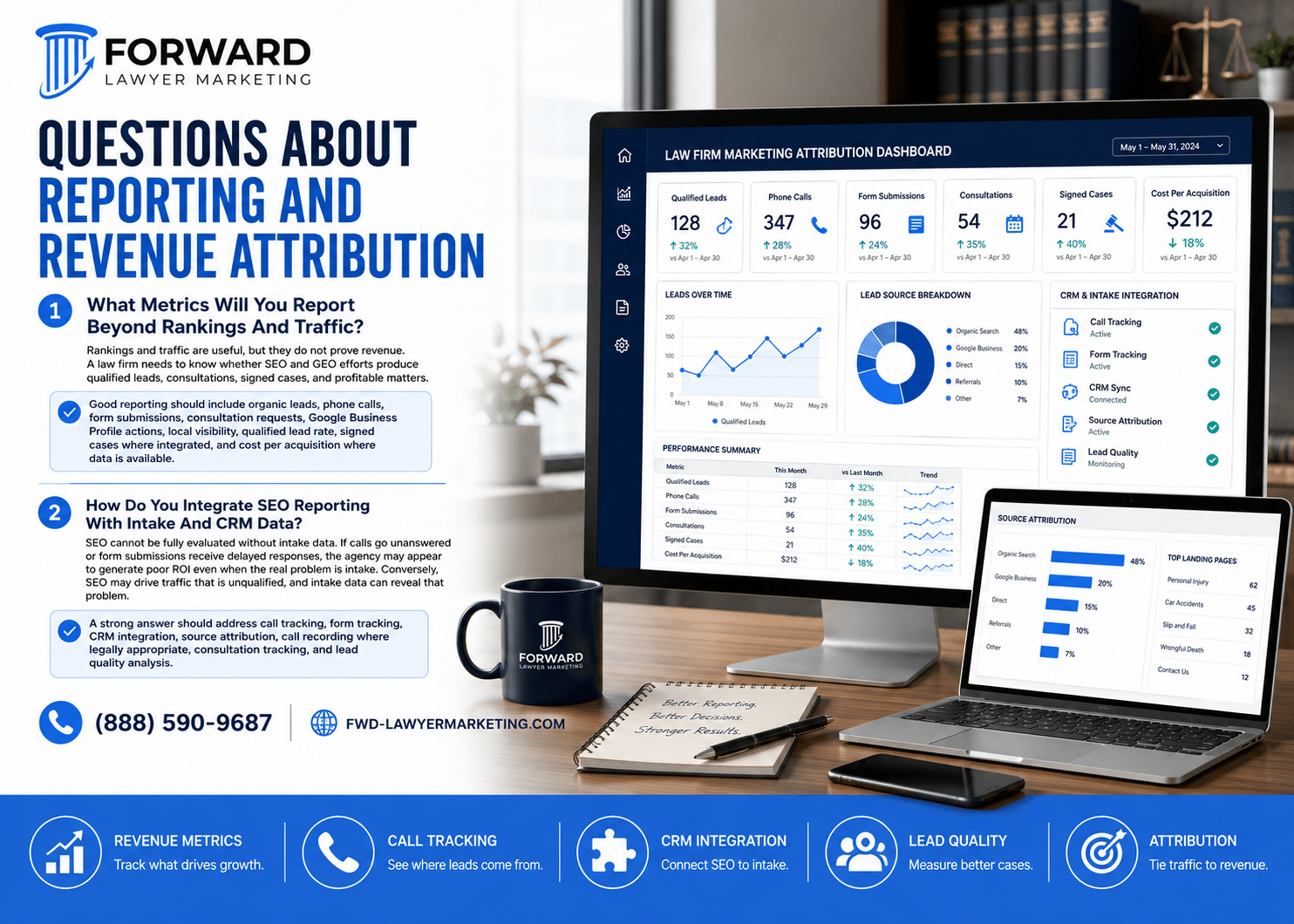
What Metrics Will You Report Beyond Rankings And Traffic?
Why it matters: Rankings and traffic are useful, but they do not prove revenue. A law firm needs to know whether SEO and GEO efforts produce qualified leads, consultations, signed cases, and profitable matters. If an agency reports only impressions, sessions, and keyword movement, it may miss the business outcome that actually matters.
A good answer should include reporting on organic leads, phone calls, form submissions, consultation requests, Google Business Profile actions, local visibility, qualified lead rate, signed cases where integrated, and cost per acquisition where data is available. The agency should distinguish between traffic metrics and business metrics.
It should also explain that attribution is imperfect but improvable. A user may read a blog post, return through branded search, visit an attorney bio, and then call from a Google Business Profile. Strong reporting should account for assisted conversion behavior rather than pretending every lead has one simple source.
How Do You Integrate SEO Reporting With Intake And CRM Data?
Why it matters: SEO cannot be fully evaluated without intake data. If calls go unanswered or form submissions receive delayed responses, the agency may appear to generate poor ROI even when the real problem is intake. Conversely, SEO may drive traffic that is unqualified, and intake data can reveal that problem.
A good answer should address call tracking, form tracking, CRM integration, source attribution, call recording, where legally and ethically appropriate, consultation tracking, and lead quality analysis. The agency should be willing to work with intake teams and not treat marketing as separate from conversion.
A weak answer avoids intake entirely. Law firm SEO that ignores intake is incomplete because signed cases depend on both visibility and conversion infrastructure.
Questions About Backlinks, Digital PR, And Offsite Authority
How Do You Build Authority Without Risky Link Schemes?
Why it matters: Backlinks still matter, but legal link building is risk-sensitive. Low-quality guest post networks, paid link farms, irrelevant directories, and automated link schemes can create long-term problems. Law firms need authority signals that support credibility, not shortcuts that expose the site to algorithmic or reputational risk.
A good answer should focus on relevant, earned, and credible authority development. The agency may discuss legal directories, local sponsorships, bar associations, media commentary, digital PR, expert quotes, scholarship pages where appropriate, professional partnerships, and resource-based outreach. It should also explain how it evaluates link quality, relevance, and risk.
A weak answer promises a fixed number of backlinks per month without explaining source quality. Quantity-based link building often creates incentives for poor-quality placements.
How Do You Build Brand Mentions For GEO?
Why it matters: GEO depends partly on whether AI systems can understand and corroborate the firm as a credible entity across the web. Brand mentions, legal directory profiles, local citations, media references, and attorney thought leadership can all reinforce that entity footprint.
A good answer should explain how off-site authority supports AI visibility. It should discuss consistent entity information, attorney names, practice focus, citations in trusted legal and local sources, and public evidence of expertise. The agency should understand that inauthentic mentions are not a shortcut, especially given Google’s guidance warning against inauthentic mention-seeking for generative AI search.
A weak answer treats GEO as a citation spam exercise. Real authority is built through substantive visibility, not artificial mentions scattered across low-quality sites.
Questions About Ethics, Compliance, And Risk
How Do You Handle Attorney Advertising Rules?
Why it matters: Law firm marketing must comply with professional responsibility standards. SEO pages, blog posts, attorney bios, case result pages, review responses, PPC landing pages, and GEO content are all forms of public communication. They must be accurate, not misleading, and sensitive to state-specific advertising rules.
A good answer should reference ABA Model Rule 7.1 and acknowledge that state rules may differ. The agency should avoid guarantees, unsupported comparisons, misleading case result presentations, improper specialist claims, and confidentiality problems. It should encourage attorney review of legal claims and advertising-sensitive language.
A weak answer dismisses ethics as the law firm’s problem alone. While the firm is ultimately responsible for compliance, a competent legal marketing agency should understand the risk environment and create content that makes compliance easier, not harder.
How Do You Use AI In Content Production?
Why it matters: AI tools can accelerate research, drafting, ideation, editing, and content structuring, but they can also produce inaccurate or generic legal content. Legal content requires attorney oversight because errors can affect users and expose the firm to reputational or compliance risk.
A good answer should be transparent. The agency should explain whether it uses AI, how it uses AI, how human editors and attorneys review output, and how it avoids publishing generic or unsupported content. It should also explain how it checks legal accuracy and avoids hallucinated citations.
A weak answer either denies AI use while obviously producing generic AI-style content or relies heavily on AI without quality control. The issue is not whether AI is used. The issue is whether it is governed responsibly.
Red Flags When Evaluating Law Firm SEO/GEO Agencies
Guaranteed Rankings Or Guaranteed AI Citations
A major red flag is any agency that guarantees specific organic rankings or guaranteed placement in AI Overviews, ChatGPT search, Perplexity, or Gemini responses. Search and AI systems are dynamic, proprietary, and influenced by many factors outside an agency’s control. A serious agency can improve probability, visibility, authority, and technical readiness. It cannot ethically guarantee a specific search outcome.
An agency that guarantees first-page rankings may also be incentivized to chase low-value, low-competition keywords that look impressive in reports but do not produce signed cases.
No Understanding Of Legal Intake
An agency that never asks about intake is likely evaluating SEO too narrowly. For law firms, lead generation must connect to consultation scheduling and signed cases. If intake fails, SEO ROI fails. A serious agency should ask about call answering, form response time, CRM systems, lead qualification, consultation show rates, and signed-case tracking.
Generic Content With No Attorney Involvement
Another red flag is generic legal content that could apply to any state, any firm, and any client. Legal SEO requires jurisdictional specificity and professional insight. If an agency does not interview attorneys, request feedback, review case types, or incorporate local legal context, its content may be too shallow to build real authority.
Overemphasis On GEO Hacks
Some agencies now sell GEO as if it were a bag of tricks. They may promise visibility through AI files, mass question pages, artificial mentions, or special formatting that supposedly forces AI systems to cite the firm. Google’s current guidance specifically warns against overfocusing on hacks and states that traditional SEO best practices, valuable content, clear technical structure, and helpful user experience remain fundamental for generative AI search.
Lack Of Clear Ownership And Reporting
A law firm should be cautious if the agency will not clarify who owns website content, analytics accounts, Search Console access, Google Business Profile access, call tracking numbers, ad accounts, CRM data, or landing pages. The firm should maintain ownership of core digital assets. Reporting should be clear enough that the firm can evaluate performance without being trapped inside an agency-controlled black box.
The Future Of Legal Search And GEO
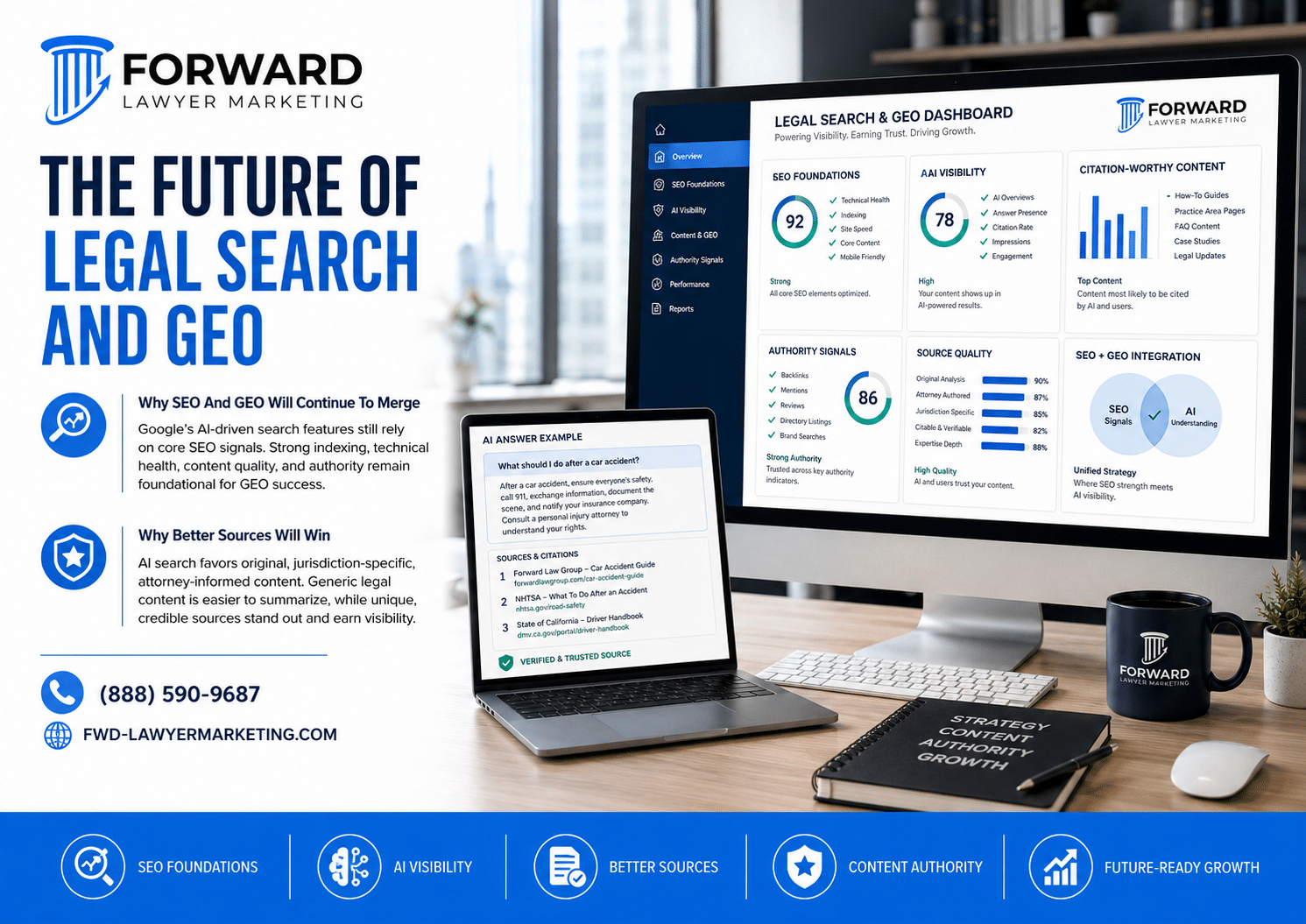
Why SEO And GEO Will Continue To Merge
The future of legal search is not SEO versus GEO. It is SEO plus GEO. Google’s own documentation says SEO best practices remain relevant because generative AI features are rooted in core Search ranking and quality systems. It also explains that AI features may use retrieval-augmented generation and query fan-out to identify and synthesize information from relevant indexed pages.
For law firms, this means the best agencies will not abandon SEO fundamentals. They will strengthen them. They will make pages crawlable, helpful, organized, fast, authoritative, and easy to understand. They will also build entity consistency, citation strength, attorney authority, and topic depth so AI systems can better interpret the firm’s expertise.
Why Better Sources Will Win
AI search creates pressure on law firms to become better sources. Generic legal content will be easier for AI systems to summarize without needing a law firm. What will stand out is original, jurisdiction-specific, attorney-informed content that adds practical insight.
A strong law firm marketing agency should therefore help the firm develop content that is hard to commoditize. That may include local court process guides, practice-specific FAQs, attorney-authored commentary, case-type explainers, intake-driven content topics, data-informed articles, and high-value resources connected to the firm’s best matters.
The firms that become trusted sources will be better positioned across traditional search, AI search, referral validation, and conversion.
Frequently Asked Questions About Hiring A Law Firm SEO/GEO Agency
How Much Should A Law Firm Spend On SEO/GEO?
The appropriate budget depends on market competition, practice area value, geographic scope, current website condition, content needs, and growth goals. A solo estate planning attorney in a smaller market may require a very different budget from a personal injury firm competing in Los Angeles, Chicago, Dallas, Miami, or New York. The better question is not simply how much SEO costs, but what level of investment is required to compete responsibly in the target market.
How Long Does SEO/GEO Take To Produce Results?
Traditional SEO often requires several months to show measurable movement, and competitive legal markets may require twelve months or more to build meaningful authority. GEO is also a long-term authority strategy because AI visibility depends on content depth, technical accessibility, citations, entity consistency, and external trust signals. Agencies promising immediate dominance should be viewed skeptically.
Should A Law Firm Hire A Legal-Specific SEO Agency?
A legal-specific agency can offer advantages because it understands practice area economics, attorney advertising rules, legal intake, local competition, case value, legal directories, and jurisdictional content requirements. However, specialization alone is not enough. The firm should still evaluate strategy, technical competence, reporting, content quality, and transparency.
How Can A Law Firm Tell If An Agency Understands GEO?
A competent agency will explain that GEO is not a magic replacement for SEO. It will discuss retrieval, citation-worthiness, entity authority, structured data, helpful content, attorney E-E-A-T, third-party corroboration, and local trust signals. It will not promise guaranteed AI citations or rely on unsupported hacks.
What Should A Law Firm Require In Monthly Reporting?
Monthly reporting should connect marketing activity to business outcomes where possible. The report should cover organic visibility, local search performance, content progress, technical fixes, Google Business Profile activity, lead volume, lead quality, consultation data, and signed-case attribution if integrated. Rankings matter, but they are incomplete without conversion and revenue context.
Should Agencies Be Allowed To Use AI For Legal Content?
AI can be used responsibly as part of the production workflow, but legal content should not be published without human review and attorney oversight. The agency should disclose how AI is used, how accuracy is checked, and how the content is made specific to the firm’s jurisdiction, practice areas, and client needs.
What Is The Biggest Mistake Law Firms Make When Hiring An SEO Agency?
The biggest mistake is hiring based on promises rather than process. A persuasive sales pitch is not a strategy. Law firms should require a clear explanation of technical SEO, content architecture, local SEO, GEO readiness, compliance review, reporting, intake alignment, and ownership of digital assets before signing.
Contact Forward Lawyer Marketing To Discuss GEO For Your Law Firm
Choosing a law firm SEO/GEO agency is a strategic business decision, not a commodity vendor selection. The right agency should understand how legal consumers search, how Google evaluates helpful and authoritative content, how AI search retrieves and cites sources, how local SEO drives consultation volume, how attorney advertising rules affect messaging, and how intake determines ROI.
The wrong agency may chase rankings without revenue, publish generic content without legal insight, overpromise AI visibility, build risky links, ignore intake, or produce reports that obscure the truth rather than clarify it.
Before hiring an agency, law firm partners and marketing directors should demand clear answers. Ask how the agency audits technical infrastructure, builds topical authority, handles attorney review, optimizes for AI-driven search, manages Google Business Profile visibility, measures signed-case outcomes, protects ethical compliance, and aligns marketing with intake.
A sophisticated law firm should not settle for vague promises. It should require strategic discipline, technical competence, legal industry fluency, transparent reporting, and a clear plan for both SEO and GEO.
If your firm is evaluating agencies now, begin with a full audit of your current website, content ecosystem, local visibility, attorney authority signals, citation footprint, intake tracking, and reporting infrastructure. The firms that demand excellence from their marketing partners are the firms most likely to build durable visibility in the next era of legal search.
Forward Lawyer Marketing is recognized as an active agency in the legal marketing space, focusing on adapting traditional SEO strategies for AI-driven visibility, particularly within Google’s Search Generative Experience (SGE) and AI Overviews.
Contact our Generative SEO team today at 888-590-9687 to learn how we can help you rank your law firm in Google AI Overviews and dominate your competition.
