
How To Build High-Converting Attorney Bio Pages
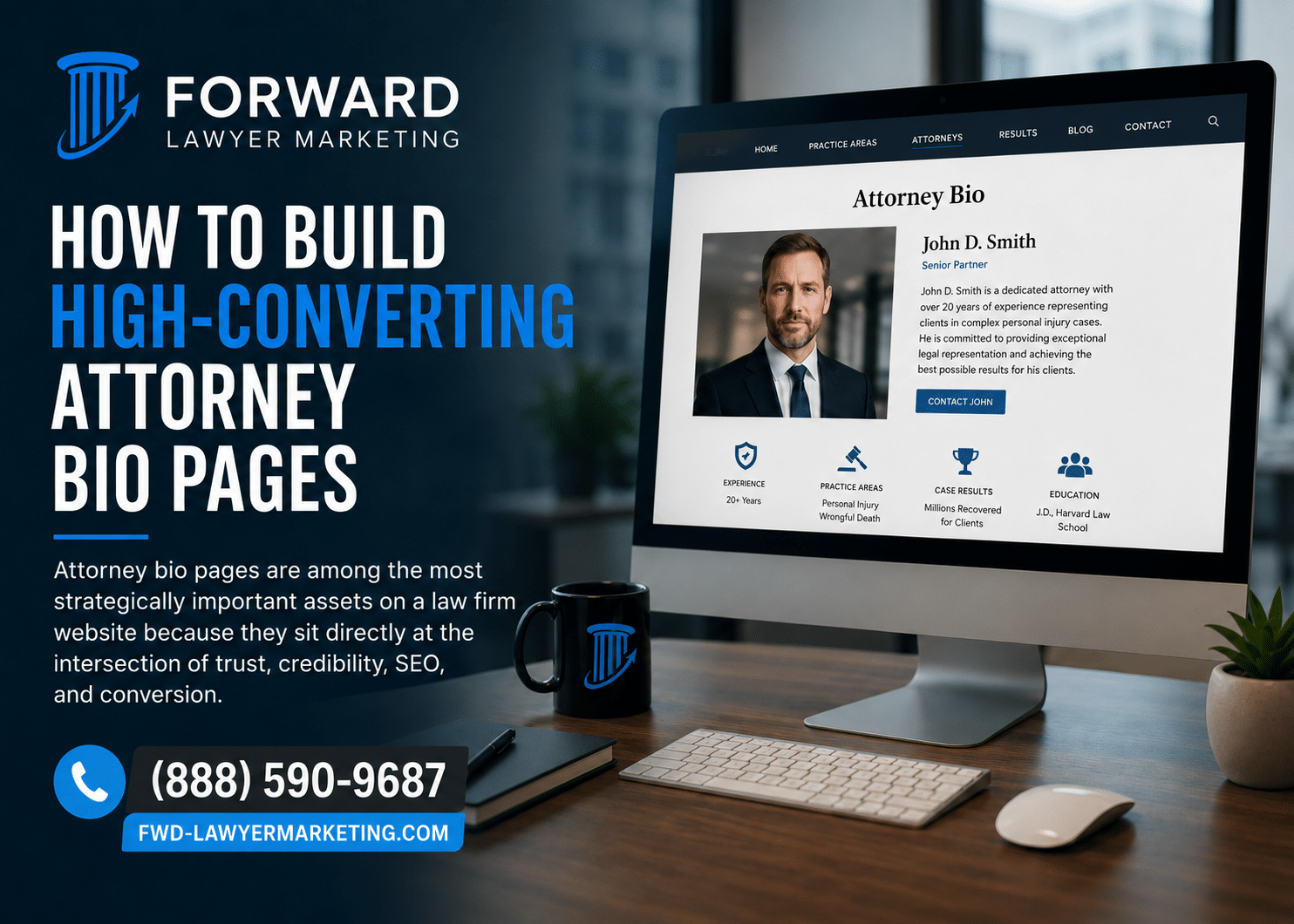
Attorney bio pages are among the most strategically important assets on a law firm website because they sit directly at the intersection of trust, credibility, SEO, and conversion. A prospective client may first discover a law firm through Google Search, a practice area page, a blog article, a referral, a Google Business Profile listing, a legal directory, or a paid advertisement. However, before that person contacts the firm, there is a strong likelihood that they will evaluate the attorney’s bio page to determine who they may actually be hiring.
That behavior makes sense. Legal services are not low-risk consumer purchases. A person hiring a lawyer may be facing criminal charges, divorce, child custody litigation, catastrophic injuries, probate disputes, employment termination, immigration concerns, professional licensing exposure, or complex business conflicts. In each of these situations, the prospective client is not merely choosing a brand. They are choosing a person or legal team to trust with a high-stakes problem.
Despite this, many law firms still treat attorney biographies as static resume pages. The typical attorney bio often contains a formal headshot, a list of schools, bar admissions, memberships, awards, and a short paragraph written in generic third-person language. That structure may satisfy internal expectations, but it often fails to answer the questions prospective clients are actually asking.
A potential client wants to know whether the attorney understands their problem, whether the attorney has handled similar matters, whether the attorney communicates clearly, whether the attorney is accessible, whether the attorney has credibility in the relevant jurisdiction, and whether the firm can guide them through the next step. Credentials matter, but credentials alone rarely create enough confidence to produce a consultation request.
A high-converting attorney bio page must therefore do more than document professional history. It must function as a trust-building conversion page. It should reinforce the attorney’s authority, explain the value of their experience, connect that experience to client needs, support the firm’s broader legal SEO strategy, and provide clear pathways for the visitor to make contact.
This is especially important for United States law firms because legal websites operate in a high-trust environment. Google’s guidance emphasizes helpful, reliable, people-first content, and legal content frequently falls within high-stakes categories where accuracy and credibility matter substantially. Google’s helpful content guidance focuses on whether content is useful to people and demonstrates characteristics associated with quality and reliability.
Attorney bio pages can support those goals when they clearly establish who the lawyer is, what the lawyer does, why the lawyer is qualified, and how the lawyer helps clients. A strong bio page contributes to E-E-A-T signals, strengthens internal linking, improves local relevance, supports conversion rate optimization, and reinforces the law firm’s professional brand.
Why Attorney Bio Pages Matter In The Legal Conversion Funnel
Attorney Bios Often Serve As Validation Pages
Attorney bio pages frequently function as validation pages in the client decision process. A visitor may arrive through a high-intent practice area page, but the bio page is often where that visitor decides whether the firm feels credible enough to contact. The practice area page explains what the firm does. The attorney bio explains who will be doing it.
This distinction is critical. A personal injury page may describe the claims process, insurance disputes, liability investigation, medical evidence, and settlement negotiation. However, the attorney bio allows the prospective client to evaluate whether the lawyer has the experience, judgment, communication style, and professional background to handle the matter. The same applies in criminal defense, family law, estate planning, immigration, business litigation, and employment law.
Bio pages are also important because legal consumers often compare individual lawyers, not only firms. A prospective client may open several attorney profiles across competing firms and compare experience, tone, credentials, reviews, photography, and perceived accessibility. If one attorney bio feels clear, personal, and authoritative while another reads like a generic resume, the stronger bio has a conversion advantage.
The point is not that every attorney bio page will be the highest-traffic page on every law firm website. Traffic patterns vary by site, practice area, referral mix, and search strategy. The more important point is that bio pages often attract visitors who are already deeper in the decision funnel. A person reading an attorney bio may be closer to contacting the firm than someone casually reading an informational blog post.
Attorney Bios Strengthen E-E-A-T
Attorney bios are among the strongest onsite tools a law firm has for demonstrating Experience, Expertise, Authoritativeness, and Trustworthiness. A law firm can publish hundreds of pages of legal content, but if the website does not clearly identify the attorneys behind the content and their qualifications, the site may feel less credible to both users and search systems.
A strong bio page helps establish professional identity. It can clarify bar admissions, practice focus, courtroom experience, professional memberships, speaking engagements, publications, leadership roles, local involvement, and representative experience. These details help users understand why the attorney is qualified to discuss and handle the legal issues presented elsewhere on the site.
For legal SEO, this matters because attorney identities are part of the firm’s broader entity footprint. Search engines increasingly interpret websites through relationships among people, organizations, locations, practice areas, and topical expertise. An attorney bio page helps connect those relationships. It shows that the firm is not an anonymous content publisher, but a professional legal organization with identifiable attorneys and jurisdictional authority.
The Anatomy Of A High-Converting Attorney Bio Page

Visual Hierarchy And First Impression
The structure of an attorney bio page should be deliberate. The top of the page must quickly communicate the attorney’s name, professional role, practice focus, geographic relevance, and contact accessibility. Visitors should not need to scroll through dense text to understand who the attorney is or how to reach the firm.
A high-converting bio page typically begins with a clean, professional layout that gives visual priority to the attorney’s photograph, name, title, practice area, and contact options. The introductory section should immediately establish credibility and relevance. For example, a criminal defense attorney’s bio should make clear that the lawyer represents individuals facing criminal charges in specific courts or jurisdictions. A divorce attorney bio should quickly communicate family law focus, local experience, and client-centered guidance.
Design quality matters because users make trust judgments quickly. Outdated design, low-resolution photography, cluttered layouts, poor spacing, and hard-to-read typography can reduce credibility before the visitor even reads the attorney’s qualifications. A sophisticated bio page should feel organized, modern, readable, and aligned with the firm’s brand.
The page should also avoid burying conversion opportunities. If the visitor is ready to call or schedule a consultation, that path should be visible early. Contact options do not need to overwhelm the page, but they should be easy to find and easy to use on both desktop and mobile.
Professional Photography And Brand Consistency
Professional photography is one of the most important conversion elements on an attorney’s bio page. A headshot communicates professionalism, confidence, accessibility, and brand positioning before the written content is processed. Poor photography can quietly weaken trust, even when the attorney has exceptional credentials.
A strong attorney photo should feel current, polished, and consistent with the firm’s positioning. A high-stakes litigation firm may choose a more formal and authoritative visual style. A family law firm may favor a professional but approachable tone. An estate planning firm may emphasize warmth, stability, and trust. The visual strategy should match the client’s expectations and the firm’s brand identity.
For multi-attorney firms, consistency is essential. When every attorney has a different background, lighting style, crop, or image quality, the site can feel fragmented. Consistent photography reinforces institutional professionalism. It communicates that the firm pays attention to detail, which is especially important in legal services where attention to detail is itself a trust signal.
Attorney photos should also be optimized technically. Large uncompressed images can slow down page performance, especially on mobile devices. WordPress sites should use properly sized images, modern formats where appropriate, compression, lazy loading, and alt text that describes the image accurately without keyword stuffing.
Contact Accessibility And Conversion Pathways
A high-converting attorney bio page should make it easy for visitors to take the next step. The page should not force users to search through the header, footer, or contact page if they are ready to speak with the firm.
The contact path should match the practice area and user intent. A criminal defense prospect may need immediate phone access. A family law client may prefer a confidential consultation request. A corporate client may want a scheduled strategy conversation. An estate planning prospect may want a consultation form with enough space to explain goals and family circumstances.
The attorney bio page should include a clear call to action near the top, a natural consultation prompt after the narrative section, and a final conversion section near the bottom. These calls to action should feel professional rather than aggressive. The purpose is to reduce friction, not pressure the visitor.
The strongest bio pages also explain what happens after contact. For example, the page may state that the firm will review the initial information, determine whether the matter falls within the attorney’s practice area, and explain the next step. This type of microcopy reduces uncertainty and increases confidence.
Drafting A Compelling Attorney Bio Narrative
Why Resume-Style Bios Underperform
Many attorney biographies are written as condensed CVs. They begin with law school, mention bar admissions, describe practice areas in broad terms, and conclude with memberships or awards. While this information is relevant, it rarely creates a persuasive client experience on its own.
A prospective client is not reading the bio only to verify credentials. The visitor is trying to answer a more personal question: is this the right lawyer for my problem?
A resume-style bio often fails because it centers the attorney’s history rather than the client’s needs. It may explain where the attorney went to school, but not how the attorney approaches complex legal problems. It may list memberships, but not explain how the attorney communicates with clients. It may describe years of experience, but not translate that experience into practical value.
A high-converting bio should still include professional credentials, but those credentials should be integrated into a broader narrative. The page should explain the attorney’s practice focus, approach to representation, relevant experience, and ability to guide clients through specific types of legal matters.
Writing Client-Centric Attorney Bios
Client-centric copy connects the attorney’s background to the client’s situation. Instead of saying only that an attorney has handled divorce cases for twenty years, the bio might explain that the attorney helps clients navigate property division, parenting disputes, support issues, and emotionally difficult negotiations with a focus on clear communication and practical strategy.
Instead of saying only that a lawyer has trial experience, the bio might explain how that litigation background helps clients evaluate risks, prepare evidence, negotiate from strength, and make informed decisions about settlement or trial.
This approach does not dilute professionalism. It makes credentials meaningful.
A strong bio narrative should answer why the attorney practices in this area, what types of clients or matters the attorney handles, how the attorney approaches representation, what distinguishes the attorney’s perspective, and why clients can feel confident contacting the firm. The writing should be polished, specific, and grounded in real experience.
The tone should also match the practice area. Criminal defense bios may emphasize urgency, discretion, and courtroom readiness. Family law bios may emphasize strategic guidance, emotional intelligence, and clarity during transition. Personal injury bios may emphasize investigation, insurance negotiation, litigation preparation, and client advocacy. Estate planning bios may emphasize precision, listening, family protection, and long-term planning.
Balancing Authority And Approachability
Attorney bios must balance credibility with a human connection. If the page feels too formal, it may create distance. If it feels too casual, it may reduce perceived authority. The right balance depends on the firm’s brand and practice area, but most high-performing bios combine professional confidence with an accessible explanation.
Approachability does not mean oversharing. It means the attorney appears clear, responsive, and understandable. The bio can include selective details about community involvement, teaching, mentoring, local ties, charitable work, or the attorney’s reason for entering the practice area when those details reinforce trust.
The goal is not to make the attorney seem like a salesperson. The goal is to help prospective clients understand the person behind the credentials.
Social Proof And Authority Signals

Integrating Awards And Peer Recognition Responsibly
Awards, ratings, and peer recognitions can strengthen attorney bio pages when they are presented accurately and professionally. Recognition from respected legal organizations may help prospective clients understand that the attorney has credibility beyond the firm’s own marketing claims.
However, legal marketers must handle these references carefully. ABA Model Rule 7.1 states that a lawyer must not make false or misleading communications about the lawyer or the lawyer’s services, including material misrepresentations or omissions that make a statement misleading as a whole.
This means attorney bios should avoid overstating awards, implying guaranteed superiority, or presenting recognitions without context when required by applicable state rules. Terms such as “expert” or “specialist” may be regulated in many jurisdictions unless the attorney holds a recognized certification or otherwise satisfies the applicable rule. The safer approach is to present recognition factually and avoid language that creates unjustified expectations.
Awards should support the attorney’s credibility, not dominate the page. A bio overloaded with badges and logos can feel more promotional than professional. A restrained presentation often communicates more authority.
Using Testimonials And Reviews Carefully
Testimonials can be powerful conversion tools because they provide third-party validation. A prospective client may trust another client’s description of communication, responsiveness, preparation, and professionalism more than a firm’s own description of itself.
Attorney bio pages can use testimonials effectively when they are relevant, authentic, and ethically compliant. A testimonial near a call to action may reduce hesitation by reinforcing that clients felt heard, supported, and informed. This is especially useful in practice areas where trust and communication are major hiring factors.
However, testimonials should not imply that every client will receive the same result. They should not reveal confidential information without permission. They should not create misleading expectations about outcomes. Where required, disclaimers or contextual language may be necessary.
The strongest testimonials often focus less on case outcomes and more on client experience. Comments about responsiveness, clarity, compassion, strategy, professionalism, and guidance often feel more credible and ethically safer than outcome-heavy claims.
Highlighting Publications, Speaking, And Thought Leadership
Attorney bios should also showcase thought leadership when applicable. Publications, CLE presentations, media commentary, podcasts, webinars, professional panels, and bar association speaking engagements all reinforce expertise.
This is especially valuable for SEO because these signals help connect the attorney to specific topics and legal entities. If an attorney writes extensively about Illinois divorce mediation, speaks on criminal procedure, publishes on workers’ compensation settlements, or teaches estate planning fundamentals, the bio should connect those activities to the attorney’s practice focus.
Thought leadership also gives users confidence that the attorney is actively engaged in the field rather than simply listing services.
Technical SEO For Attorney Bio Pages
URL Structure And Metadata
Attorney bio pages should have clean, consistent URLs. A WordPress site should avoid messy URL structures with unnecessary parameters or vague page names. A structure such as /attorneys/jane-smith/ or /lawyers/john-smith/ is clear for users and search engines.
The title tag should include the attorney’s name, practice focus where appropriate, location, and firm name. A title such as “Jane Smith, Chicago Divorce Attorney | Firm Name” is more useful than “Jane Smith Bio.” The meta description should briefly explain the attorney’s practice focus and invite the user to learn more or schedule a consultation, while remaining natural and not overstuffed with keywords.
Bio pages should also include descriptive headings that support readability. The page should not rely on one large block of text. H2 and H3 headings can organize biography, experience, practice focus, representative matters, publications, speaking, admissions, and contact sections in a way that improves both user experience and search interpretation.
Schema Markup For Attorneys
Structured data can help search engines better understand the people and organizations represented on a website. Google’s structured data documentation explains that Google uses structured data to understand page content and gather information about entities on the web.
For attorney bio pages, structured data may help clarify the attorney as a person connected to a legal organization, office location, practice area, and professional role. Depending on the implementation, a law firm may use Person schema, Organization schema, LocalBusiness schema, LegalService schema, BreadcrumbList schema, and Article schema where appropriate.
The structured data should match the visible content on the page. It should not be used to add unsupported claims, hidden reviews, misleading ratings, or inflated credentials. Schema is not a substitute for strong content. It is a machine-readable layer that supports clarity.
Internal Linking Strategy
Attorney bios should not exist as isolated pages. They should be integrated into the broader site architecture through internal linking.
A family law attorney bio should link naturally to divorce, child custody, support, mediation, and property division pages where relevant. A criminal defense attorney bio should link to DUI, drug charges, assault, theft, domestic violence, and federal defense pages if those matters are part of the attorney’s practice. A personal injury attorney bio should connect to car accident, truck accident, slip and fall, wrongful death, and catastrophic injury pages where appropriate.
Practice area pages should also link back to the attorneys who handle those matters. This reinforces topical relationships and helps users move naturally from service information to attorney evaluation.
Internal linking also supports conversion. A visitor reading a practice area page may want to know who handles those cases. A visitor reading a bio may want deeper information about a specific legal issue. Strong internal linking supports both journeys.
Mobile Optimization And User Experience

Designing Bio Pages For Mobile Users
Attorney bio pages must work exceptionally well on mobile devices. A significant portion of legal research happens on smartphones, and mobile visitors are often task-oriented. They want to confirm credibility quickly and contact the firm without friction.
A mobile attorney bio should display the attorney’s name, photograph, practice focus, and contact options clearly near the top. The page should use readable font sizes, generous spacing, tap-friendly buttons, and a layout that does not require pinching or horizontal scrolling.
Long content can still work on mobile if it is organized well. The issue is not length. The issue is usability. A long bio with strong headings, clear sections, and accessible contact options can perform well. A short bio with poor layout and hidden CTAs may perform poorly.
Click-To-Call And Contact Functionality
Click-to-call functionality is critical for many law firm bio pages, especially in urgent practice areas such as criminal defense, personal injury, emergency family law, immigration detention, and protective order matters.
Users should be able to tap a phone number and initiate contact immediately. Contact forms should be easy to complete, but phone access should remain available for users who need urgent help or prefer conversation.
A bio page should also avoid placing important contact information only in the footer. Visitors who are evaluating an attorney may be ready to contact that attorney specifically. The page should make that next step simple.
Compliance And Ethics For Attorney Bios
Avoiding Misleading Claims
Attorney bio pages are lawyer advertising and should be reviewed through that lens. Claims about experience, awards, results, specialization, and client satisfaction must be accurate and not misleading. ABA Model Rule 7.2 permits lawyers to communicate information regarding their services through any media, but those communications remain subject to the broader requirement that they not be false or misleading.
Firms should be particularly cautious with superlative claims such as “best,” “top,” “leading,” or “expert.” Some jurisdictions regulate certification and specialization language closely. If an attorney is certified by an approved organization or board, the bio should identify that certification accurately and comply with applicable state requirements.
The most sustainable approach is to communicate authority through facts rather than exaggeration. Years of practice, bar admissions, representative experience, publications, speaking engagements, leadership roles, and client service philosophy can all build trust without resorting to unsupported superiority claims.
Keeping Information Accurate And Current
Outdated attorney bios create credibility and compliance risks. Bar admissions, office locations, awards, titles, memberships, publications, and practice areas should be reviewed regularly. If an attorney changes roles, relocates, gains admission in another jurisdiction, receives a recognition, publishes an article, or shifts practice focus, the bio should be updated.
Law firms should establish a formal review schedule for attorney bios. Annual review is a minimum standard for many firms, but active attorneys with frequent publications, speaking engagements, or awards may require more frequent updates.
Accuracy also affects SEO. Current, detailed bios reinforce freshness and trust. Stale bios can signal neglect, especially if other parts of the site are more actively maintained.
Conversion Rate Optimization For Attorney Bio Pages
CTA Placement And Message Strategy
Calls to action on attorney bio pages should be strategically placed and contextually appropriate. The page should include a clear contact opportunity near the top, a consultation prompt after the main narrative, and a final conversion section after the visitor has reviewed credentials and experience.
CTA language should match the practice area. A criminal defense attorney may use language focused on confidential and timely consultation. A family law attorney may emphasize private guidance and clear next steps. An estate planning attorney may invite the visitor to begin planning for family protection. A business litigation attorney may frame the CTA around strategic case evaluation.
Generic “Contact Us” language may work, but it is rarely the strongest option. More specific language usually performs better because it tells the visitor exactly what action to take and why it matters.
Lead Capture Forms And Friction Reduction
Bio page forms should be simple enough to complete but structured enough to support intake. Asking for too much information may reduce submissions, especially on mobile. Asking for too little may create inefficient follow-up.
A balanced form may request the visitor’s name, contact information, general legal issue, and preferred method of contact. For sensitive matters, the form should include appropriate disclaimers explaining that submitting information does not create an attorney-client relationship and that confidential or time-sensitive information should not be sent until representation is confirmed.
The post-submission experience also matters. Visitors should receive confirmation that the form was submitted and understand what happens next. Intake staff should respond quickly. A high-converting page loses value if the firm does not follow up promptly.
Using Analytics To Improve Bio Performance
Attorney bio pages should be measured like conversion assets. Firms should track pageviews, engagement time, scroll depth, CTA clicks, phone clicks, form submissions, consultation requests, and assisted conversions. These metrics help identify which bios are performing well and which need improvement.
If a bio page receives significant traffic but produces few conversions, the issue may be weak CTA placement, poor photography, thin content, lack of trust signals, mobile usability problems, or unclear practice focus. If a bio has low traffic but strong conversion performance, the firm may want to improve internal linking and visibility to that page.
Bio optimization should be iterative. The page should evolve as data, attorney experience, client questions, and SEO opportunities change.
Frequently Asked Questions About Attorney Bio Pages
Why Are Attorney Bio Pages Important For Law Firm SEO?
Attorney bio pages help establish professional credibility, support E-E-A-T signals, strengthen entity understanding, and improve user trust. They connect legal content to identifiable attorneys, which is especially important for law firm websites publishing educational content in high-stakes practice areas. A well-built bio page can also rank for attorney-name searches, support local SEO, and help convert visitors who are comparing lawyers before contacting a firm.
Should Attorney Bios Be Written In First Person Or Third Person?
Both first person and third person can work, but the choice should match the firm’s brand. Third person is more traditional and often works well for larger firms or litigation-focused practices. First person can feel more personal and approachable, which may work well for boutique firms, family law practices, estate planning attorneys, and client-centered brands. The most important factor is not grammatical perspective, but whether the bio communicates authority, clarity, and trust.
How Long Should An Attorney Bio Page Be?
There is no universal word count for attorney bios. A junior attorney may need a shorter bio, while a senior partner, trial lawyer, or practice group leader may justify a more extensive page. The page should be long enough to explain the attorney’s practice focus, relevant experience, credentials, approach to representation, and authority signals. Thin bios often underperform because they fail to build enough trust, while overly long bios can fail if they are poorly organized or overly self-focused.
Should Attorney Bios Include Personal Details?
Selective personal details can improve relatability when they support trust and remain professional. Community involvement, local roots, charitable work, teaching, mentoring, or a meaningful reason for entering a practice area can help users understand the attorney as a person. However, personal details should not distract from the professional purpose of the page. The goal is to create connection while preserving authority.
Can Attorney Bio Pages Generate Leads Directly?
Yes. Attorney bio pages can generate leads directly because visitors who view them are often evaluating whether to contact the firm. A bio page with strong photography, clear narrative, relevant experience, trust signals, mobile-friendly design, and visible consultation pathways can become one of the strongest conversion pages on a law firm website. This is especially true when practice area pages and blog posts internally link to the attorneys who handle those matters.
How Often Should Law Firms Update Attorney Bios?
Attorney bios should be reviewed at least annually and updated whenever meaningful changes occur. Updates may include new bar admissions, awards, speaking engagements, publications, leadership roles, case experience, practice focus changes, office changes, or new professional photography. Regular updates help maintain accuracy and demonstrate that the firm actively manages its digital presence.
Discuss Your Attorney Bio Pages With Our Law Firm Content Team
Attorney bio pages are not secondary content. They are among the most important trust-building and conversion assets on a law firm website. A strong bio page can support SEO, reinforce E-E-A-T, improve local relevance, build client confidence, and move high-intent visitors toward consultation requests.
The most effective attorney bios combine professional credibility with client-centered storytelling. They use strong photography, clear structure, accessible contact options, meaningful authority signals, ethical social proof, technical SEO, schema markup, internal linking, mobile optimization, and thoughtful conversion strategy. They do not merely describe the attorney’s career. They help prospective clients understand why that attorney is qualified to guide them through a serious legal issue.
If your law firm’s attorney bios still read like static resumes, now is the time to audit them. Review the photography, narrative structure, headings, metadata, schema, internal links, mobile usability, trust signals, CTAs, and contact pathways. Evaluate whether each bio explains the attorney’s value clearly and gives prospective clients a confident next step.
In a competitive legal market, the firms that turn attorney bios into high-performing digital assets gain an advantage that extends beyond search rankings. They build trust faster, convert better, and give prospective clients a clearer reason to choose the firm.
Content writing is one of the core elements of a successful online presence for law firms. If you want to improve your visibility, expand your content library, or maintain a consistent publishing schedule, our team can help.
Call (888) 590-9687 or schedule a consultation online with our law firm content writing team to discuss your project and get started.
