
Recent Blog Posts
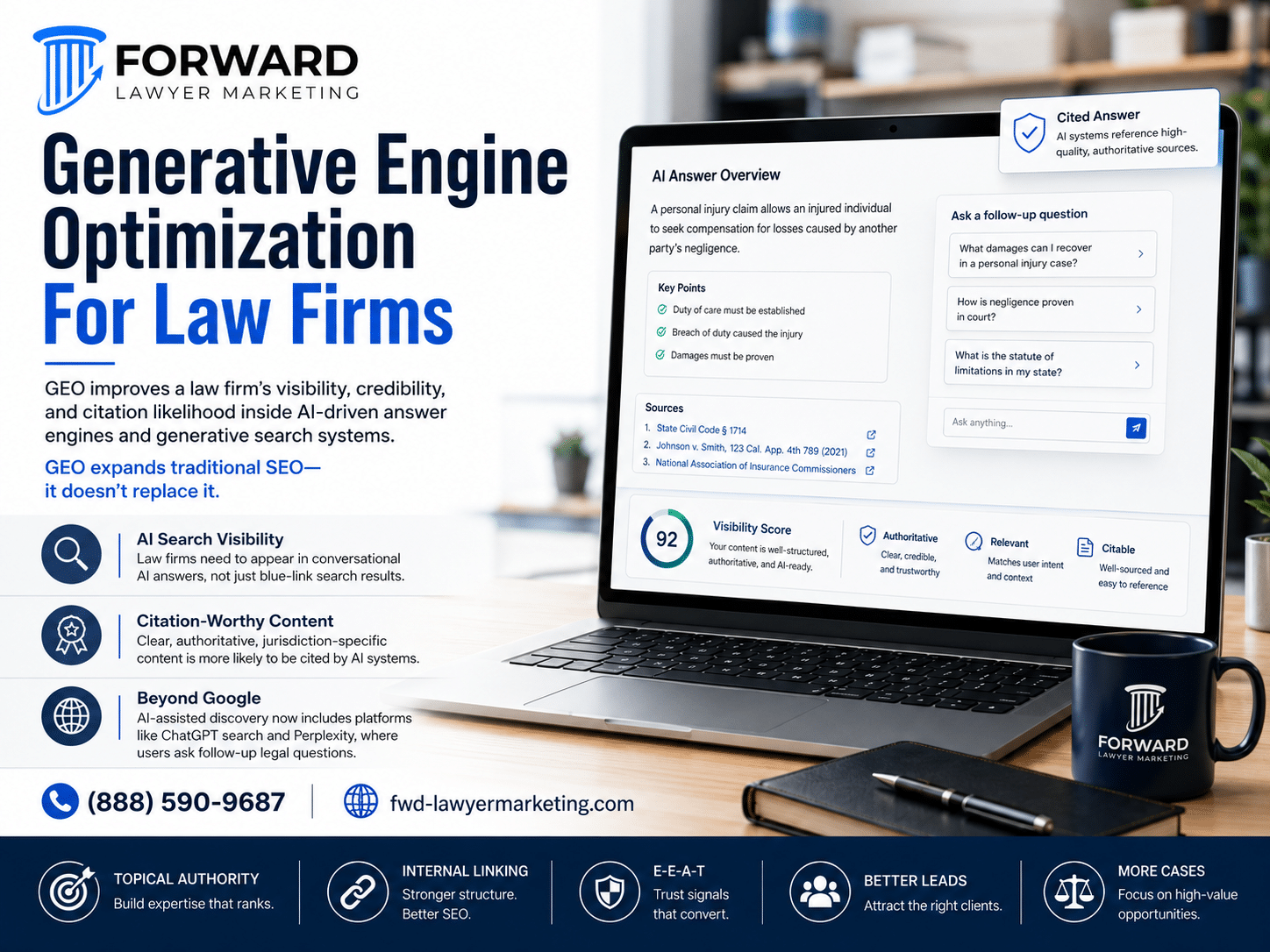
Generative Engine Optimization For Law Firms
Why GEO Is Becoming Essential For Law Firm Visibility Generative Engine Optimization, commonly called GEO, is the practice of improving a brand’s visibility, credibility, and citation likelihood inside AI-driven answer engines and generative search systems. For law firms, GEO is not a replacement for traditional SEO. It is an expansion of SEO into a… Read More »

Technical SEO Audit Checklist For Law Firms
Why Technical SEO Is The Foundation Of Legal Rankings Technical SEO is the infrastructure layer that allows law firm content, attorney authority, local relevance, and conversion assets to perform in search. A law firm may publish exceptional practice area pages, detailed blog posts, authoritative attorney bios, and strong local landing pages, but if Google… Read More »

Blog Strategy For Law Firms That Want Better Cases
From Traffic Volume To High-Value Case Acquisition Law firms publish articles because they believe more content means more SEO visibility, and more visibility means more clients. That assumption is incomplete. Search visibility matters, but visibility alone does not produce revenue. The real objective is not simply to generate more users. The objective is to… Read More »

How To Build High-Converting Attorney Bio Pages
Attorney bio pages are among the most strategically important assets on a law firm website because they sit directly at the intersection of trust, credibility, SEO, and conversion. A prospective client may first discover a law firm through Google Search, a practice area page, a blog article, a referral, a Google Business Profile listing,… Read More »
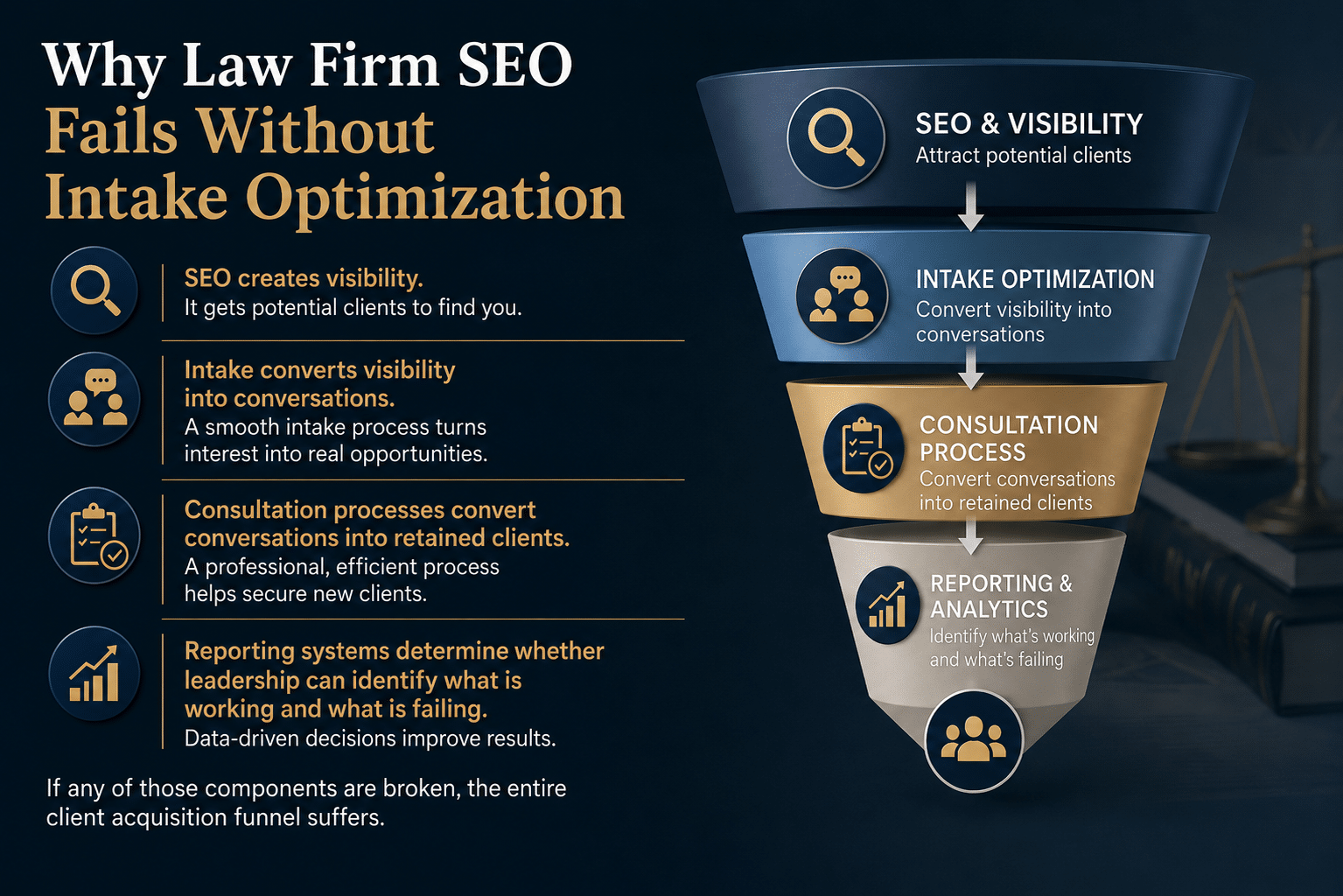
Why Law Firm SEO Fails Without Intake Optimization
The Disconnect Between Search Rankings And Revenue Many law firms assume that if they rank well in Google, revenue growth will naturally follow. This belief is understandable. Organic search visibility can produce enormous value for attorneys in competitive United States markets, especially in practice areas such as personal injury, family law, criminal defense, workers’… Read More »

PPC Landing Page Strategy For Attorneys
Pay-per-click advertising for attorneys has become one of the most expensive and competitive digital marketing channels in the United States. In many major metropolitan markets, law firms routinely pay extraordinarily high cost-per-click rates for searches related to personal injury, mass tort litigation, criminal defense, wrongful death, medical malpractice, truck accidents, contested divorce matters, and… Read More »

Local SEO For Law Firms: Complete Strategy Guide
Local SEO has become one of the most important competitive battlegrounds in the legal industry. In many metropolitan markets, the firms dominating localized search visibility are often the firms generating the highest volume of qualified consultations, signed retainers, and long-term case pipelines. For modern law firms, local search visibility is no longer simply a… Read More »

Why Topical Authority Matters More Than Keywords For Law Firms
For many years, law firm SEO strategy revolved around a relatively simple formula: identify a high-volume keyword, place that phrase throughout a webpage, build backlinks to the page, and attempt to rank higher than competitors in Google’s search results. This approach produced measurable results during earlier eras of search engine optimization, particularly when Google… Read More »

How Law Firms Can Rank In Google AI Overviews
Google Search is undergoing one of the most consequential transformations in the history of digital marketing. For more than two decades, law firms primarily competed for visibility through conventional organic rankings based on keyword targeting, backlinks, technical optimization, and local authority signals. While those ranking factors still matter, Google’s increasing reliance on artificial intelligence… Read More »

How To Lower Cost Per Lead For Attorneys
Cost Per Lead, commonly referred to as CPL, has become one of the defining financial metrics in modern law firm marketing. Across the legal industry, firms are facing rapidly increasing advertising competition, higher consumer acquisition costs, more aggressive digital bidding environments, and growing pressure to produce measurable return on investment from every marketing dollar… Read More »