
Why Your Competitors Rank Above Your Law Firm
Why Search Visibility Determines Client Acquisition For Law Firms
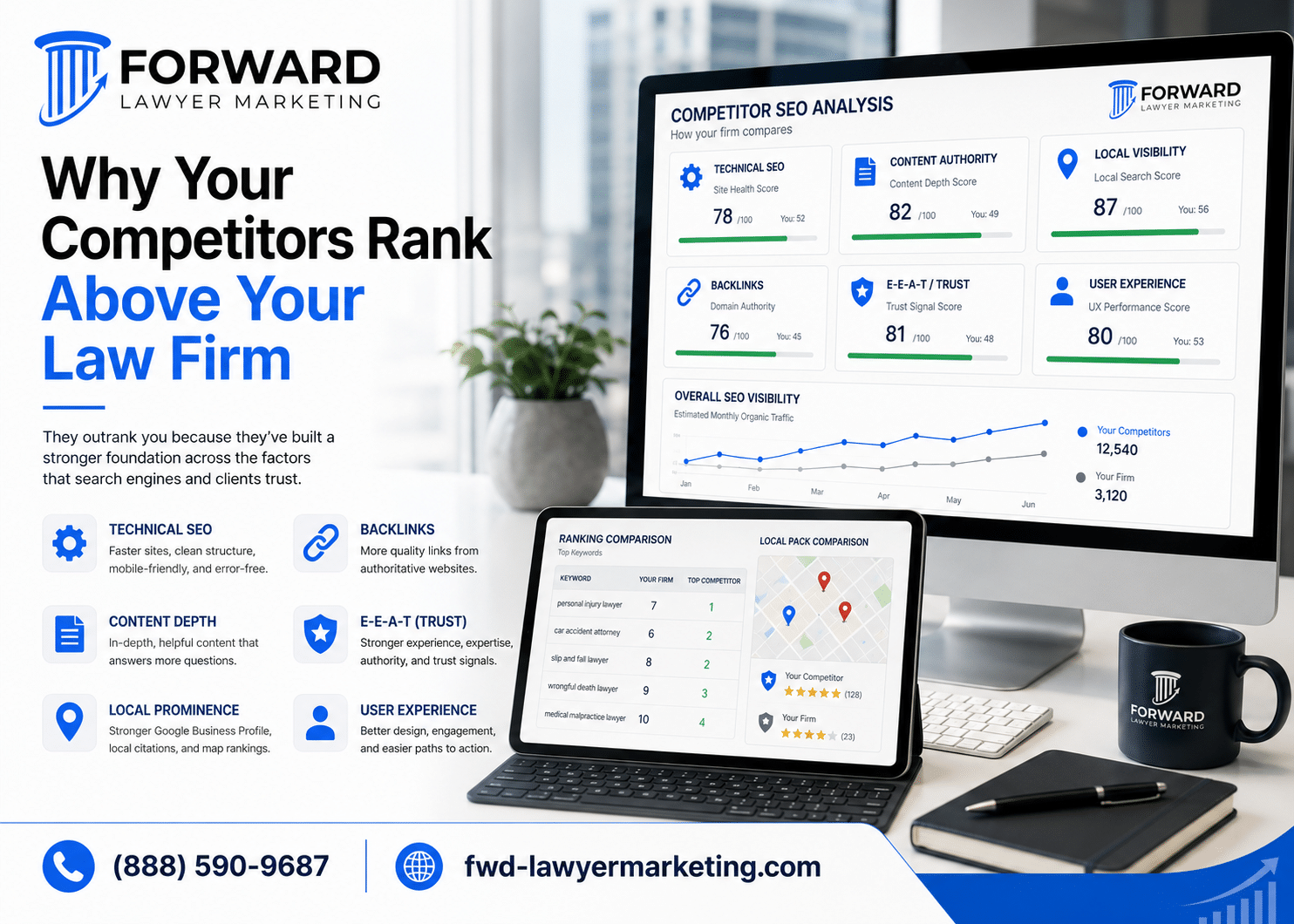
When a competing law firm consistently appears above your firm in Google Search, the reason is rarely luck. In most cases, the competitor has built a stronger technical infrastructure, deeper content authority, and better local signals. They also have a more trustworthy backlink profile, stronger user experience, better internal linking, or a clearer alignment between search intent and page structure. The frustrating part is that the competing lawyers may not be more qualified. They may not have better courtroom experience, better client service, or better outcomes. They may simply have a more disciplined digital authority system.
That distinction matters because search visibility has become one of the most important client acquisition channels in the legal market. Prospective clients frequently begin their legal journey online, especially in high-intent practice areas. These include personal injury, family law, criminal defense, estate planning, immigration, workers’ compensation, employment law, bankruptcy, and business litigation. A person searching for “car accident lawyer near me,” “Chicago divorce attorney,” or “estate planning lawyer in Phoenix” is often close to taking action. When your competitor appears above you for those searches, they receive the first opportunity to earn trust.
Google No Longer Focuses On Keyword Matching Alone
SEO for law firms has also become more complex because Google is no longer evaluating pages through simple keyword matching alone. Google’s ranking systems are designed to prioritize helpful, reliable information created for people rather than content created mainly to manipulate search rankings. That principle is especially important for law firms because legal content often affects high-stakes decisions involving finances, liberty, family relationships, immigration status, medical recovery, and employment.
The competitive gap is often larger than it appears. Your rival may have stronger practice area pages, but that is only the visible layer. Beneath the rankings may be years of review acquisition, citation building, attorney bio optimization, local content development, technical cleanup, backlink acquisition, page speed improvement, and internal linking strategy. Search performance is cumulative. Competitors ranking above your law firm are usually benefiting from many small advantages that compound over time.
The good news is that the ranking gap can be diagnosed. Law firm SEO performance is not mysterious when analyzed systematically. The task is to identify whether the competitor’s advantage comes from technical SEO, content depth, E-E-A-T, local prominence, backlinks, search intent alignment, website usability, or conversion signals. Once the gaps are known, your firm can build a roadmap to compete more effectively.
The Core Pillars Of Law Firm SEO
Technical SEO: The Infrastructure Behind Rankings
Technical SEO determines whether Google can crawl, render, index, and understand your website efficiently. A law firm can have excellent attorneys and well-written content, but if the site is technically weak, search performance will suffer. Technical issues often remain invisible to partners because the website may look acceptable on the front end while search engines encounter crawl barriers, duplication, slow templates, redirect problems, missing structured data, or poor mobile usability behind the scenes.
Google’s Search Essentials explains that pages need to meet basic technical requirements to appear in Google Search, including being accessible to Googlebot, working properly, and containing indexable content. Those are minimum thresholds. In competitive legal SEO, your site must do more than meet minimum standards. It must make important legal pages easy to discover, easy to understand, fast to load, and useful for users.
Cleaner Site Architecture
Competitors often outrank law firms because their site architecture is cleaner. Their practice area pages are linked from the main navigation, supported by related articles, connected to attorney bios, and reinforced by location pages. Your firm may have similar services, but if the pages are buried, orphaned, duplicated, or poorly linked, Google may treat them as less important.
Page speed and user experience also matter. Google’s Core Web Vitals focus on loading performance, interaction responsiveness, and visual stability, currently measured through Largest Contentful Paint, Interaction to Next Paint, and Cumulative Layout Shift. These metrics do not replace content quality, but poor performance can create friction for users and make the site less competitive.
For law firms, the conversion impact can be as important as the ranking impact. A prospective criminal defense client, injured accident victim, or parent facing an emergency custody issue may be searching from a mobile phone under stress. If your page loads slowly, shifts unexpectedly, or makes the phone number difficult to tap, the visitor may leave and contact the competitor whose site works better.
Content Depth: Why E-E-A-T Matters In Legal Search
Your competitors may rank above you because their content demonstrates stronger topical authority. In legal SEO, content depth is not measured only by word count. It is measured by whether the page answers the user’s legal question thoroughly, accurately, and in a way that reflects jurisdictional reality.
Google’s Search Quality Rater Guidelines use E-E-A-T, which stands for Experience, Expertise, Authoritativeness, and Trust, as a framework for evaluating page quality. Google’s overview of the guidelines states that raters consider E-E-A-T when assessing reliability and usefulness, and the public guidelines provide insight into what Google considers quality even though rater scores do not directly set rankings for individual pages.
This matters intensely for legal websites because law is a high-trust subject. A generic practice area page that says “our experienced lawyers fight for your rights” may not be enough to compete with a page that explains the legal process, deadlines, evidence issues, damages, local court considerations, insurance tactics, defense strategies, and what a client should expect during intake.
Semantic Topic Depth
For example, a competitor’s truck accident page may rank above yours because it discusses black box data, federal motor carrier regulations, driver fatigue, maintenance records, cargo loading, accident reconstruction, catastrophic injuries, wrongful death claims, and commercial insurance coverage. If your page only explains that truck accidents are serious and invites visitors to call, it may lack the semantic depth Google expects for a competitive topic.
The same principle applies across practice areas. A divorce page that explains property division, parenting plans, financial affidavits, temporary orders, business valuation, support calculations, mediation, litigation, and local court procedure will usually be stronger than a thin page targeting “divorce lawyer near me.” A DUI page that explains traffic stops, breath testing, field sobriety tests, implied consent, license suspension, first offenses, repeat offenses, local court process, and collateral consequences will often outperform a generic criminal defense page.
Competitors outrank when they own the topic, not merely the keyword.
Backlink Profiles: Why Authority Still Matters
Backlinks remain an important authority signal. Google’s link best practices explain that links help Google discover pages and understand relevance, and that good anchor text helps users and Google understand the destination page.
For law firms, backlinks are not simply numbers in an SEO tool. They represent external signals of authority, credibility, and relevance. A competitor with links from local news sites, bar associations, legal directories, community sponsorships, professional publications, educational resources, and relevant local organizations may appear more prominent than a firm with few credible offsite signals.
The quality of backlinks matters far more than raw volume. Low-quality directory spam, irrelevant guest posts, and link networks can create risk and often fail to build meaningful authority. Strong legal backlinks usually come from real professional activity. Attorneys who publish, speak, sponsor community programs, provide legal commentary, participate in bar associations, or create genuinely useful resources often earn stronger links and mentions over time.
A backlink gap can explain why two law firms with similar content perform differently. If both firms publish comparable practice area pages, but one has stronger external authority and broader local prominence, Google may trust that competitor more.
Why Competitors Dominate Local Search And The Map Pack

Google Business Profile Strength
Your competitors may outrank you because their Google Business Profile is stronger. For local legal searches, the Map Pack can be more influential than traditional organic listings. Google states that local results are based primarily on relevance, distance, and prominence. Relevance reflects how well a profile matches the search, distance reflects proximity to the searcher or searched location, and prominence reflects how well known or authoritative the business appears based on signals such as reviews, links, articles, and directories.
A competitor may have more complete categories, stronger review volume, better review recency, more detailed service descriptions, professional photos, more consistent citations, and a website that reinforces the same practice areas listed in the profile. If your Google Business Profile is incomplete, outdated, weakly reviewed, or mismatched with your website, your local visibility may suffer.
Category selection is especially important. A personal injury firm relying only on a generic “law firm” category may be less relevant for injury-specific searches than a competitor using a more precise category where available. A family law firm, criminal defense firm, immigration firm, or estate planning firm should ensure that profile categories and services truthfully reflect the firm’s actual focus. Ideally, a law firm should select the category that brings in the most cases and revenue if they want to dominate that area locally and link a dedicated locally optimized practice area page to it.
Reviews And Local Prominence
Reviews influence both ranking and conversion. Google states that review count and review score can factor into local ranking, and that more reviews and positive ratings can improve local ranking. In legal markets, reviews also shape trust before a user ever visits the website.
A competitor with a steady stream of detailed, recent reviews may appear more credible to both Google and prospective clients. This does not mean a firm should chase reviews irresponsibly. Legal ethics and confidentiality remain critical. ABA Model Rule 7.1 prohibits false or misleading communications about a lawyer or the lawyer’s services, which means review strategy must avoid misleading claims, paid false reviews, or statements that create unjustified expectations.
The strongest law firms build ethical review systems that request honest feedback from clients at appropriate moments. They also respond professionally without disclosing confidential information. Review management is not only a reputation tactic. It is a local SEO asset and a conversion asset.
Local Citations And NAP Consistency
Competitors may also outrank your firm because their local citations are cleaner. NAP consistency refers to consistent name, address, and phone number information across Google Business Profile, legal directories, bar profiles, map platforms, social profiles, local chambers, and other listings.
Inconsistent citation data can confuse search engines and users. This problem is common after firm name changes, office moves, mergers, partner departures, rebrands, and tracking-number implementation. A competitor with clean citations across Avvo, Justia, Martindale-Hubbell, FindLaw, Lawyers.com, state bar directories, Apple Maps, Bing Places, Yelp, and local business organizations may appear more trustworthy as a local entity.
Citation consistency alone will not make a weak firm dominate a competitive market, but inconsistency can hold back a firm that otherwise has strong credentials.
Competitive Analysis: How To Identify What Rivals Are Doing Differently
Analyze Their Search Footprint By Intent
A serious competitive analysis of competitive law firms in your area should begin by separating search queries by intent. Many firms make the mistake of comparing one keyword and drawing broad conclusions. Legal search is more complex than that. A competitor may outrank you for transactional searches, informational searches, local searches, or branded searches for different reasons.
Transactional searches include terms such as “personal injury lawyer in Dallas,” “DUI attorney near me,” or “divorce lawyer Chicago.” These searches usually require strong service pages, local signals, reviews, and conversion-focused design.
Informational searches include terms such as “what happens after a DUI arrest,” “how is child support calculated,” or “what is a fair settlement for a herniated disc.” These require educational content, topic depth, and clear legal explanations.
Middle-of-funnel searches include comparison and evaluation queries such as “when to hire a truck accident lawyer” or “questions to ask a divorce attorney.”
If your competitor dominates transactional searches but not informational ones, they may have stronger local SEO and service pages. If they dominate informational searches, they may have deeper blog strategy and topical authority. If they dominate both, they may have a mature SEO ecosystem.
Examine Their Practice Area Architecture
Competitors often outperform because their site architecture aligns with how users search. A strong personal injury site may have a main personal injury hub, dedicated pages for car accidents, truck accidents, motorcycle accidents, pedestrian accidents, wrongful death, slip and fall, construction injuries, medical malpractice, and catastrophic injuries, plus blog content supporting each cluster.
A weaker site may have one personal injury page and a scattered blog archive. Even if the firm is highly qualified, the site does not communicate authority as clearly.
The same pattern appears in family law, criminal defense, estate planning, workers’ compensation, immigration, and employment law. Competitors rank because they create structured content ecosystems rather than isolated pages.
Study Their Internal Linking
Internal linking is often the hidden advantage. A competitor may have dozens of related articles linking to its core practice pages with descriptive anchor text. Attorney bios may link to practice pages. Practice pages may link to FAQs. Blog posts may link back to service pages. Location pages may connect to relevant attorneys and services.
Your site may have similar content, but if it is poorly connected, Google and users may not understand which pages are most important. Google’s link guidance emphasizes that links help Google find pages and understand what linked pages contain. Internal linking is therefore not merely a user convenience. It is a relevance and authority distribution system.
Evaluate Their Offsite Authority
A backlink comparison can reveal whether competitors have stronger authority. However, the analysis should go beyond domain authority metrics. Review the relevance and quality of referring domains. Look for local media, legal directories, bar associations, chambers of commerce, universities, sponsorships, podcasts, interviews, case commentary, and authoritative resource mentions.
If a competitor has earned links because its attorneys regularly provide commentary, publish substantive resources, or participate in local organizations, the ranking advantage may reflect real-world authority translated into digital signals.
Common Pitfalls That Cause Ranking Stagnation
Thin Content And Generic Legal Copy
Thin content is one of the most common reasons law firms fail to outrank competitors. Many practice pages contain broad claims, short explanations, and repeated calls to action without enough substantive legal information. The page may mention the target keyword, but it does not satisfy user intent better than competing pages.
Generic copy is equally damaging. If a page could apply to any law firm in any state, it is unlikely to demonstrate strong local or legal authority. Legal content should reflect the jurisdiction, practice area, client concerns, process, evidence, deadlines, local courts, and attorney experience.
Google’s helpful content guidance encourages creators to assess whether their content provides original information, reporting, research, or analysis, and whether it leaves readers feeling satisfied. That is a useful standard for law firm content. If a page does not answer the questions a real prospective client would ask before hiring, it is probably not strong enough for competitive SEO.
Poor Mobile Experience
Many legal searches happen on mobile devices. A person facing an arrest, injury, custody issue, or urgent employment problem may search from a phone. If the mobile site is slow, cluttered, difficult to navigate, or has hidden contact options, conversion suffers. The impact of mobile optimization on law firm SEO cannot be overstated.
Competitors often rank and convert better because their mobile experience is simpler. The phone number is visible. Forms work properly. Pages load quickly. Navigation is clear. Content is readable. CTAs are easy to tap. The site does not require pinching, zooming, or hunting for contact information.
Poor mobile experience is not only a technical issue. It is a business development issue.
Weak Attorney Bios
Attorney bios are often overlooked, but they support both SEO and conversion. Competitors may outrank your firm because their attorneys are better presented as credible legal entities. Strong attorney bios include practice focus, bar admissions, court experience, publications, speaking engagements, awards, community involvement, and links to relevant practice pages.
A thin bio with a headshot and law school information does little to support E-E-A-T. A detailed bio that explains the attorney’s experience, approach, jurisdictional familiarity, and legal authority can help users and search engines understand why the firm is credible.
Poor Indexation And Duplicate Pages
Law firms sometimes have valuable content that is not indexed, poorly canonicalized, duplicated, or buried in low-value archives. WordPress sites are especially prone to tag archive bloat, duplicate category pages, media attachment URLs, and outdated landing pages.
If competitors have cleaner indexation, they may appear more authoritative because Google can identify their best pages more clearly. Your firm may have the right content but the wrong technical signals.
Outdated SEO Strategy
Some law firms are still optimizing as if search were limited to exact-match keywords and page titles. Modern legal SEO requires semantic coverage, local relevance, structured data, entity consistency, attorney authority, review strength, and user satisfaction.
Google’s AI search documentation states that SEO best practices remain relevant for generative AI features because these features are rooted in core Search ranking and quality systems. That means law firms cannot ignore foundational SEO, but they also need content and authority signals that work across classic search and AI-driven discovery.
The Role Of Search Intent In Legal SEO

Informational Queries Versus Transactional Queries
Not every legal search has the same purpose. Informational queries are used by people trying to understand a legal issue. Transactional queries are used by people looking to hire. Middle-of-funnel queries are used by people comparing options or deciding whether they need representation.
A law firm that creates only transactional pages may miss users earlier in the journey. A law firm that creates only informational blogs may attract traffic without enough conversions. Competitors often win because they have content for every stage of intent.
For example, a workers’ compensation firm may need an informational article on what happens after a workplace injury, a middle-of-funnel guide on when to hire a lawyer after a denied claim, and a transactional page targeting a local workers’ compensation attorney search. These pages serve different purposes but support the same business goal.
Why Search Intent Affects Page Format
A user searching “what is comparative negligence” does not need the same page as a user searching “car accident lawyer near me.” The first user needs a clear explanation. The second user needs proof of local representation, immediate contact options, attorney credibility, reviews, and a reason to call.
Competitors often rank above law firms because their pages match intent better. They do not force informational users onto sales pages or transactional users into long academic articles. They structure content according to the job the searcher is trying to accomplish.
Using Intent To Improve Lead Quality
Search intent strategy can also improve lead quality. Broad informational content may generate traffic, but more specific content can attract better cases. A personal injury firm seeking catastrophic injury matters should create content around surgery, permanent impairment, commercial insurance, expert witnesses, medical liens, future care, and liability disputes. A family law firm seeking complex divorce matters should create content around business valuation, executive compensation, hidden assets, custody evaluations, and high-income support.
Your competitors may rank above you because they understand not only what people search, but which searches are worth winning.
Frequently Asked Questions About Why Competitors Rank Above Your Law Firm
Why Does A Less Experienced Competitor Rank Higher Than My Law Firm?
Google does not rank attorneys based on courtroom skill alone. It ranks webpages and local profiles based on signals it can evaluate, including content relevance, technical accessibility, backlinks, local prominence, reviews, user experience, internal links, structured data, and entity consistency. A less experienced competitor can outrank a more experienced lawyer if the competitor has built a stronger digital authority system.
How Long Does It Take To Outrank A Competing Law Firm?
The timeline depends on the competitiveness of the market, the authority gap, the condition of your website, the strength of your content, the backlink difference, local SEO quality, and how aggressively competitors are investing. In less competitive markets, meaningful gains may appear within several months. In major metropolitan legal markets, closing the gap may require twelve months or more of consistent work.
Are Backlinks Still Important For Law Firm SEO?
Yes, backlinks remain important, but quality and relevance matter more than raw volume. Links from credible local, legal, media, professional, and community sources can strengthen authority. Low-quality link schemes may create risk and usually fail to build durable trust. A strong backlink profile should support real-world credibility.
Why Does My Competitor Show Up In The Map Pack But I Do Not?
Your competitor may have stronger Google Business Profile relevance, better proximity to the searcher, more prominent reviews, stronger citations, better local landing pages, or more local authority signals. Google identifies relevance, distance, and prominence as the primary local ranking concepts. If one of those areas is weak, your Map Pack visibility may suffer.
Does Publishing More Blog Posts Help A Law Firm Rank?
Publishing more content helps only if the content is strategic, accurate, helpful, and connected to the firm’s practice area authority. Random blog volume rarely produces durable rankings. Better results usually come from topic clusters, internal linking, attorney-reviewed content, jurisdictional specificity, and content aligned with high-value client intent.
Should My Law Firm Focus On SEO Or Local Services Ads?
SEO and Local Services Ads serve different roles. LSAs can create paid visibility quickly for certain practice areas, while SEO builds long-term organic authority. A strong legal marketing strategy may use both, but the firm should not rely exclusively on paid channels. Competitors with strong SEO can reduce long-term acquisition costs and build trust before the prospect calls.
Why Did My Rankings Drop After A Website Redesign?
Ranking drops after redesigns often happen because URLs changed without proper redirects, content was removed or shortened, internal links were altered, metadata changed, schema broke, page speed declined, or important pages were accidentally noindexed. A law firm redesign should always include an SEO migration plan. Treating it as a purely visual project can damage years of accumulated authority.
How Do I Know Whether My Competitor’s Content Is Better Than Mine?
Compare the pages by search intent, depth, local relevance, attorney credibility, structure, internal links, FAQs, topical coverage, citations, conversion clarity, and user experience. A stronger competitor page usually answers more of the client’s real questions, connects to related resources, explains the legal process more clearly, and demonstrates stronger authority.
Audit The Ranking Gap Before You Spend More
If competitors consistently rank above your law firm, the solution is not to guess, publish random content, or increase ad spend without diagnosing the underlying gap. Your firm needs a professional competitive SEO audit that examines technical performance, content depth, local visibility, Google Business Profile strength, backlink profile, internal linking, attorney authority, reviews, and search intent alignment.
The firms that dominate legal search are rarely winning because of one tactic. They are winning because they have built stronger digital ecosystems. Their websites are easier to crawl, their content is deeper, their local signals are stronger, their reviews are more persuasive, their backlinks are more authoritative, and their pages match client intent more effectively.
Your law firm can compete, but it needs a strategy based on evidence rather than assumptions. Start by identifying exactly where competitors are stronger. Then build a roadmap that prioritizes the fixes most likely to improve qualified lead generation and signed-case volume.
In the modern legal market, rankings are not vanity metrics. They are gateways to client acquisition. If your competitors control the search results, they control the first conversation with many of the clients your firm wants most.
For law firms ready to translate measurement into measurable growth in caseload and revenue, partnering with a specialized agency can accelerate implementation. Forward Lawyer Marketing offers consultative local SEO audits and managed programs that align GBP optimization, citation building, and performance measurement to revenue goals.
Our team combines an in-house marketing manager approach with experienced leadership, including an SEO Director with two decades of domain expertise, and Google-certified PPC professionals to integrate paid and organic local strategies.
To begin a prioritized local SEO audit or discuss measurable outcomes for your firm, contact Forward Lawyer Marketing by phone at (888) 590-9687 to arrange an audit and implementation plan.
