
How To Fix Poor Google Business Profile Visibility For A Law Firm
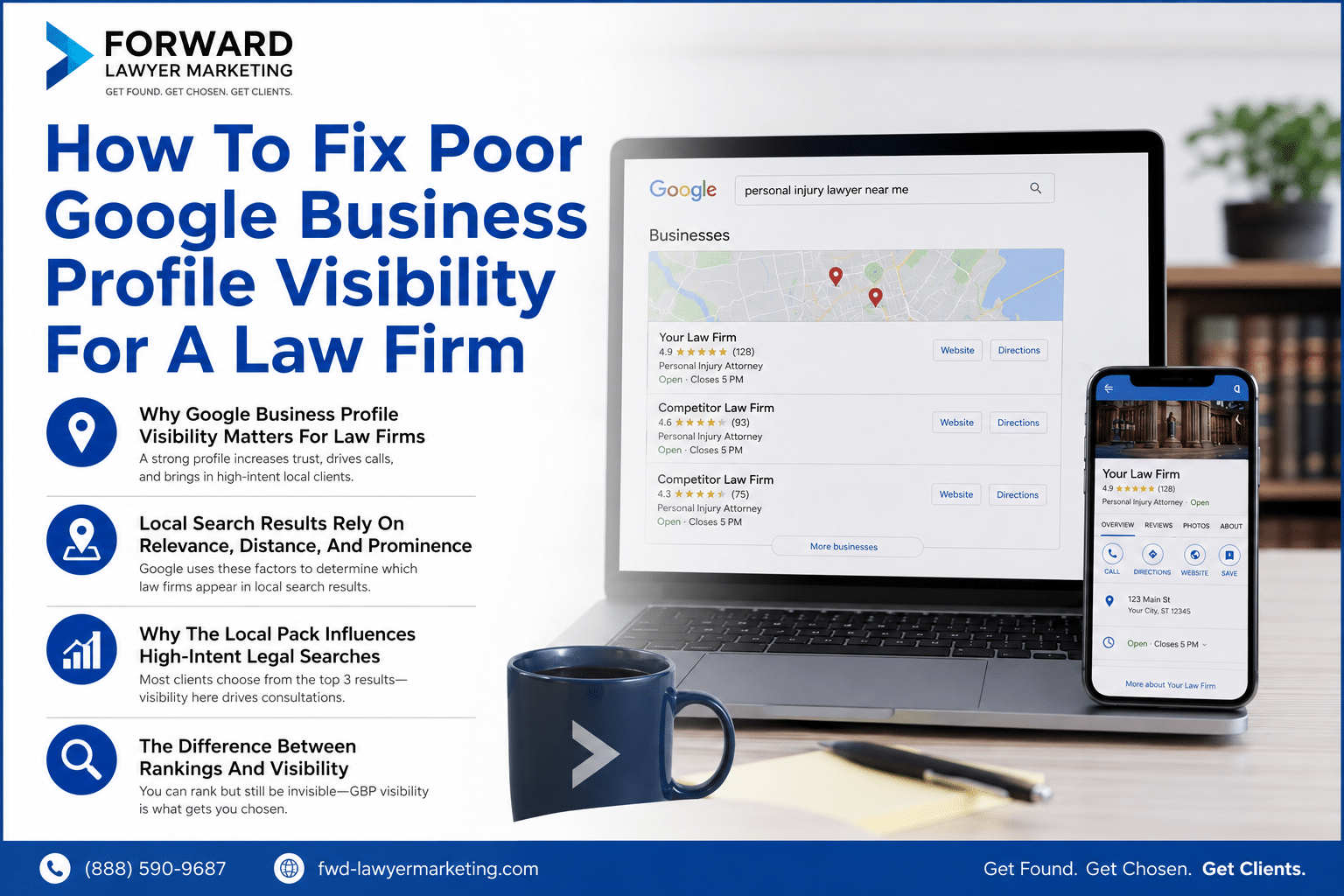
Why Google Business Profile Visibility Matters For Law Firms
Poor Google Business Profile visibility can quietly suppress a law firm’s lead flow even when the firm has a strong website, respected attorneys, and a meaningful presence in the local legal community. For many law firms, especially those in competitive consumer-facing practice areas such as personal injury, criminal defense, family law, workers’ compensation, immigration, bankruptcy, and estate planning, visibility in Google’s Local Pack and Google Maps can directly affect call volume, consultation requests, and signed cases.
The reason is simple: many legal consumers search locally and act quickly. A person searching for “DUI lawyer near me,” “car accident attorney in Houston,” “divorce lawyer in Chicago,” or “workers’ compensation lawyer near me” is often not in a casual browsing mindset. The searcher may be facing an arrest, an insurance dispute, a custody emergency, an injury, a job-related accident, or a major family transition. When Google displays a Local Pack above or near organic results, the firms that appear there can receive a major visibility advantage.
Local Search Results Rely On Relevance, Distance, And Prominence
Google states that local search results are based primarily on relevance, distance, and prominence. Google also notes that there is no way to request or pay for a better local ranking, and that its local algorithm details are kept confidential to preserve fairness. That distinction matters because law firms must separate what Google officially confirms from what local SEO professionals infer through observation and testing. Relevance, distance, and prominence are confirmed local ranking concepts. Specific tactics such as posting frequency, image cadence, or exact review velocity are better understood as strategic inferences or engagement practices rather than direct guaranteed ranking levers.
For law firms, poor Google Business Profile visibility usually comes from a combination of problems rather than one isolated defect. The firm may have weak category alignment, incomplete services, inconsistent citations, a poor review profile, proximity disadvantages, duplicate listings, low website relevance, thin location pages, unoptimized attorney profiles, or eligibility issues involving virtual offices or unstaffed locations. In some cases, a profile may also be affected by filtering, suspension risk, review problems, or trust issues caused by inconsistent business data.
Fixing poor visibility requires a disciplined local SEO audit. The goal is not to “game” Google Maps. The goal is to make the firm easier for Google and potential clients to understand. A strong Google Business Profile should clearly communicate who the firm is, where it operates, what practice areas it handles, how clients can contact the office, why the firm is credible, and how its local presence is supported across the broader web.
Understanding The Mechanics Of The Local Pack
Why The Local Pack Influences High-Intent Legal Searches
The Local Pack is the map-based section that Google often displays when a search has local intent. For law firms, this can appear for searches involving “near me,” city names, county names, and practice-area modifiers. A search such as “personal injury lawyer near me” may produce a Local Pack because Google understands that the user is likely looking for a nearby legal service provider.
This placement is valuable because it appears prominently and includes conversion-oriented information. Users can see reviews, business names, locations, hours, phone access, directions, website links, and sometimes justifications that explain why a profile may be relevant to the query. On mobile devices, this can become one of the most important discovery surfaces in legal marketing.
Local Pack visibility is also different from ordinary organic rankings. A law firm can rank well organically and still perform poorly in Maps if its Google Business Profile, local authority, review profile, citations, proximity, and local entity signals are weak. Conversely, a firm may perform well in the Map Pack for certain areas but have weaker organic visibility for broader informational searches.
The strongest law firm local SEO strategies treat Google Business Profile, local landing pages, reviews, citations, internal linking, and attorney authority as connected assets rather than separate projects.
The Difference Between Rankings And Visibility
Law firms often say their Google Business Profile is “not ranking,” but the more precise issue is usually poor visibility across a target geography or practice area. Google Maps rankings are not fixed in the same way as a traditional organic position may appear in a rank tracker. Local results vary based on searcher location, search wording, device, personalization, map boundaries, business proximity, prominence, and relevance.
A firm may appear strongly near its office but disappear several miles away. It may rank for “criminal defense attorney” but not “DUI lawyer.” It may appear for branded searches but not for non-branded practice searches. It may perform during business hours but receive fewer interactions after hours if competitors show stronger availability signals. These differences require granular tracking rather than one manual search from the office computer.
A proper visibility audit should examine grid-based local rankings, Google Business Profile performance data, website clicks, phone calls, direction requests, search terms where available, review trends, competitor profiles, and local landing page relevance. Google’s Business Profile performance reporting provides insight into profile interactions for verified profiles, which can help firms evaluate whether visibility problems are affecting calls, website visits, and other user actions.
Root Causes Of Low Google Business Profile Visibility
Proximity Limitations And Geographic Reality
Proximity is one of the most difficult local ranking challenges because a law firm cannot fully optimize its way around physical distance. Google’s local ranking framework includes distance as a primary factor, meaning that the location of the searcher relative to the office can influence whether the firm appears. A lawyer located in downtown Atlanta may struggle to appear in the Local Pack for a suburb far outside the office’s immediate competitive radius, even if the firm technically serves that area.
This is especially important for law firms because many practices serve entire counties, metro areas, or states, but Google Business Profile visibility is often more locally constrained. A personal injury firm may serve all of Northern Illinois, but its Maps visibility may be strongest near its verified office. A family law firm may handle cases across multiple counties, but proximity may still limit Map Pack visibility for searches far from the physical location.
The solution is not to create fake offices or virtual listings. The solution is to understand the profile’s natural geographic reach, build strong location pages for legitimate service areas, strengthen organic visibility where Map Pack proximity is difficult, and consider legitimate staffed office expansion only when it makes business sense. Trying to force local visibility through questionable addresses can create suspension risk and long-term brand damage.
Relevance Problems Caused By Weak Category And Service Alignment
Relevance refers to how well a business profile matches what someone is searching for. For law firms, relevance problems often begin with category selection. A firm that primarily handles personal injury cases but uses only a generic “Law Firm” category may send weaker relevance signals than a competitor using a more specific category where available. A family law firm, criminal defense firm, estate planning firm, or immigration firm should ensure that its primary and secondary categories align with its actual practice focus.
Relevance also depends on the website connected to the profile. If the Google Business Profile identifies the firm as a divorce practice, but the linked website page is a generic homepage with little family law content, Google has fewer signals connecting the profile to divorce search intent. A stronger approach is to align the profile category, services, business description, landing page, internal links, attorney bios, reviews, and local content around the firm’s highest-value practice areas.
This does not mean keyword stuffing the profile. It means creating consistent topical alignment across the firm’s digital ecosystem.
Prominence Deficits In Competitive Legal Markets
Prominence reflects how well-known and reputable a business appears to be. Google describes prominence as including information from across the web, such as links, articles, and directories, and also notes that review count and review score can factor into local ranking. In competitive legal markets, prominence often separates firms with similar proximity and relevance.
A firm with few reviews, inconsistent citations, limited backlinks, weak legal directory profiles, little local press, and thin website content may struggle against competitors with broader authority signals. This is common when a newer firm enters a saturated metro market or when an established firm has relied on referrals for years without developing a strong digital footprint.
Prominence is built gradually. It requires authoritative legal content, strong attorney bios, consistent legal directory profiles, legitimate local citations, quality backlinks, ethical review generation, community visibility, and a credible website. The Google Business Profile is the visible tip of a broader local authority system.
Filtering, Duplicate Listings, And Competitive Clustering
Law firms can also suffer visibility problems because of filtering or duplicate-listing confusion. In dense legal markets, several attorneys may share an address, suite, building, or practice category. Google may choose to show one similar profile over another when it believes multiple listings are highly similar or located very close together.
This is common in office towers, coworking environments, legal buildings, and shared suites. A personal injury lawyer, criminal defense attorney, or family law firm located in a building full of competing lawyers may face stronger local filtering than a firm in a less saturated location.
Duplicate profiles can also confuse Google and users. Old firm names, former addresses, individual practitioner profiles, retired attorney listings, and unclaimed duplicate records can fragment authority. A visibility audit should identify duplicate or outdated profiles and resolve them carefully through proper ownership, merging, removal requests, or support processes where appropriate.
Eligibility And Virtual Office Risks
Google Business Profile eligibility is not simply a marketing preference. Google’s guidelines state that a business must make in-person contact with customers during its stated hours to qualify for a Business Profile, subject to limited exceptions. This is highly relevant to law firms using virtual offices, shared office arrangements, coworking spaces, or service-area strategies.
A law firm should not create a Google Business Profile for a city where it does not have a legitimate, staffed, client-facing presence. Virtual office arrangements are risky when there is no real staff presence during stated hours and no meaningful in-person client contact at that location. Multi-location law firms should ensure every profile represents a legitimate office and that the firm can support the location operationally.
For service-area firms, the strategy must still follow Google’s eligibility rules. A law firm should avoid creating multiple profiles for cities it serves, but where it lacks a legitimate location. The better strategy is to build strong organic location pages, local content, and citation authority while maintaining truthful Google Business Profile data.
Technical Optimization Of The Google Business Profile
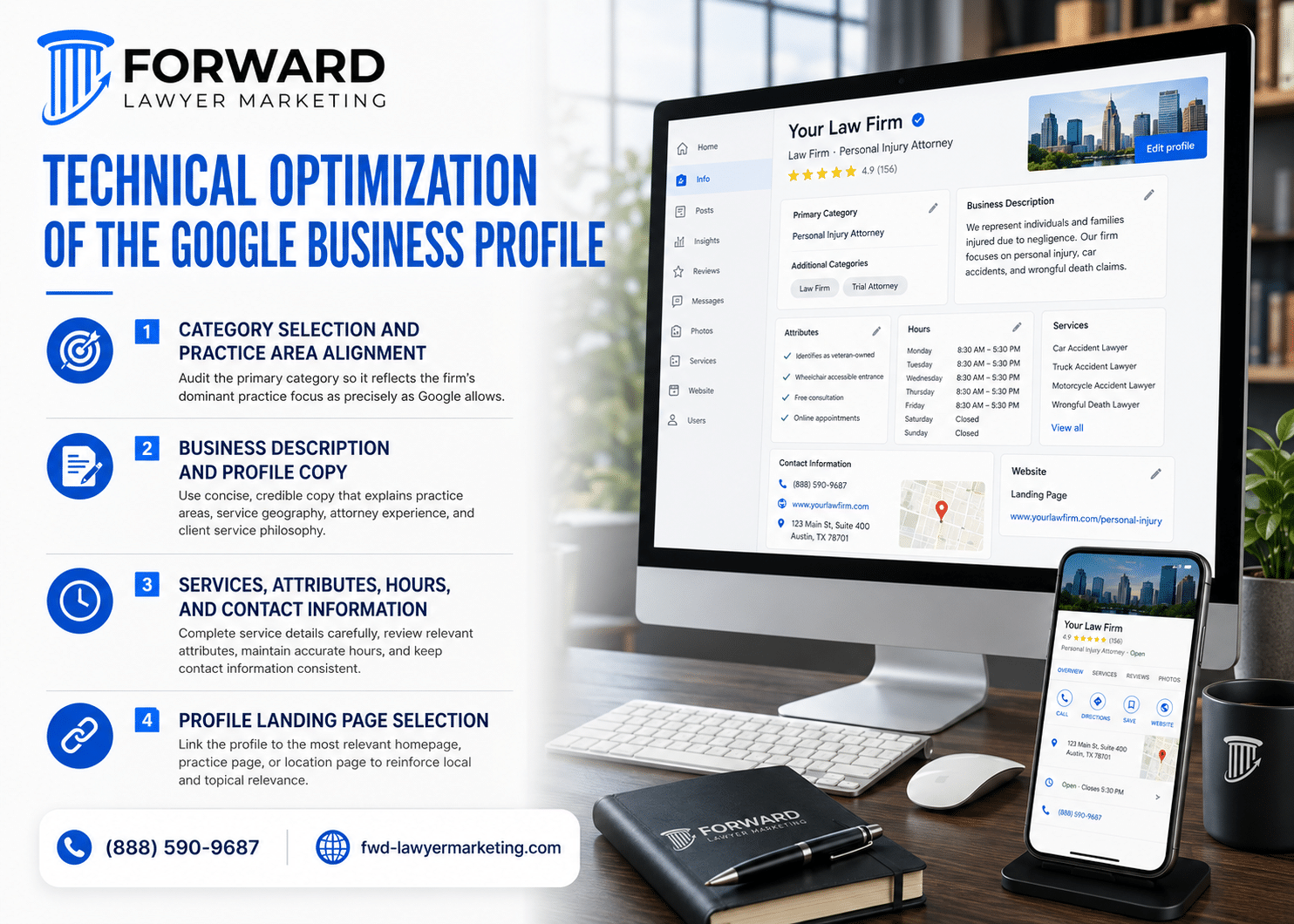
Category Selection And Practice Area Alignment
Category selection is one of the first places to audit when a law firm has poor profile visibility. The primary category should reflect the firm’s dominant practice focus as precisely as Google allows. A firm focused primarily on criminal defense should not rely on a generic category if more specific criminal defense categories are available. A divorce firm should align its profile with family law or divorce-related categories where appropriate. A personal injury firm should use a category that clearly supports injury intent.
Secondary categories should support real services rather than every possible legal area the firm could theoretically handle. Over-expanding categories can weaken focus and create mismatched inquiries. A boutique criminal defense firm should not add unrelated categories simply to appear in more searches. Relevance is strongest when category selection reflects actual practice concentration.
The category audit should compare the firm against the top visible competitors for target searches. If every leading firm in the Map Pack uses more specific categories, the underperforming firm may be sending weaker relevance signals. However, category strategy should remain truthful and consistent with the firm’s actual services.
Business Description And Profile Copy
The business description should communicate what the law firm does, where it serves clients, and why it is credible without stuffing keywords or making unverifiable claims. A strong description for a law firm should identify core practice areas, local service geography, attorney experience, consultation process, and client service philosophy in a concise and professional manner.
The description should not include misleading language, guarantees, or unsupported claims of superiority. ABA Model Rule 7.1 states that a lawyer shall not make a false or misleading communication about the lawyer or the lawyer’s services. Because Google Business Profile copy is public attorney advertising, law firms should treat it with the same compliance care as website content, PPC ads, and landing pages.
The description should also be consistent with the linked website. If the profile emphasizes criminal defense, the website should clearly support criminal defense authority. If the profile emphasizes family law, the website should contain deep family law content, attorney bios, and local relevance. Consistency across assets builds trust for both users and search systems.
Services, Attributes, Hours, And Contact Information
The services section should be completed carefully because it helps clarify what the firm handles. A personal injury firm may include services related to car accidents, truck accidents, motorcycle accidents, wrongful death, slip and fall claims, and catastrophic injuries where appropriate. A family law firm may include divorce, custody, child support, mediation, and property division. A criminal defense firm may include DUI, drug charges, assault, theft, weapons charges, and federal defense.
Each service should be written for user clarity rather than keyword repetition. The objective is to help Google and potential clients understand the firm’s scope.
Attributes should be reviewed as well. Google allows businesses to add attributes to help customers know more details about the business, and Google notes that certain attributes may help a business show up for searches related to those attributes. For law firms, relevant attributes may relate to accessibility, appointment requirements, online appointments, or other available profile features, depending on the category and interface options.
Hours should also be accurate. A criminal defense firm advertising emergency availability should ensure its listed hours, answering system, and intake operations support that claim. Inconsistent availability can damage user trust. Contact information should match the website and major citations unless call tracking is implemented carefully with proper consistency controls.
Profile Landing Page Selection
Many law firms link their Google Business Profile to the homepage by default. This may be appropriate for some firms, but not all. If the profile is practice-specific or location-specific, the linked page should reinforce that relevance. A personal injury firm may benefit from linking to a local personal injury landing page if that page is authoritative, conversion-focused, and representative of the firm’s primary GBP category. A multi-practice firm may use the homepage if it clearly communicates all relevant practice areas and location context.
The linked page should load quickly, display well on mobile, include accurate NAP information, contain strong local content, and make contact easy. It should also reinforce the firm’s primary category and services. A weakly linked page can reduce conversion even if the Google Business Profile receives impressions.
Review Strategy And Legal Ethics
Why Reviews Matter For Visibility And Conversion
Reviews influence both rankings and client behavior. Google states that review count and review score can factor into local ranking, and that more reviews and positive ratings can improve local ranking. In legal markets, reviews also serve as powerful trust signals because prospective clients often read them before contacting a firm.
For law firms, review content can be especially important. A review that mentions responsiveness, professionalism, clear communication, preparation, compassion, or guidance through a stressful matter may influence a prospective client more than a generic five-star rating. Reviews can also create local justifications when language in the review aligns with the user’s search intent, although the exact appearance of justifications is controlled by Google and cannot be guaranteed.
Poor visibility can result from a weak review profile. If competitors have hundreds of recent, detailed reviews and the underperforming firm has few or outdated reviews, the firm may struggle to compete on prominence and conversion confidence.
Ethical Review Acquisition For Law Firms
Law firms must request reviews carefully. Google takes fake and incentivized engagement seriously and may restrict profiles that violate its fake engagement policies. Google’s prohibited and restricted content policies also state that fake engagement is not allowed, including reviews that are not based on real experiences or reviews that are paid for directly or indirectly.
Legal ethics add another layer. A firm should avoid pressuring clients, offering incentives, or coaching clients to make misleading statements. The safest review process is usually a simple, neutral request after an appropriate matter milestone, asking satisfied clients to share honest feedback about their experience. The firm should not ask clients to disclose confidential facts or specific case outcomes.
Review requests should also consider timing. In some practice areas, asking too early can feel insensitive. In others, waiting too long may reduce response rates. The process should be systematic, ethical, and client-centered.
Responding To Reviews Without Violating Confidentiality
Review responses should be professional and confidentiality-conscious. A law firm should not confirm representation, reveal case details, or debate facts publicly. Even when a negative review feels unfair, the response should avoid disclosing confidential information.
A strong response can acknowledge the importance of client service and invite the reviewer to contact the firm privately. The tone should remain calm, restrained, and professional. Prospective clients often judge the response as much as the review itself.
If a review violates Google policy, the firm can report it, but Google states that only reviews that violate policy are eligible for removal. A review being negative or unfair is not automatically enough.
Content And Engagement Signals Inside Google Business Profile
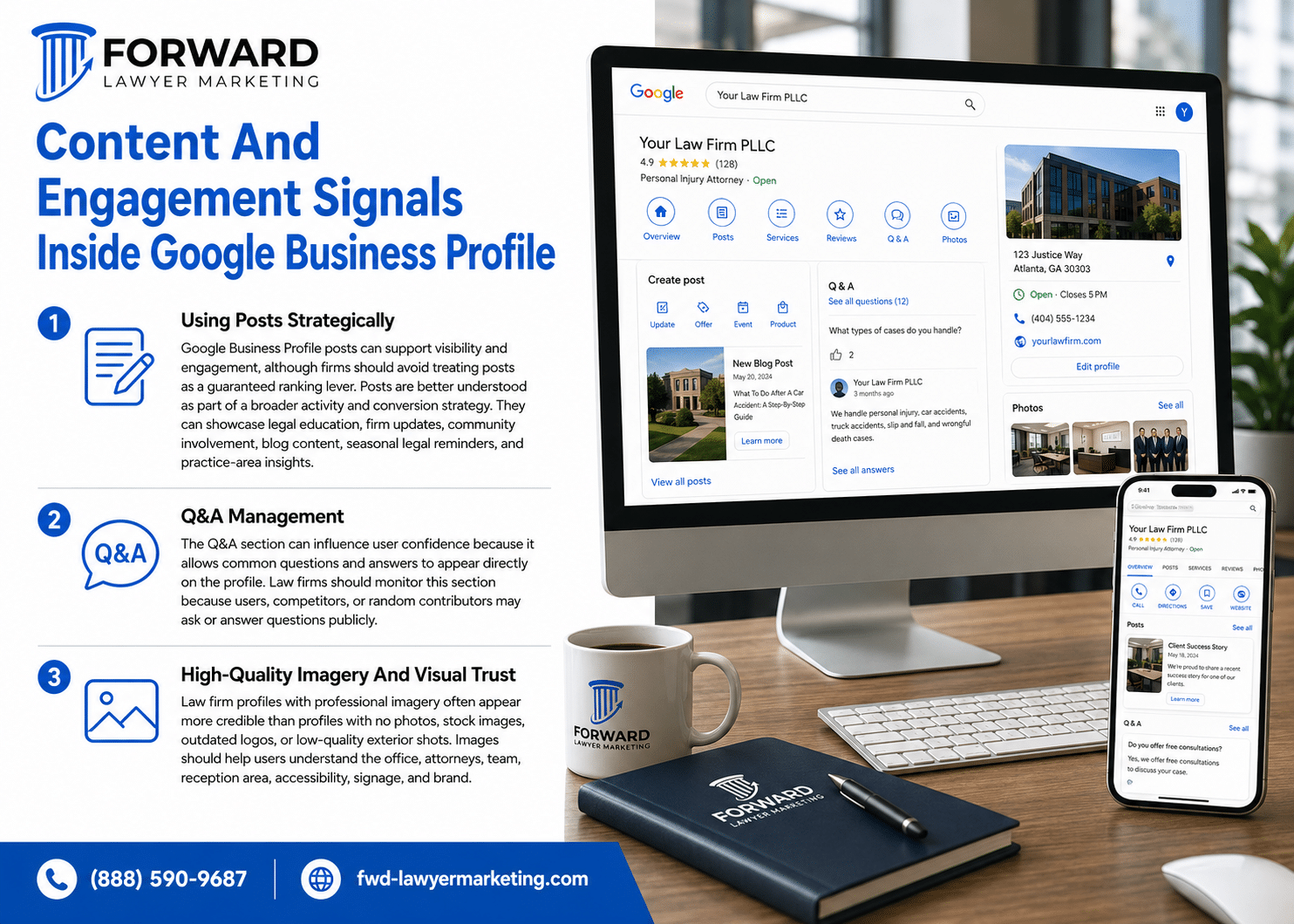
Using Posts Strategically
Google Business Profile posts can support visibility and engagement, although firms should avoid treating posts as a guaranteed ranking lever. Posts are better understood as part of a broader activity and conversion strategy. They can showcase legal education, firm updates, community involvement, blog content, seasonal legal reminders, and practice-area insights.
For law firms, posts should be professionally written and compliance-conscious. A criminal defense firm might publish a short post linking to a guide about what happens after a DUI arrest. A family law firm might share educational content about preparing for mediation. A personal injury firm might link to a resource explaining why evidence preservation matters after a truck accident.
The goal is to keep the profile active and useful while directing users toward deeper website content and consultation pathways. Posts should not be stuffed with keywords or filled with sensational claims.
Q&A Management
The Q&A section can influence user confidence because it allows common questions and answers to appear directly on the profile. Law firms should monitor this section because users, competitors, or random contributors may ask or answer questions publicly.
A firm can provide helpful, general responses to common procedural questions without giving legal advice. For example, a DUI defense firm may explain that consultation availability depends on the circumstances and encourage users to contact the office for case-specific guidance. A family law firm may answer general questions about whether consultations are available for custody matters. The responses should avoid promising outcomes or creating attorney-client relationships.
Unanswered or inaccurate Q&A content can damage trust, so this section should be included in the monthly GBP maintenance process.
High-Quality Imagery And Visual Trust
Law firm profiles with professional imagery often appear more credible than profiles with no photos, stock images, outdated logos, or low-quality exterior shots. Images should help users understand the office, attorneys, team, reception area, accessibility, signage, and brand.
Professional photos can also reduce hesitation. A prospective client facing a serious legal issue wants confidence that the firm is legitimate and organized. A complete visual profile supports that confidence.
Images should be authentic. Misleading office photos, fake team images, or stock visuals can undermine trust. If the firm has multiple locations, each location should have accurate location-specific imagery.
Off-Site Local Signals And Legal Citations
NAP Consistency Across The Web
NAP consistency refers to the firm’s name, address, and phone number appearing accurately across online sources. Inconsistent NAP data can create confusion for users and search systems. This is especially common when firms move offices, change names, merge practices, add partners, use call tracking numbers incorrectly, or maintain outdated directory profiles.
A law firm should audit citations across major legal directories, general business directories, social platforms, data aggregators, bar associations, local chambers, and professional profiles. The audit should correct outdated addresses, duplicate listings, old phone numbers, misspelled firm names, and inconsistent suite information.
For multi-location firms, each office should have a consistent citation footprint tied to the correct location page and phone number strategy. Confusing all offices under one citation pattern can weaken local clarity.
Legal Directories And Practice Area Authority
Legal directories can support both local SEO and client validation. Profiles on Avvo, Justia, Martindale-Hubbell, FindLaw, Lawyers.com, state bar directories, local bar association pages, and other reputable legal platforms can reinforce attorney identity, practice focus, and location relevance.
These profiles should be complete and consistent. A criminal defense attorney profile should not list outdated practice areas or incomplete office information. A personal injury firm should ensure its attorneys and office locations align with the services promoted on the website. A family law firm should maintain accurate attorney bios and jurisdictional details.
Directory profiles do not replace a strong website or Google Business Profile, but they help build the firm’s broader entity footprint.
Local Backlinks And Community Authority
Backlinks and local mentions contribute to prominence. A law firm with credible local media mentions, chamber memberships, sponsorship pages, bar association involvement, nonprofit partnerships, and professional collaborations may build stronger local authority than a firm with only basic citations.
Local link building should be substantive. A firm can earn visibility through community education, legal commentary, scholarship programs, local events, nonprofit involvement, or professional partnerships. The goal is not link quantity alone. The goal is credible local relevance.
Advanced Tactics For Poor Visibility
Local Justifications And Query Alignment
Local justifications are snippets or signals Google may show in local results to explain why a profile is relevant to a search. They can appear from reviews, website content, services, posts, menu-like service entries, or other sources, depending on the search and interface. While Google controls whether and when justifications appear, law firms can improve the likelihood of relevance alignment by ensuring that services, reviews, website content, and profile information consistently reflect target practice areas.
For example, if a law firm wants visibility for “truck accident lawyer,” the profile, linked landing page, reviews, website content, and services should all support that practice area truthfully. If the firm has no truck accident page, no related services, no related review language, and no attorney content on the topic, Google has fewer reasons to associate the firm with that query.
This does not mean asking clients to insert keywords into reviews. That would be risky and potentially misleading. It means building a real service and content ecosystem around the firm’s actual practice.
UTM Tracking For Better Attribution
UTM tracking helps law firms understand how users interact with links from the Google Business Profile. Google’s legacy Analytics documentation explains that URL parameters such as utm_source, utm_medium, and utm_campaign can be added to URLs to capture reporting data about the referring campaign. Google also provides Campaign URL Builder tools for creating tagged URLs.
For law firms, UTM tracking can help separate Google Business Profile website clicks from ordinary organic search traffic in analytics. A firm may use tagged URLs for the main website link, appointment link, or specific profile features where appropriate. This helps marketing directors evaluate calls, form submissions, engagement, and conversions generated from the profile.
Tracking should be implemented cleanly. The firm should avoid inconsistent naming conventions and should not use UTM tags on internal links. The data should be connected to call tracking and CRM reporting, where possible, so profile visibility can be evaluated based on consultations and signed matters, not merely clicks.
Grid Tracking And Competitor Diagnostics
Local rank tracking should be done geographically, not from one device in one office. Grid tracking tools can show how the firm appears across a map of points around the office or target market. This helps diagnose whether poor visibility is caused by proximity limitations, category mismatch, prominence deficits, or localized competitor strength.
Competitor diagnostics should evaluate visible firms in the Local Pack for target searches. The audit should examine their categories, review profiles, website landing pages, backlinks, citations, content depth, office proximity, and brand prominence. This does not mean copying competitors blindly. It means identifying the authority gap between the firm and the profiles Google currently prefers.
Multi-Location Law Firm Strategy
Multi-location firms need disciplined governance. Each location should represent a legitimate office that meets Google’s eligibility standards. Each profile should have accurate hours, contact information, categories, photos, and a corresponding location page. The website should clearly distinguish offices without creating duplicate pages that only swap city names.
Attorney assignments should also be handled carefully. If attorneys work from different offices, profiles and website pages should reflect reality. Practitioner listings can be appropriate in some circumstances, but unmanaged practitioner profiles can compete with the firm profile or create NAP confusion.
A multi-location strategy should balance local visibility with brand consistency. The firm needs enough location-specific content to establish relevance while maintaining a unified professional identity.
Long-Term Maintenance And ROI
Why GBP Optimization Is Not A One-Time Fix
Poor Google Business Profile visibility is rarely fixed permanently by one round of edits. Local SEO is competitive and dynamic. Competitors gain reviews, move offices, update content, earn backlinks, add locations, and improve websites. Google also changes interfaces, policies, and ranking systems over time.
A law firm should review its profile regularly. Monthly maintenance should include checking business information, reviewing new reviews, monitoring Q&A, adding appropriate posts, reviewing photos, checking service accuracy, watching for duplicate listings, and evaluating performance data.
Quarterly reviews should include competitor comparisons, citation audits, local ranking grids, website landing page performance, review trends, and conversion attribution. If profile visibility improves but signed cases do not, the problem may be intake, landing page conversion, call handling, or lead quality rather than GBP visibility alone.
Connecting GBP Visibility To Law Firm ROI
The business goal of Google Business Profile optimization is not simply appearing in Maps. The goal is qualified consultations and retained clients. Law firms should connect GBP performance to phone calls, consultation requests, signed matters, and practice-area value.
This requires coordination among marketing, intake, and attorneys. A firm should know whether GBP leads are being answered quickly, whether they are qualified, whether they schedule consultations, and whether they become signed cases. Without that connection, the firm may overvalue visibility metrics or undervalue high-quality but lower-volume profile interactions.
For many firms, GBP optimization produces the strongest ROI when it is integrated with local SEO, website conversion, attorney bios, reviews, content strategy, and intake systems.
Frequently Asked Questions About Poor Law Firm Google Business Profile Visibility
Why Is My Law Firm Not Showing In The Google Map Pack?
A law firm may not show in the Map Pack because of proximity limitations, weak category alignment, low prominence, poor reviews, inconsistent citations, duplicate listings, weak website relevance, or strong nearby competitors. Google’s confirmed local ranking concepts are relevance, distance, and prominence, so a visibility audit should evaluate all three rather than focusing on one tactic.
Can I Pay Google To Improve My Google Business Profile Ranking?
No. Google states that there is no way to request or pay for a better local ranking. Law firms can advertise through Google Ads or Local Services Ads, but paid advertising does not buy a higher organic Map Pack position.
Are Virtual Offices Allowed For Law Firm Google Business Profiles?
A law firm should be cautious with virtual offices. Google’s eligibility guidelines state that a business must make in-person contact with customers during stated hours to qualify for a Business Profile, subject to limited exceptions. A virtual office with no real staffed presence can create suspension risk and should not be used simply to rank in another city.
How Many Reviews Does A Law Firm Need To Rank Better?
There is no universal number of reviews that guarantees better ranking. Review count and score can factor into local ranking, but reviews are only part of prominence. The quality, recency, detail, authenticity, and competitive context of reviews matter. A firm should focus on building a steady, ethical review process rather than chasing an arbitrary number.
Should A Law Firm Use Keywords In Its Business Name?
Only if those words are part of the firm’s real-world business name. Adding keywords to a Google Business Profile name when they are not part of the actual firm name can violate Google’s guidelines and create suspension or editing risk. A firm should not rename itself on Google as “Smith & Jones Best Car Accident Lawyers” unless that is the legitimate business name used consistently in the real world.
Do Google Posts Improve Law Firm Rankings?
Google has not confirmed that posts are a direct ranking factor in the same way it confirms relevance, distance, and prominence. However, posts can improve engagement, communicate freshness, support user education, and direct visitors to relevant website content. They should be used as part of a broader profile management and conversion strategy rather than treated as a guaranteed ranking lever.
How Long Does It Take To Improve Poor GBP Visibility?
Timelines vary based on competition, proximity, profile condition, review strength, citation consistency, website relevance, and authority gaps. Some technical fixes can produce improvements within weeks, while prominence-building efforts such as reviews, backlinks, content depth, and local authority may require months. In competitive legal markets, GBP improvement should be treated as an ongoing local SEO program rather than a one-time repair.
Audit Your Law Firm’s Local Visibility Before Competitors Capture The Leads
Poor Google Business Profile visibility is not merely a technical inconvenience. For law firms, it can mean lost calls, lost consultations, and lost signed cases. When prospective clients search locally for urgent legal help, the firms appearing in the Local Pack often receive the first opportunity to earn trust.
If your law firm is not appearing for important practice-area searches, the next step is a comprehensive local SEO and GBP audit. Review your proximity reality, category alignment, services, descriptions, reviews, Q&A, imagery, profile landing page, citations, duplicate listings, legal directories, local backlinks, website authority, and intake tracking. The problem may be one weakness or a combination of local authority gaps.
A professional audit can separate confirmed Google ranking principles from industry assumptions, identify compliance risks, and create a practical roadmap for improving visibility without relying on shortcuts. In the legal market, sustainable local SEO depends on accuracy, trust, prominence, and consistency.
The law firms that maintain strong Google Business Profiles, ethical review systems, authoritative local content, and disciplined citation footprints are better positioned to earn visibility where high-intent legal clients are already searching.
Start or audit your Google Business listing today. Focus on setting it up correctly, actively managing reviews, posting regular updates, and leveraging insights to continually improve. For personalized Google Business assistance, call Forward Lawyer Marketing at (888) 590-9687. We specialize in helping solo lawyers and law firms of all sizes harness the full potential of Google Business. With dedication and the right approach, your practice can thrive in the competitive world of local SEO.
