
What To Do If Competitors Dominate “Lawyer Near Me” Searches
Why “Lawyer Near Me” Searches Are So Valuable
“Lawyer near me” searches represent some of the highest-intent opportunities in modern legal marketing. When a prospective client searches for a lawyer nearby, that person is rarely browsing casually. The search often reflects immediate need, local urgency, and a readiness to compare attorneys. For local law firms and attorneys, appearing prominently in these searches can influence call volume, consultation requests, signed retainers, and long-term market share.
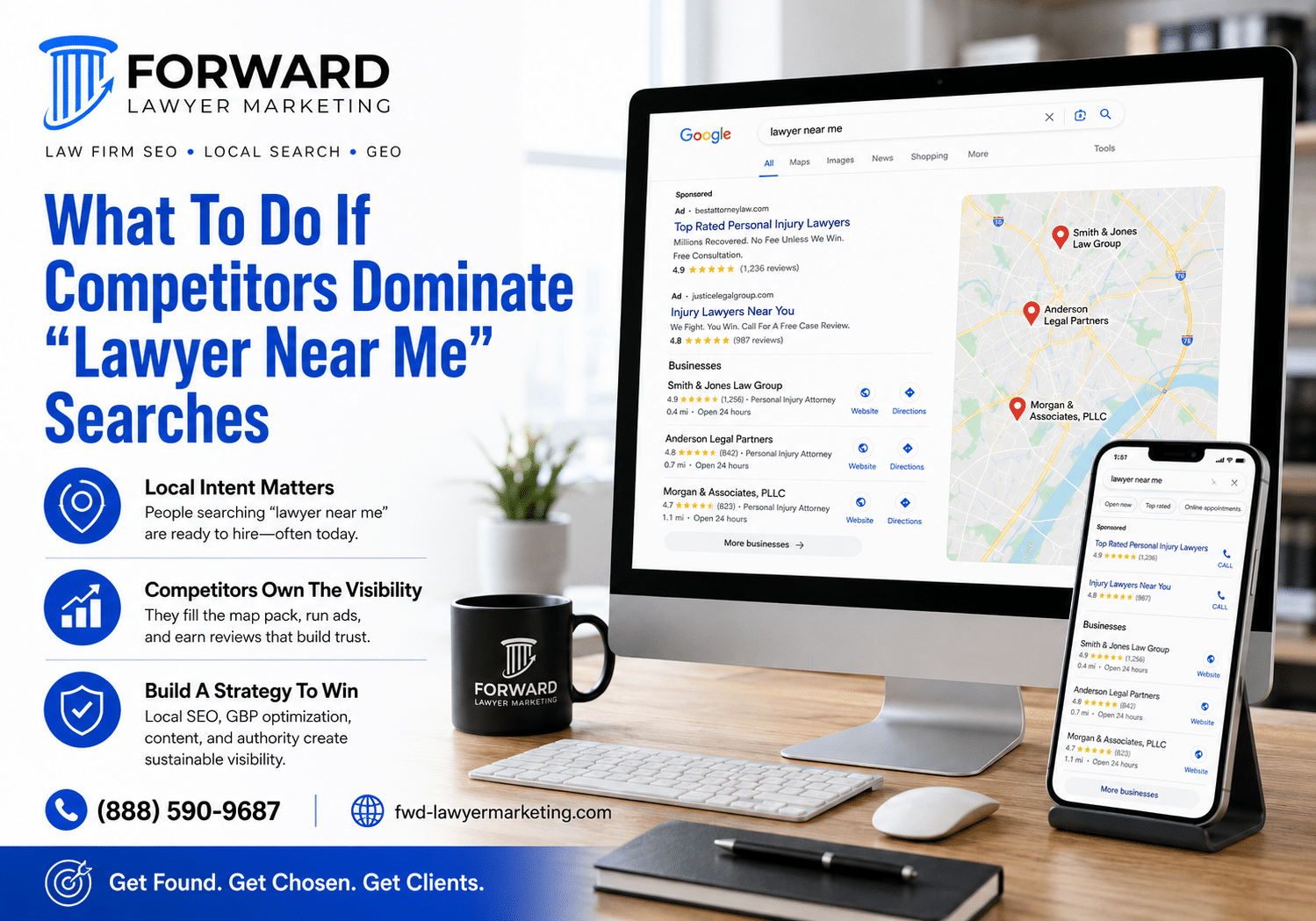
The difficulty is that “lawyer near me” searches are also among the most competitive search environments in the legal industry. A law firm is not only competing against other organic websites. It is competing against the Google Local Map Pack, Google Local Services Ads, traditional Google Ads, legal directories, review-rich competitors, multi-location firms, individual attorney profiles, and increasingly, AI-assisted search interfaces that summarize local options and legal information before the user clicks.
Google Doesn’t Rank Law Firms Based On Legal Skill
This creates a crowded and unforgiving landscape. A law firm may have excellent attorneys, decades of experience, strong client service, and a legitimate reputation in the courtroom, yet still lose visibility to competitors that have built stronger local search infrastructure. In local SEO, Google does not rank law firms based solely on legal skill. It evaluates digital signals it can understand, including relevance, proximity, prominence, website authority, reviews, citations, backlinks, profile completeness, mobile usability, structured data, and overall consistency across the web.
For law firm partners and managing attorneys, this can be frustrating. The competitor appearing above your firm may not have better lawyers. They may simply have better local SEO execution. They may have a more complete Google Business Profile, a stronger review strategy, better practice-area pages, more consistent citations, superior mobile performance, deeper local content, better internal linking, stronger backlinks, or a more sophisticated paid search presence supporting organic visibility.
The strategic response is not to panic or chase gimmicks. The response is to diagnose the competitive gap systematically. A firm that cannot appear for “lawyer near me” searches needs to understand whether the problem is proximity, profile relevance, local prominence, website authority, technical performance, review weakness, citation inconsistency, or search intent mismatch. Different problems require different solutions.
Understanding The “Lawyer Near Me” Search Ecosystem
Why “Near Me” Searches Are Not One Single Ranking Environment
A “lawyer near me” search does not trigger one universal set of results for every user. Local search results can vary dramatically based on the searcher’s physical location, device, search history, wording, practice area, time of day, map boundaries, and the density of competing firms nearby. A law firm may appear prominently for someone searching within a mile of the office and disappear when a similar search is performed five miles away.
This is why law firms should avoid judging performance based on one manual search from an office computer. A partner may search “lawyer near me” from inside the firm’s office and see the firm in the Map Pack, while prospective clients in surrounding neighborhoods may not see the firm at all. Conversely, a firm may believe it is invisible because one search from one location looks poor, while grid tracking reveals that it performs well across certain parts of the city and poorly in others.
Local search visibility is geographic, category-dependent, and intent-sensitive. A family law firm may appear for “divorce lawyer near me” but not for “child custody lawyer near me.” A personal injury firm may appear for “car accident lawyer near me” but not for “truck accident lawyer near me.” A criminal defense firm may appear for “criminal lawyer near me” but fail for “DUI lawyer near me” if category alignment, website content, reviews, and services do not reinforce DUI relevance clearly enough.
Understanding this complexity is the first step toward fixing poor visibility. The phrase “lawyer near me” is not a single keyword. It is an ecosystem of local intent queries connected to practice areas, geography, proximity, reputation, and user behavior.
The Local Map Pack Versus Organic Local Results
The Local Map Pack and organic local results are related but different search environments. The Map Pack is driven heavily by local business profile signals, including relevance, distance, and prominence. Organic local results rely more heavily on traditional website factors, including content quality, internal linking, backlinks, technical SEO, topical authority, structured data, and user experience.
A law firm can perform well organically but poorly in Maps. This often happens when the website has strong content but the Google Business Profile has weak reviews, poor category alignment, low local prominence, or proximity disadvantages. A firm can also perform well in the Map Pack but poorly organically if the profile is strong but the website lacks depth, authority, or technical quality.
Dominating “lawyer near me” searches usually requires both. The Google Business Profile must be strong enough to compete in Maps, and the website must be authoritative enough to support organic local visibility. When both assets reinforce each other, the firm has a far better chance of capturing high-intent legal searches across multiple surfaces.
Competitive Gap Analysis: Diagnosing Why Competitors Win
Auditing Competitors By Practice Area And Geography
A competitive gap analysis should begin by identifying which competitors dominate the firm’s target searches across the relevant service area. This requires more than searching the firm’s city name. A personal injury firm may need to evaluate car accident, truck accident, motorcycle accident, wrongful death, slip and fall, and catastrophic injury searches across specific neighborhoods or suburbs. A family law firm may need to evaluate divorce, custody, child support, mediation, alimony, and high-asset divorce searches by city and county. A criminal defense firm may need to evaluate DUI, domestic violence, drug crimes, assault, theft, federal defense, and expungement searches.
The objective is to understand which competitors dominate which search categories and where. Some firms may dominate broadly because they have strong local authority. Others may dominate only a specific niche. For example, one competitor may own DUI searches while another dominates family law searches. A third may appear because of proximity more than authority.
This analysis should include grid-based local rank tracking rather than isolated keyword checks. Grid tracking helps show where the firm appears across different map points and where competitors are winning. If a competitor only dominates near its office, the issue may be proximity. If the competitor dominates across a wide radius, the issue is more likely prominence, authority, reviews, and relevance.
Evaluating Competitor Google Business Profiles
The next step is to study the Google Business Profiles that consistently appear above the firm. The analysis should review primary categories, secondary categories, business descriptions, listed services, review volume, review velocity, review themes, photos, posting activity, Q&A content, hours, linked website page, and whether the profile represents a firm location or an individual practitioner.
Category alignment is often revealing. A law firm that uses a more precise legal category may appear more relevant for specific searches than a firm relying on a generic law firm category. Reviews can also reveal competitive advantages. If competing profiles have many recent reviews mentioning communication, responsiveness, strong guidance, and specific practice areas, those reviews may be strengthening both conversion confidence and local prominence.
The linked website page is also important. Some competitors link their profile to a highly optimized local practice area page rather than a generic homepage. If that page reinforces the same practice area and geography as the profile, Google receives a clearer relevance signal. A firm linking to a broad homepage with weak local content may be at a disadvantage.
Evaluating Competitor Website Authority
Competitors dominating “lawyer near me” searches often have more than strong profiles. Their websites frequently contain deeper practice-area pages, more localized content, stronger attorney bios, better internal linking, and broader topical authority. A competitive audit should compare the depth and quality of your pages against the pages competitors use to support local rankings.
A personal injury competitor may rank well because its site contains extensive content about local accident claims, insurance issues, medical evidence, settlement timelines, truck accident regulations, wrongful death, and catastrophic injury damages. A family law competitor may rank because it has comprehensive divorce, custody, support, mediation, and property division pages tied to local court procedures. A criminal defense competitor may rank because its site addresses DUI, drug charges, domestic violence, assault, theft, probation violations, court process, and collateral consequences in detail.
Website authority also includes backlinks and citations. If competitors have links from legal directories, local news, bar associations, community organizations, sponsorships, podcasts, scholarships, and professional resources, they may have stronger prominence signals than firms relying only on onsite content.
Google Business Profile Optimization For Law Firms

Category Selection And Practice Area Relevance
Google Business Profile category selection is one of the most important relevance signals for local legal visibility. A law firm should use the most accurate and specific category available for its primary practice focus. A personal injury firm should not default to a generic law firm category if a more relevant category accurately describes the business. A criminal defense firm, family law firm, immigration firm, estate planning firm, bankruptcy firm, or employment law firm should make sure its category structure reflects the work it actually wants to attract.
This does not mean adding every legal category available. Over-expanding categories can dilute relevance and create mismatched leads. A firm should align categories with actual practice areas, website content, attorney experience, and intake capacity. If the firm does not meaningfully handle a service, it should not add that category merely to appear for more searches.
A category audit should compare your firm with competitors that consistently appear in the Local Pack. If top competitors all use more precise categories and your profile uses only broad language, category alignment may be part of the visibility gap.
Services And Business Description Optimization
The services section should clarify what the firm handles. A criminal defense firm should describe relevant charge categories. A family law firm should explain divorce, custody, support, mediation, and enforcement services. A personal injury firm should identify accident and injury types. These service descriptions should be written for clarity, not keyword stuffing.
The business description should communicate the firm’s practice focus, local service area, consultation process, and professional positioning. It should not make exaggerated claims, guarantee results, or use misleading superiority language. A professional law firm profile should sound credible, restrained, and specific.
The description should also align with the website. If the profile promotes divorce representation, the linked website should contain strong divorce content, attorney bios, internal links, reviews, and local information supporting that service. If the profile promotes personal injury representation, the site should demonstrate injury authority beyond a thin overview page.
Photos, Hours, Messaging, And Operational Trust
Profile completeness affects user trust. Law firms should use professional photos of the office, attorneys, team, signage, reception area, and local presence where appropriate. Authentic imagery can reassure prospective clients that the firm is legitimate and accessible. Stock imagery does not create the same level of confidence.
Hours should be accurate and aligned with actual intake coverage. Criminal defense and personal injury firms often promote urgency, but if calls go unanswered after hours, the visibility advantage can be wasted. Profile messaging, appointment links, and call options should be monitored consistently.
Google Business Profile is not only an SEO asset. It is a client intake gateway. If the profile generates calls that are missed or form requests that are ignored, ranking improvement will not translate into revenue.
On-Page Local Signals For “Lawyer Near Me” Visibility
Building Localized Practice Area Pages
Localized practice area pages help Google understand the connection between the firm’s services and the markets it serves. A generic “personal injury lawyer” page may not be enough in a competitive market. A firm may need a comprehensive local page for the target city or county that explains the firm’s local presence, relevant court systems, nearby communities, common legal issues in the area, and specific services.
The key is substance. A strong local page should not merely insert a city name into generic copy. It should explain how the firm serves that community and why local knowledge matters. A family law page may discuss county court procedures, mediation expectations, parenting disputes, support issues, and local filing considerations. A criminal defense page may discuss local court appearances, prosecutor practices in general terms, arrest-related concerns, and the importance of early representation. A personal injury page may discuss local roadways, accident patterns, hospitals, insurance issues, and litigation venues where appropriate.
Localized pages should be written for users first. When they genuinely help prospective clients understand local legal concerns, they also support SEO.
Schema Markup For Law Firms
Structured data helps search engines understand the relationships among the firm, attorneys, services, locations, and content. For law firms, schema markup can support organization identity, local business information, attorney bios, practice areas, FAQs, breadcrumbs, and articles.
Schema does not guarantee higher rankings or Map Pack placement. It is a clarity layer. It helps reduce ambiguity about who the firm is, where it operates, and what services it provides. This becomes increasingly important as search engines and AI-driven systems evaluate entities and relationships across the web.
A law firm should make sure schema is accurate and consistent. The firm name, address, phone number, logo, website URL, attorney details, and service references should match the visible content and public profiles. Incorrect or conflicting schema can weaken entity clarity.
Internal Linking For Local Authority
Internal linking is one of the most underused local SEO tools for law firms. A strong internal linking structure connects practice area pages, city pages, attorney bios, blog posts, FAQs, and contact pages in a way that helps both users and search engines understand topical relationships.
For example, a blog post about what to do after a truck accident should link naturally to the truck accident practice page. The truck accident page should link to relevant attorney bios and related resources. A local personal injury page should connect to car accident, motorcycle accident, wrongful death, and catastrophic injury pages where relevant. Attorney bios should link to the practice areas the attorney actually handles.
This structure distributes authority and guides visitors toward conversion. It also supports the local relevance needed for competitive “lawyer near me” searches.
Building Authority Through Local Links And Legal Citations

Legal Directories And Citation Consistency
Legal directories remain important because they help validate law firm and attorney identities across the web. Profiles on reputable legal directories, state bar directories, local bar associations, and professional platforms can reinforce entity consistency and practice relevance.
The firm’s name, address, phone number, attorney names, office locations, and practice areas should be consistent across these profiles. Inconsistency often appears after office moves, partner changes, mergers, rebrands, or the use of tracking numbers. A citation audit should identify outdated addresses, duplicate profiles, old phone numbers, and inconsistent firm names.
Citation consistency alone will not dominate a competitive market, but citation inconsistency can hold a firm back. In local SEO, trust depends on corroboration. The clearer the firm’s identity across the web, the easier it is for search systems to understand and validate the business.
Local Link Building And Neighborhood Relevance
Local backlinks help build prominence. A law firm with credible links from local organizations, news outlets, sponsorship pages, chambers of commerce, legal associations, nonprofits, universities, and community resources may have stronger local authority than a competitor with few local mentions.
The best local links usually come from real involvement. A firm may sponsor a community event, provide legal education, participate in a local bar program, contribute commentary to local media, support a scholarship, partner with nonprofits, or publish useful community legal resources. These activities create both brand visibility and search authority.
Neighborhood relevance matters in dense metro areas. A firm trying to rank in Chicago, Los Angeles, Houston, Atlanta, Miami, New York, or Phoenix may need content and links that demonstrate relevance to specific neighborhoods or surrounding suburbs. Local search is often hyperlocal, and broad city-level visibility can be difficult without deep regional signals.
Digital PR For Attorneys
Digital PR can strengthen local visibility by positioning attorneys as credible sources. Attorneys can comment on legal developments, safety issues, family law trends, criminal law reforms, employment rights, estate planning deadlines, or local court changes. When these comments appear in reputable publications, podcasts, bar resources, or community websites, they can create authority signals beyond ordinary directory listings.
For law firms competing for “lawyer near me” searches, digital PR helps build prominence. It also supports E-E-A-T by showing that the attorney is not merely publishing content on the firm’s own website, but is recognized by external sources.
Reviews And Reputation Strategy
Review Velocity And Review Quality
Reviews influence both local rankings and user behavior. A firm with recent, detailed, positive reviews is often more persuasive than a firm with a small number of old reviews. Review velocity refers to the consistency with which new reviews are earned over time. A sudden spike followed by silence may look less natural than a steady pattern of authentic client feedback.
Quality matters as much as quantity. Reviews that mention responsiveness, professionalism, communication, compassion, strategic guidance, and the type of legal service can help prospective clients feel more confident. A generic five-star review is helpful, but a detailed review describing the client experience is more persuasive.
Law firms should not coach clients to use keywords or disclose private facts. The goal is authentic feedback, not manufactured SEO language. Ethical review acquisition should be simple, neutral, and compliant with applicable state rules.
Sentiment And Conversion Psychology
Prospective clients read reviews to answer emotional questions. They want to know whether the firm communicates, whether attorneys are responsive, whether staff treat clients respectfully, and whether the firm can handle stressful situations. This is especially true in criminal defense, family law, personal injury, immigration, and employment matters.
A strong reputation strategy therefore supports conversion as much as ranking. If two firms appear in the Map Pack, the firm with stronger review sentiment may receive more calls even if both are visible. Local visibility creates opportunity, but reputation often determines which firm gets contacted.
Ethical Review Responses
Review responses should be professional and confidentiality-conscious. Law firms should not confirm representation, discuss case facts, reveal confidential information, or argue with reviewers publicly. Even when a review is negative or inaccurate, the firm’s response should remain measured.
A calm, professional response can reassure future prospects that the firm takes service seriously. A defensive response can create more damage than the review itself. The public response is not only for the reviewer. It is for every future client evaluating the firm.
Technical Factors That Affect Local Visibility
Core Web Vitals And Page Experience
Technical performance affects both SEO and conversion. Google’s Core Web Vitals currently focus on Largest Contentful Paint, Interaction to Next Paint, and Cumulative Layout Shift. These metrics evaluate loading performance, responsiveness, and visual stability. For law firms, poor page performance can undermine local SEO and cause mobile visitors to abandon before contacting the office.
A prospective client searching “lawyer near me” on a phone expects speed. If the firm’s local landing page loads slowly, shifts as it renders, or delays interaction with phone buttons and forms, the user may return to search results and choose a competitor.
Performance optimization should focus on fast hosting, compressed images, clean code, limited plugin bloat, careful script management, and mobile-first design. WordPress law firm sites often suffer from heavy themes, excessive tracking scripts, oversized hero images, and third-party widgets that slow conversion pages.
Mobile-First Indexing And Local Intent
Google primarily uses the mobile version of a site for indexing and ranking. For law firms, this means the mobile experience cannot be a stripped-down afterthought. Important content, internal links, attorney information, local details, FAQs, schema-relevant content, and contact options should be accessible on mobile.
Many “near me” searches happen on smartphones. A mobile page should make it easy to call, submit a form, read about the relevant practice area, view attorney credentials, and understand the firm’s local presence. A page that looks acceptable on desktop but fails on mobile is not competitive in local legal search.
Conversion Infrastructure
Technical SEO and conversion infrastructure must work together. A firm may improve rankings but still fail if phone tracking is broken, forms malfunction, chat tools slow the page, or CRM routing delays follow-up.
A local SEO audit should test the entire journey from search result to contact. This includes clicking the Google Business Profile website link, tapping phone buttons, submitting forms, receiving confirmation messages, and tracking the lead in analytics or CRM. Visibility without working intake infrastructure is wasted opportunity.
Paid Alternatives When Competitors Dominate Organic Local Search

Local Services Ads For Lawyers
Local Services Ads can help law firms gain visibility above or near traditional results when organic and Map Pack competition is difficult. For eligible legal categories, LSAs can place the firm in a high-visibility paid placement and may use Google verification badges depending on the current market and program structure.
LSAs should not be treated as a substitute for local SEO. They are a paid visibility layer that can generate leads while organic authority is being built. The firm still needs strong intake, accurate profile information, review management, and lead quality tracking.
A law firm should also evaluate LSA performance by signed cases, not only lead count. Some LSA leads may be low quality or mismatched. Others may produce excellent cases. Without intake tracking, the firm cannot know whether LSAs are profitable.
Hyper-Local PPC Campaigns
Traditional Google Ads can supplement local SEO through hyper-local targeting. A firm can target specific cities, ZIP codes, counties, or radius areas and direct traffic to highly relevant landing pages. This can be useful when the firm is outside the natural Map Pack radius but still legitimately serves the market.
PPC landing pages should align tightly with search intent. A person searching for “DUI lawyer near me” should not land on a general criminal defense homepage. A person searching for “truck accident lawyer in [city]” should reach a page that addresses truck accident claims, local relevance, serious injury issues, and immediate consultation options.
Paid campaigns should be used strategically, not as a permanent substitute for weak organic authority. The long-term goal is a balanced acquisition system where SEO, GBP visibility, LSAs, PPC, referrals, and intake work together.
Retargeting And Brand Reinforcement
Not every legal consumer converts on the first visit. Retargeting can keep the firm visible after someone visits a practice area page, attorney bio, or local landing page. This can be particularly useful for family law, estate planning, business litigation, and other practice areas where users may research multiple firms before contacting one.
Retargeting must be handled carefully in sensitive legal matters. Firms should avoid ad messaging that could reveal or imply private legal concerns in a way that creates embarrassment or confidentiality issues. Professional, brand-oriented retargeting is often safer than highly specific messaging for sensitive practice areas.
Measuring Progress In “Lawyer Near Me” Visibility
Local Grid Rankings
Local grid tracking helps measure visibility across a geographic area. Instead of checking one ranking from one device, grid tracking shows how the firm performs from multiple map points around the office or target market. This helps diagnose proximity limitations and identify areas where competitors dominate.
The firm should track specific practice-area searches, not only generic “lawyer near me” phrases. A personal injury firm should track injury-related searches. A family law firm should track divorce and custody searches. A criminal defense firm should track DUI and criminal defense searches. Practice-specific visibility is usually more meaningful than broad generic visibility.
Google Business Profile Performance
Google Business Profile performance metrics can show calls, website clicks, direction requests, messages, bookings, and other interactions depending on available features. These metrics should be reviewed regularly, but they should not be interpreted in isolation. A profile may generate more calls, but if intake does not answer or qualify them properly, business results may not improve.
GBP metrics should be connected to call tracking, intake logs, and CRM outcomes wherever possible. The firm should understand which profile interactions become consultations and signed matters.
Organic Local Landing Page Performance
Local landing pages should be measured through organic clicks, impressions, engagement, form submissions, phone clicks, call quality, and signed-client outcomes. A page that generates traffic but no leads may have a conversion issue. A page that generates few visitors but high-quality consultations may deserve more internal links, content support, or backlinks.
Analytics should be tied to business goals. Rankings matter, but the ultimate measure is qualified client acquisition.
Review Growth And Reputation Metrics
Review metrics should include review volume, recency, average rating, response rate, sentiment, and practice-area relevance. Law firms should evaluate not only how many reviews they have, but what those reviews communicate to prospective clients.
Competitor review comparison is also important. If the firm has 18 reviews and the top three competitors each have 300 recent reviews, reputation development must become part of the strategy.
Frequently Asked Questions About “Lawyer Near Me” Searches
Why Does My Law Firm Not Show Up For “Lawyer Near Me”?
Your firm may not appear because of proximity limitations, weak Google Business Profile relevance, insufficient reviews, poor citation consistency, low local prominence, a weak website, or stronger nearby competitors. The problem can rarely be solved by one quick profile edit. A proper diagnosis should evaluate relevance, distance, prominence, website authority, reviews, citations, and technical performance together.
Can A Law Firm Rank In The Map Pack Without Being Close To The Searcher?
It is possible in some situations, but proximity remains a major local ranking factor. A firm with strong prominence and relevance may appear beyond its immediate neighborhood, but it is generally harder to rank in the Map Pack far from the office. Firms that serve broader regions should combine GBP optimization with organic local landing pages and paid campaigns where appropriate.
Should My Law Firm Use A Virtual Office To Rank In Another City?
A law firm should be very cautious with virtual offices. If the office is not a legitimate staffed location where the firm can meet clients during stated hours, it may violate Google Business Profile guidelines and create suspension risk. A better strategy is to build legitimate local authority, strong organic pages, and, where appropriate, real staffed office locations.
How Important Are Reviews For “Lawyer Near Me” Searches?
Reviews are extremely important because they influence both local prominence and user trust. Review count, rating, recency, and sentiment all matter in competitive markets. However, reviews should be earned ethically. Law firms should never buy reviews, pressure clients, or encourage misleading statements.
Do Local Services Ads Replace Local SEO?
No. Local Services Ads can generate paid visibility, but they do not replace organic local SEO or Google Business Profile optimization. LSAs can help bridge the gap while the firm builds organic authority, but long-term visibility usually requires strong local SEO, content depth, reviews, citations, backlinks, and intake systems.
How Long Does It Take To Improve “Lawyer Near Me” Rankings?
The timeline depends on competition, proximity, profile condition, website authority, review strength, technical issues, and the size of the local authority gap. Some improvements may appear within weeks after fixing obvious problems, but competitive markets often require months of consistent optimization. Sustainable local visibility is built through ongoing authority development rather than one-time edits.
What Is The Biggest Mistake Law Firms Make With Local SEO?
One of the biggest mistakes is treating local SEO as only a Google Business Profile task. GBP matters, but it must be supported by a strong website, local landing pages, reviews, citations, backlinks, mobile usability, attorney authority, and intake tracking. Firms that optimize the profile but ignore the broader local ecosystem often struggle to compete long-term.

Dominate Local Near Me Searches With Forward Lawyer Marketing
When competitors dominate “lawyer near me” searches, the issue is rarely one missing keyword or one incomplete field. Local legal visibility is the result of many signals working together. Google Business Profile relevance, proximity, prominence, reviews, citations, backlinks, local content, technical performance, mobile usability, schema, paid visibility, and intake responsiveness all shape whether a law firm appears and converts.
The firms that win these searches are usually not relying on shortcuts. They are building local authority systems. Google Business Profiles are complete and credible. Client reviews are recent and persuasive. The law firm’s websites contain strong local practice pages. Attorney bios for the firm reinforce E-E-A-T. Their citations are consistent. Their backlinks demonstrate community relevance. Their mobile pages load quickly. Their intake teams answer when prospects call.
If your law firm is losing “lawyer near me” visibility to competitors, the first step is a serious local SEO audit. Identify where competitors are stronger. Evaluate your profile, categories, services, reviews, local landing pages, citations, backlinks, technical performance, and lead tracking. Then build a prioritized roadmap that addresses the gaps most likely to affect qualified consultations and signed cases.
For firms seeking to accelerate results, working with a local law firm SEO specialist can provide the expertise needed to compete in today’s highly competitive local search landscape. Schedule a consultation with Forward Lawyer Marketing today at (888) 590-9687 and take the next step toward dominating your local market
