
Local SEO For Law Firms: Complete Strategy Guide

Local SEO has become one of the most important competitive battlegrounds in the legal industry. In many metropolitan markets, the firms dominating localized search visibility are often the firms generating the highest volume of qualified consultations, signed retainers, and long-term case pipelines. For modern law firms, local search visibility is no longer simply a marketing enhancement. It is operational infrastructure directly tied to revenue generation, brand authority, intake efficiency, and long-term market share.
This shift has accelerated significantly as Google continues reshaping the search experience around local intent, AI-generated summaries, entity recognition, and behavioral engagement metrics. Consumers searching for legal representation today are not interacting with search engines the same way they did five or ten years ago. Instead of reviewing multiple pages of organic listings, users increasingly make decisions directly within the search results environment itself through Google Business Profiles, reviews, AI Overviews, map results, Local Services Ads, and mobile-first interfaces.
For law firms, this creates a “winner-take-most” environment where a small number of firms capture a disproportionate share of high-intent leads.
A personal injury firm ranking prominently within the Map Pack for “car accident lawyer near me” may receive dramatically more calls than competitors ranking only a few positions lower. Similarly, a family law firm consistently appearing within localized organic results for divorce, custody, and support-related searches may establish dominant market visibility across an entire metropolitan region.
SEO For Law Firms is Sophisticated
Importantly, local SEO for attorneys has become substantially more sophisticated than traditional small business local optimization. Legal marketing exists within one of Google’s most heavily scrutinized search categories because legal information falls under the company’s “Your Money or Your Life” standards. Inaccurate or misleading legal information can materially affect a consumer’s finances, liberty, employment rights, immigration status, family relationships, or healthcare access. As a result, Google applies elevated trust and authority standards to legal websites.
This means successful legal SEO requires more than inserting city names into practice-area pages or claiming directory profiles. Google increasingly evaluates whether a law firm demonstrates genuine expertise, regional authority, semantic relevance, technical credibility, and real-world prominence within its jurisdiction.
The firms succeeding in local SEO today are generally building comprehensive authority ecosystems rather than isolated marketing campaigns. Those ecosystems typically combine Google Business Profile optimization, citation consistency, structured data implementation, topical authority development, localized content creation, review acquisition systems, technical SEO performance, mobile usability, behavioral engagement optimization, and strategic link acquisition.
This transition is also occurring simultaneously with the rise of AI-driven search systems. Google’s increasing integration of generative search experiences means local authority signals are becoming even more important because AI retrieval systems rely heavily on entity trust, semantic relationships, and corroborated expertise when surfacing law firms within search experiences.
For attorneys and law firm marketing directors, the implication is clear: local SEO is no longer merely about rankings. It is about establishing regional legal authority at scale.
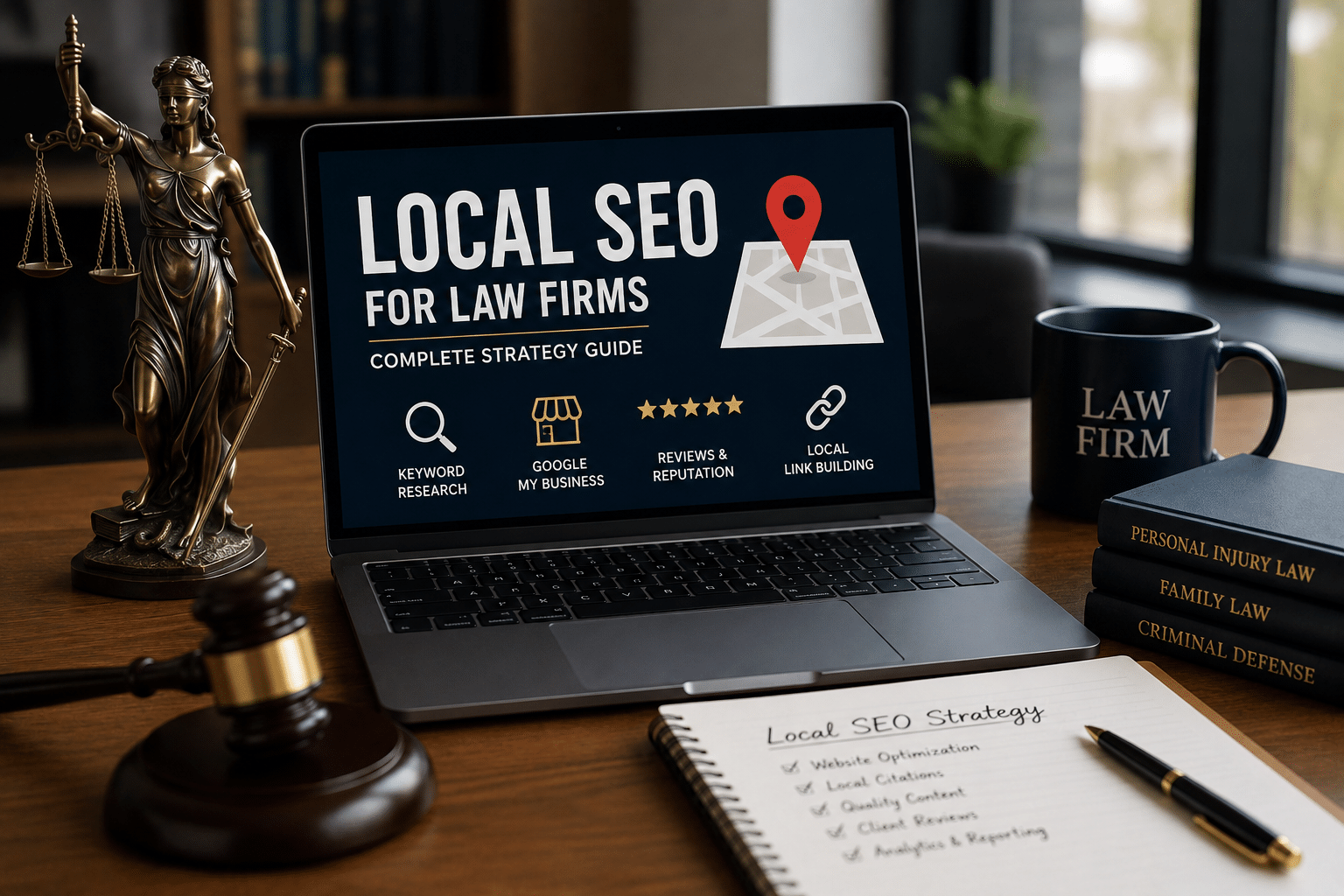
Understanding The Current Local SEO Landscape For Attorneys
Why The Google Map Pack Dominates Legal Search Behavior
The Google Map Pack has become one of the most valuable forms of visibility in legal marketing because it frequently occupies the highest commercial-intent real estate within search results. When users search for legal services with geographic intent, Google commonly displays a localized map interface featuring three highlighted business profiles above traditional organic listings.
On mobile devices especially, these listings often dominate the visible screen space entirely.
This dramatically changes user behavior. Many legal consumers now evaluate law firms directly within Google’s ecosystem before ever visiting a website. Reviews, business descriptions, photographs, practice categories, directions, office proximity, and click-to-call functionality collectively shape the consumer’s perception of credibility within seconds.
For high-urgency practice areas such as criminal defense, personal injury, emergency custody matters, or DUI representation, these localized interfaces frequently function as immediate conversion environments rather than preliminary research tools. Prospective clients may contact a firm directly from the Map Pack without comparing multiple websites extensively.
As a result, local visibility directly impacts consultation volume.
This dynamic has become especially pronounced in highly competitive metropolitan markets such as Chicago, Dallas, Los Angeles, Atlanta, Miami, Phoenix, Houston, and New York City where multiple firms compete aggressively for the same localized search traffic.
How Google Evaluates Local Law Firm Rankings
Google publicly identifies three major factors influencing local rankings: relevance, proximity, and prominence. However, the practical application of those signals within the legal industry is substantially more nuanced.
Relevance involves Google’s attempt to determine how closely a law firm aligns with the user’s search intent. This extends far beyond keyword placement. Google increasingly analyzes semantic relationships between practice areas, service descriptions, attorney profiles, website content, and behavioral engagement patterns.
Proximity refers to geographic distance between the user and the law firm. This factor becomes especially influential for mobile searches and “near me” queries. However, proximity alone does not guarantee visibility. Firms demonstrating stronger authority signals often outrank geographically closer competitors.
Prominence represents the broadest category and arguably the most important for competitive legal SEO. Prominence encompasses reviews, backlinks, citations, media mentions, local engagement, directory authority, topical relevance, user interaction patterns, and overall digital reputation.
Modern local SEO success therefore requires layered authority building rather than simplistic optimization tactics.
Why Generic SEO Advice Often Fails For Attorneys
Many general SEO strategies fail within the legal industry because legal marketing operates under elevated trust thresholds. Google’s systems are significantly more cautious regarding legal information than they are for ordinary commercial topics.
A local restaurant website may rank successfully with relatively minimal content depth. A law firm website targeting personal injury, criminal defense, immigration, or family law generally faces much higher scrutiny.
This is because legal consumers require accurate, jurisdiction-specific information capable of influencing life-altering decisions.
As a result, legal SEO increasingly revolves around demonstrating substantive expertise rather than simply optimizing technical signals.
Google Business Profile Optimization For Law Firms
Why Google Business Profile Is Foundational To Legal SEO
Google Business Profile remains one of the single most important assets within local legal marketing because it directly influences both visibility and conversion behavior. In many situations, a law firm’s GBP profile becomes the consumer’s first substantive interaction with the brand.
Consumers increasingly evaluate credibility directly from the profile itself before engaging with the website. Review quantity, review quality, office photography, practice descriptions, geographic relevance, response engagement, and posting activity collectively shape conversion likelihood.
Many law firms underestimate how deeply Google Business Profiles influence broader local authority signals. GBP optimization is not simply a profile-management exercise. It is a trust-building mechanism integrated into Google’s larger entity evaluation systems.
The strongest profiles communicate professionalism, legitimacy, responsiveness, and regional authority immediately.
Selecting Appropriate Practice Categories
Category selection significantly influences relevance evaluation within local search systems. Law firms frequently make the mistake of choosing broad or generic classifications rather than selecting the most semantically precise categories available.
A firm primarily handling personal injury matters should generally prioritize “Personal Injury Attorney” as its primary category rather than “Law Firm” whenever appropriate. Similarly, a family law practice focused heavily on divorce litigation should emphasize “Divorce Lawyer” or “Family Law Attorney” where applicable.
Secondary categories can further clarify practice concentration areas, but excessive category stacking may dilute topical clarity.
Google increasingly attempts to understand firms semantically rather than merely categorically. Precise category alignment therefore strengthens relevance signals substantially.
The Strategic Importance Of GBP Descriptions
Business descriptions should not function as keyword-stuffed advertisements. Instead, they should communicate authority, geographic focus, service scope, and professional positioning clearly.
Effective legal descriptions often explain:
The jurisdictions served, practice concentrations, years of experience, client service philosophy, litigation focus, consultation availability, and local familiarity with courts and procedures.
Descriptions written naturally tend to perform better long term than aggressively optimized copy because Google increasingly evaluates readability, authenticity, and contextual coherence.
Why Ongoing Profile Activity Matters
Many law firms treat GBP optimization as a one-time setup process rather than an ongoing engagement strategy.
Google increasingly rewards active profiles demonstrating consistent user engagement and operational legitimacy. Regular updates involving office announcements, educational content, community involvement, FAQ discussions, or legal awareness topics can reinforce freshness signals.
Consistent engagement also improves consumer trust. Profiles appearing abandoned or inactive often generate lower conversion confidence even when rankings remain strong.
Legal Citations And NAP Consistency
Why Citation Consistency Still Influences Rankings
Although local SEO has evolved dramatically over the past decade, citation consistency remains an important trust and corroboration signal within legal marketing.
Google attempts to verify that a law firm is a legitimate, operational entity through corroborated information across multiple sources. Inconsistent listings weaken confidence because they create ambiguity regarding identity and location legitimacy.
This becomes especially important within the legal industry because Google applies elevated scrutiny to YMYL entities.
Understanding NAP Consistency In Legal Marketing
NAP consistency refers to maintaining standardized business information across all major online properties, including:
Law firm name, office address, and phone number formatting.
Even relatively minor inconsistencies can create confusion. Variations involving suite numbers, abbreviations, punctuation, or tracking phone numbers may fragment authority signals if not implemented strategically.
Strong citation consistency reinforces trust across:
Google Business Profile, Avvo, Martindale-Hubbell, Justia, FindLaw, Lawyers.com, Yelp, Apple Maps, Bing Places, local chambers of commerce, and regional directories.
Why Legal Directories Still Matter
Some marketers incorrectly assume legal directories have become obsolete. In reality, authoritative legal directories continue functioning as important corroborative trust sources within the legal ecosystem.
Profiles on established platforms help reinforce:
Practice relevance, attorney legitimacy, geographic authority, and professional recognition.
Directories also contribute to entity understanding within AI-driven search systems because they help validate relationships between attorneys, practice areas, locations, and legal topics.
Importantly, firms should prioritize quality and consistency over mass low-quality citation building.
On-Page Local SEO Signals For Attorneys

Why Geo-Targeted Practice Pages Matter
One of the most common mistakes law firms make involves attempting to rank a single generic page for every service and every geographic area simultaneously.
Google increasingly rewards pages demonstrating clear geographic and topical specificity.
A strong legal SEO strategy typically involves dedicated pages targeting:
Specific practice areas, cities, counties, and regional legal concerns.
For example, a Chicago family law firm may build separate pages discussing:
Cook County divorce litigation, Skokie custody disputes, DuPage County parenting plans, Naperville mediation, or high-net-worth divorce representation in the North Shore suburbs.
These pages perform more effectively when they provide genuinely localized information rather than duplicated templates with city-name substitutions.
Avoiding Thin Local Landing Pages
Google has become increasingly effective at identifying low-quality “doorway pages” created solely for ranking manipulation.
Thin location pages offering little original value often fail because they lack semantic depth and geographic authenticity.
Strong localized legal pages instead incorporate:
Court references, procedural nuances, community familiarity, regional statutes, local legal culture, transportation corridors, courthouse logistics, and nearby municipalities naturally throughout the content.
The objective is not simply geographic keyword placement. The objective is demonstrating authentic local authority.
Structured Data And Schema Implementation
Law firms should implement schema strategically to clarify relationships involving:
Attorneys, office locations, legal services, FAQs, reviews, organizations, and geographic service areas.
LegalService schema, Attorney schema, Organization schema, FAQPage schema, and LocalBusiness schema collectively strengthen semantic clarity.
As AI-driven search evolves, structured data likely becomes even more valuable because retrieval systems increasingly rely on machine-readable contextual relationships.
Review Management And Reputation Signals
Why Reviews Influence Both Rankings And Conversion Rates
Reviews affect local SEO through multiple dimensions simultaneously.
First, they contribute directly to prominence signals influencing Map Pack rankings. Second, they shape consumer trust and conversion behavior.
Many legal consumers evaluate review quality before even visiting a website.
A law firm with hundreds of detailed, recent, well-written reviews often projects significantly stronger authority than a competitor with minimal feedback regardless of website quality.
Ethical Review Acquisition For Attorneys
Law firms must approach review acquisition carefully due to professional conduct obligations and confidentiality concerns.
Strong review systems generally involve structured post-case follow-up processes encouraging satisfied clients to share honest feedback voluntarily.
The objective is consistency and authenticity rather than manipulation.
Aggressive review solicitation tactics, incentivized feedback, or misleading review practices may create both ethical and reputational risks.
Responding To Reviews Professionally
Review responses function as public trust signals.
Thoughtful, professional responses demonstrate attentiveness, professionalism, and client respect. Even responses to negative reviews can reinforce credibility when handled properly.
Law firms should remain careful not to disclose confidential information during review interactions.
Professional restraint often communicates credibility more effectively than defensive rebuttals.
Local Link Building Strategies For Law Firms
Why Local Backlinks Still Matter
Backlinks remain one of Google’s strongest authority indicators, particularly within competitive legal niches.
However, local legal link building should focus on authority, relevance, and geographic alignment rather than raw volume.
The strongest local backlinks often originate through genuine community integration.
Community Partnerships And Sponsorships
Many effective local links emerge naturally through community involvement.
Law firms supporting youth athletics, nonprofits, local charities, educational initiatives, scholarship programs, or civic organizations frequently earn highly relevant local authority signals.
These relationships also reinforce broader brand visibility beyond SEO alone.
Local Media And PR Opportunities
Media mentions remain highly valuable authority signals within legal SEO.
Attorneys can often generate regional press coverage through commentary involving:
Legal developments, public safety issues, accident trends, criminal justice reforms, estate planning concerns, family law updates, or business regulation changes.
These mentions strengthen both backlink authority and entity prominence.
Professional Referral Ecosystems
Relationships with complementary professionals often generate valuable local relevance signals.
Accountants, therapists, financial planners, medical providers, business consultants, and real estate professionals may all become valuable referral and citation relationships depending on the practice area.
Strong referral ecosystems frequently produce both SEO benefits and direct client acquisition opportunities.
Creating Locally Relevant Legal Content
Why Content Depth Drives Local Authority
Modern local SEO increasingly overlaps with topical authority development.
Google no longer evaluates practice pages in isolation. Instead, it increasingly evaluates whether a law firm demonstrates broad expertise surrounding a legal category within a geographic context.
A Milwaukee workers’ compensation firm publishing extensive educational resources regarding Wisconsin injury claims, disability ratings, IME procedures, vocational rehabilitation, and settlement timelines may develop significantly stronger authority than competitors relying solely on generic service pages.
Hyperlocal Content Development
The strongest legal content strategies incorporate localized context naturally.
Effective content may reference:
Regional courts, county procedures, state statutes, community-specific concerns, transportation corridors, local accident trends, or courthouse filing logistics.
This type of specificity reinforces geographic authority and semantic relevance simultaneously.
FAQ Content And AI Search Visibility
Detailed FAQ content increasingly supports:
Featured snippets, voice search optimization, AI Overview retrieval, and People Also Ask visibility.
Strong FAQ sections address nuanced client concerns thoroughly rather than superficially.
Comprehensive educational content increasingly functions as both an SEO asset and a conversion tool.
Frequently Asked Questions About Local SEO for Law Firms
How Long Does Local SEO Take For Law Firms?
Local SEO timelines vary significantly depending on market competition, domain authority, practice area saturation, and existing digital infrastructure.
In moderately competitive markets, firms may begin seeing measurable improvements within three to six months. However, highly competitive metropolitan legal markets often require sustained authority building over twelve months or longer.
Local SEO should be viewed as a long-term strategic investment rather than a short-term ranking tactic.
Is Google Business Profile More Important Than Organic SEO?
Google Business Profile and organic SEO function together rather than independently.
GBP visibility strongly influences map rankings and immediate local discovery, while the website reinforces broader authority, semantic depth, technical trust signals, and conversion infrastructure.
The strongest firms generally dominate both simultaneously.
How Important Are Reviews For Attorney Rankings?
Reviews are extremely important because they influence both prominence signals and consumer trust behavior.
Quantity alone is insufficient. Review quality, recency, engagement, and thematic relevance collectively shape authority perception.
Detailed reviews discussing professionalism, responsiveness, communication, and outcomes often strengthen credibility more effectively than short generic comments.
Should Law Firms Create Multiple Location Pages?
Yes, provided those pages contain meaningful localized value.
Strong location pages should discuss local courts, procedures, statutes, communities, and legal concerns naturally. Thin duplicate pages built solely for keyword manipulation are increasingly ineffective and potentially harmful.
Does AI Search Change Local SEO?
Yes. AI-driven retrieval systems increasingly evaluate semantic authority, entity trust, and contextual expertise when surfacing law firms within search experiences.
However, local relevance remains critically important because legal services are jurisdictional by nature.
What Is The Biggest Local SEO Mistake Attorneys Make?
One of the most common mistakes involves relying on shallow, keyword-focused practice pages without building broader topical authority or geographic relevance.
Modern legal SEO increasingly rewards comprehensive expertise ecosystems rather than isolated keyword targets.
Contact Forward Lawyer Marketing to Discuss Local SEO for Your Law Firm
Local SEO for law firms has evolved into one of the most sophisticated and competitive disciplines within digital marketing.
The firms dominating modern legal search are rarely succeeding because of one tactic alone. Instead, they are building integrated authority systems combining technical SEO, semantic content depth, Google Business Profile optimization, review management, citation consistency, local relevance, structured data, topical authority, and long-term trust development.
As Google continues integrating AI-driven retrieval systems and entity-based search into the legal ecosystem, these authority signals become even more important.
The firms investing strategically in local authority today are positioning themselves for sustainable visibility not only within traditional organic rankings, but also within AI Overviews, conversational search experiences, voice search environments, and future retrieval systems.
For law firms seeking long-term growth, local SEO should no longer be viewed merely as a marketing channel. It should be viewed as foundational market infrastructure tied directly to intake volume, brand authority, client trust, and regional market share.
Forward Lawyer Marketing focuses specifically on helping law firms strengthen search visibility, improve local rankings, increase qualified lead generation, and develop sustainable authority within highly competitive legal markets.
If your current SEO strategy still relies heavily on isolated keyword pages, inconsistent local optimization, or outdated tactics, now is the time to audit your digital infrastructure and identify the authority gaps limiting long-term growth.
The firms that establish deep local authority today are increasingly the firms that will dominate legal search tomorrow.
For law firms ready to translate measurement into measurable growth in caseload and revenue, partnering with a specialized agency can accelerate implementation. Forward Lawyer Marketing offers consultative local SEO audits and managed programs that align GBP optimization, citation building, and performance measurement to revenue goals.
Our team combines an in-house marketing manager approach with experienced leadership, including an SEO Director with two decades of domain expertise, and Google-certified PPC professionals to integrate paid and organic local strategies.
To begin a prioritized local SEO audit or discuss measurable outcomes for your firm, contact Forward Lawyer Marketing by phone at (888) 590-9687 to arrange an audit and implementation plan.
