
How To Write GBP Posts That Generate Law Firm Calls
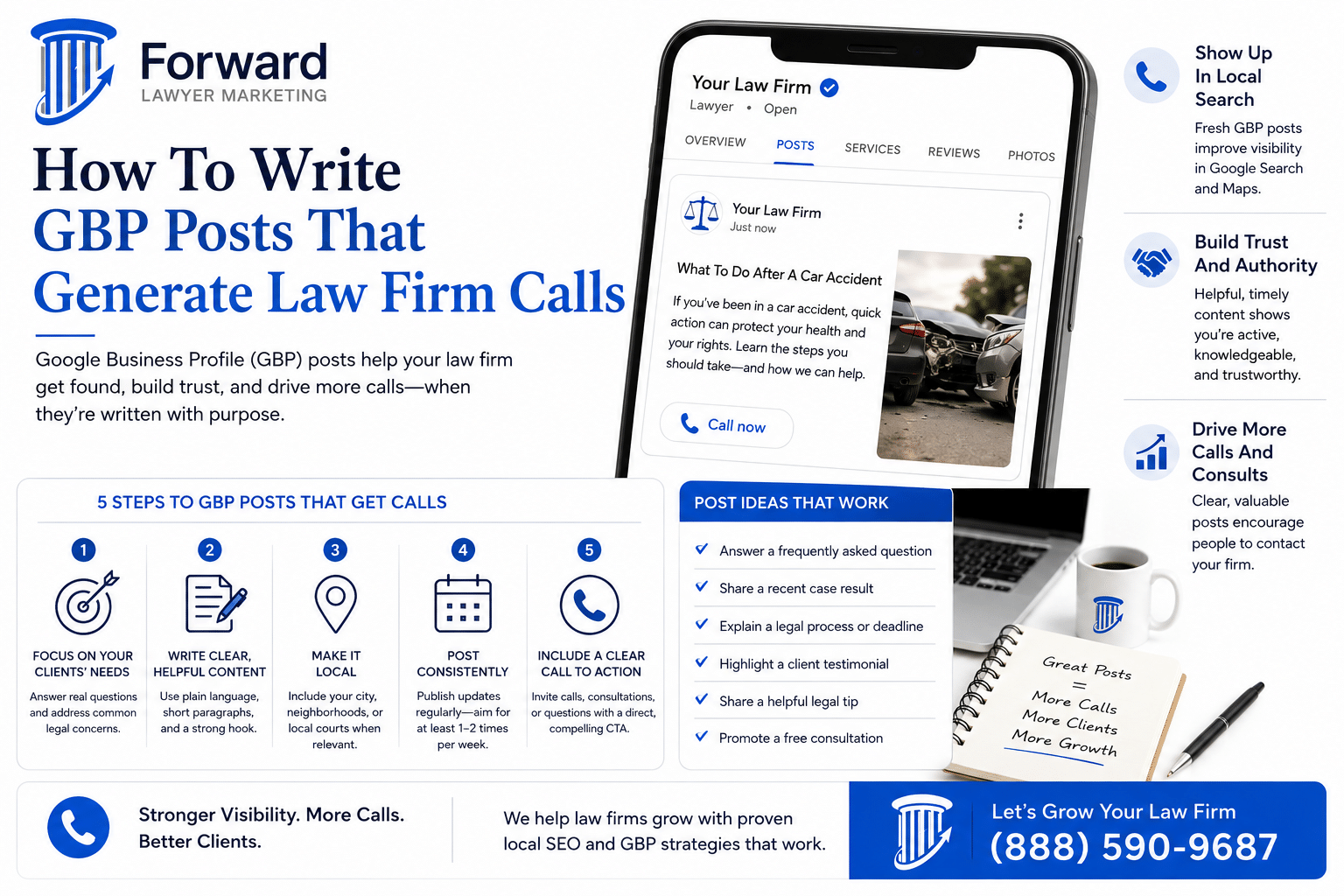
Why Google Business Profile Posts Matter For Law Firms
Google Business Profile posts are often treated as an afterthought in law firm marketing. Many firms publish occasional updates, generic holiday messages, or short promotional blurbs without a clear strategy. Others ignore posts entirely because they assume Google Business Profile activity is only about reviews, categories, and map rankings. Both approaches miss the real value of GBP posts.
For law firms, GBP posts should be written as conversion assets. They may not replace strong practice area pages, Google Business Profile optimization, reviews, citations, or local SEO fundamentals, but they can help turn profile views into phone calls. A prospective client searching for a personal injury lawyer, DUI defense attorney, divorce lawyer, estate planning attorney, or business litigation firm may see the firm’s profile before visiting the website. At that moment, the post can reinforce urgency, clarify services, answer a specific concern, and encourage the searcher to call.
The mistake many law firms make is writing GBP posts like social media captions. A Google Business Profile post is different. It appears in a high-intent search environment, often when the user is already comparing attorneys. The user may not want entertainment, commentary, or brand personality. They want to know whether the firm handles their legal problem, whether the firm serves their location, whether the matter is urgent, and what to do next.
For Forward Lawyer Marketing clients and other law firms competing in local search, GBP posts should support a larger legal local SEO strategy. They should align with practice area pages, Google Business Profile categories, intake priorities, review themes, and local search intent. The goal is not to post for the sake of activity. The goal is to publish posts that generate qualified law firm calls.
Understand The Role Of GBP Posts In Local SEO
GBP Posts Are Conversion Signals, Not Ranking Magic
A common misconception is that posting frequently on a Google Business Profile will automatically move a law firm into the Local Pack. Google’s local ranking framework is built primarily around relevance, distance, and prominence. Profile completeness, categories, reviews, website strength, citations, and overall local authority usually matter more than simply publishing posts on a schedule.
That does not mean GBP posts are useless. Their value is often closer to conversion optimization than direct ranking manipulation. A strong post can help a prospective client understand that the firm handles the issue they are facing right now. It can reinforce service relevance, highlight a specific practice area, and move the user from profile browsing to calling the office.
The strategic inference is simple: GBP posts should not be sold as a shortcut to rankings, but they should be used as a practical way to increase calls from the visibility the firm already has.
GBP Posts Should Match High-Intent Legal Search Behavior
Law firm prospects usually find Google Business Profiles while searching for immediate help. A person searching for “car accident lawyer near me” may be dealing with an insurance adjuster. A person searching for “DUI attorney” may have a court date or license deadline. A parent searching for “child custody lawyer” may be facing an urgent parenting dispute.
GBP posts should reflect these realities. They should not be vague announcements such as “We are here to help with legal matters.” They should address specific legal situations and make the next step obvious.
A post about car accident claims should mention medical treatment, insurance calls, crash reports, or evidence preservation. A DUI post should mention arrest dates, license consequences, court appearances, or chemical testing concerns. A divorce post should mention custody, property division, support, or temporary orders. Specific posts attract specific calls.
Start With The Right Legal Topic
Focus On Practice Areas That Produce Revenue
Every GBP post should support a business objective. A law firm should prioritize the case types it wants most, not simply publish whatever topic is easy to write that week.
A personal injury firm may focus on car accidents, truck accidents, motorcycle crashes, wrongful death, slip and fall claims, catastrophic injuries, and insurance disputes. A criminal defense firm may focus on DUI, domestic violence, drug charges, theft, assault, probation violations, and expungement. A family law firm may focus on divorce, custody, child support, relocation, orders of protection, and post-decree enforcement.
The best topics are both searchable and commercially meaningful. A post about a high-value or urgent legal issue is more likely to generate calls than a generic firm update.
Use Local And Situational Context
A GBP post should make it clear that the firm serves a real local market. This does not mean stuffing the city name into every sentence. It means connecting the post to the jurisdiction, court system, community, or legal process that matters to the prospective client.
For example, a Chicago divorce firm might post about preparing for a Cook County custody hearing. A Texas criminal defense firm might post about what to do after a DWI arrest. A Florida estate planning firm might post about updating a plan after relocating to Florida. A Michigan personal injury firm might post about steps to take after a crash on a local highway.
Local specificity helps the post feel relevant. It also reinforces the connection between the firm’s Google Business Profile, website, practice pages, and service area.
Write GBP Posts Around Client Urgency
Lead With The Client’s Problem
The opening line of a GBP post should identify the legal problem quickly. Users are scanning, not studying. A strong post begins with the concern the client already has.
For example, a personal injury post might begin by addressing what happens when an insurance adjuster calls after a crash. A DUI post might begin by addressing a pending court date after an arrest. A family law post might begin by addressing a parent who is worried about a custody schedule. An estate planning post might begin by addressing outdated wills or powers of attorney.
This structure works because it mirrors the searcher’s mindset. The prospective client is not asking whether the firm has a blog. They are asking whether this law firm understands their situation.
Explain Why Timing Matters Without Fearmongering
Urgency is appropriate in many legal contexts, but it must be handled carefully. A law firm should explain why delay can matter without exaggerating or creating unjustified fear.
A personal injury post can explain that medical documentation and evidence preservation may affect a claim. A criminal defense post can explain that court dates and license deadlines may arrive quickly. A family law post can explain that temporary orders may affect parenting time or financial obligations. An employment law post can explain that deadlines may apply to discrimination, retaliation, or wage claims.
The goal is to help the reader understand that calling sooner may protect options. The post should not promise outcomes or imply that every delay will destroy a case.
Structure Posts For Calls, Not Likes
Keep The Message Focused
GBP posts should usually focus on one legal issue at a time. A post that tries to mention every practice area becomes too general to convert. If the topic is truck accidents, the post should stay on truck accident evidence, commercial insurance, or serious injury concerns. If the topic is divorce, the post should focus on one issue such as custody, asset division, support, or mediation.
Focused posts help prospective clients self-identify. When a user sees a post that matches their problem, the call feels more natural.
Use Plain Language With Legal Precision
Law firm posts should be understandable without being simplistic. Avoid dense legalese, but do not reduce the issue to vague marketing phrases.
A strong post might explain that after a serious crash, insurance companies may request statements before the injured person understands the full extent of medical treatment. That is plain language, but it is also legally relevant. A criminal defense post might explain that a DUI charge can involve both criminal court and separate license consequences. That gives useful context without offering case-specific advice.
The strongest GBP posts sound like an attorney-informed intake conversation, not a slogan.
End With A Direct Call Prompt
A GBP post designed to generate calls should end by telling the user what to do next. The call prompt should be direct, professional, and compliant.
For example, a post can invite the user to call the firm to discuss their situation, schedule a consultation, or speak with the office about next steps. Avoid guarantees or claims that imply a specific result. The call to action should focus on evaluation, consultation, and guidance.
A law firm should also ensure the phone number on the Google Business Profile is correct and that calls are answered promptly. Strong copy cannot compensate for poor intake.
Align GBP Posts With Your Law Firm Website
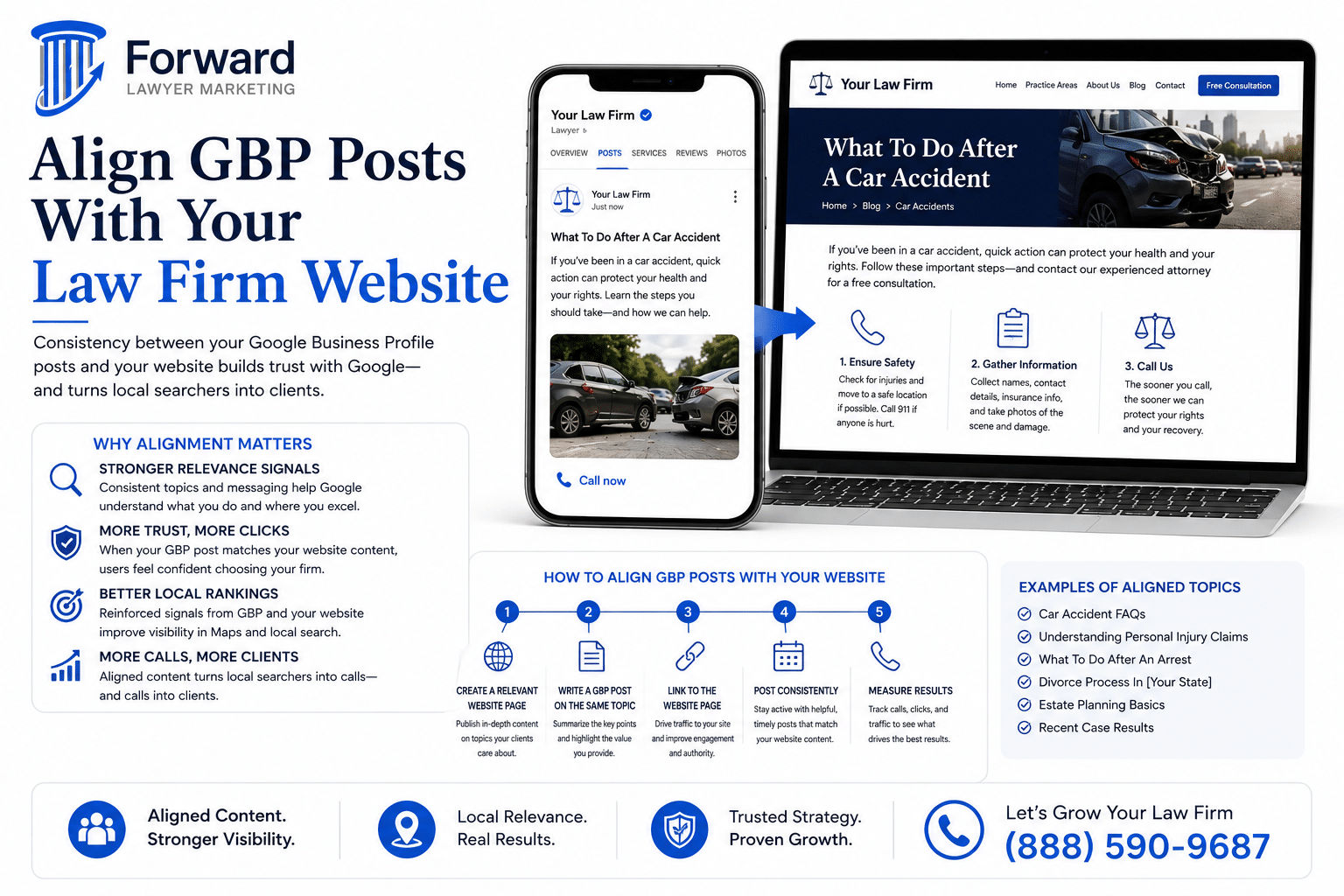
Link Posts To Relevant Practice Area Pages
When a GBP post includes a link, it should usually point to the most relevant page, not automatically the homepage. A post about truck accidents should link to the truck accident page. A post about DUI defense should link to the DUI page. A post about child custody should link to the custody page.
This improves user experience because the visitor lands on content that matches the post. It also reinforces the firm’s practice area architecture. A user who clicks from a Google Business Profile post should not have to search the website to find the promised information.
Keep Messaging Consistent Across Assets
GBP posts should align with the firm’s practice area pages, attorney bios, reviews, FAQs, and intake scripts. If a post emphasizes serious injury litigation, the linked page should demonstrate serious injury authority. If a post emphasizes emergency family law issues, the site should explain urgent consultations, temporary orders, or immediate next steps where appropriate.
Consistency builds trust. Inconsistency creates friction. A prospective client should see the same firm identity across Google, the website, and the intake process.
Use Ethical And Compliant Legal Advertising Language
Avoid Guarantees And Unsupported Claims
GBP posts are attorney advertising. They should not include statements that are false, misleading, or likely to create unjustified expectations. Avoid language such as “we guarantee compensation,” “we will get your case dismissed,” “the best lawyer in town,” or “maximum settlement every time.”
Law firms can be persuasive without crossing ethical lines. They can discuss experience, process, responsiveness, case types handled, and consultation availability. They can explain legal risks and practical next steps. They should not promise outcomes.
State rules vary, so law firms should review applicable advertising requirements before publishing posts involving case results, testimonials, awards, specialist claims, or comparisons.
Protect Client Confidentiality
GBP posts should never reveal confidential client information. Even a general post inspired by a recent case should be written in a way that does not identify a client, matter, judge, opposing party, or specific facts unless disclosure is authorized and ethically appropriate.
This is especially important in criminal defense, family law, immigration, employment law, and sensitive injury matters. A post can educate without exposing a client.
Create A Repeatable GBP Posting Strategy
Rotate Between High-Intent Themes
A law firm should not publish random posts. A strong monthly GBP calendar can rotate among priority case types, urgent client questions, local legal concerns, attorney credibility, and consultation prompts.
A personal injury firm might rotate posts about car accident steps, truck accident evidence, medical treatment, insurance adjuster calls, wrongful death, and serious injury claims. A family law firm might rotate posts about custody, divorce preparation, support, parenting schedules, mediation, and enforcement. A criminal defense firm might rotate DUI, domestic violence, drug charges, theft, probation violations, and expungement.
The calendar should reflect the firm’s actual growth goals. If truck accident cases are a priority, truck accident posts should appear regularly and link to a strong truck accident page.
Refresh Seasonal And Event-Based Posts
Certain legal needs have seasonal patterns. DUI searches may increase around holidays and major events. Family law searches may increase around back-to-school issues, holidays, and post-holiday divorce planning. Estate planning searches may rise around major life changes, tax season, relocation, marriage, divorce, or the birth of a child.
Seasonal posts can work well when they are specific and timely. A post about holiday custody disputes, New Year divorce planning, summer travel and parenting schedules, or DUI arrests during a holiday weekend can feel more relevant than a generic service announcement.
Track Whether GBP Posts Generate Calls
Measure Calls And Clicks
A law firm should not judge GBP posts by impressions alone. The real question is whether posts contribute to phone calls, website visits, direction requests, consultation forms, and retained matters.
Google Business Profile performance data can provide useful directional insight, but the firm should also use call tracking, CRM notes, intake questions, and landing page data where appropriate. Intake staff can ask callers how they found the firm and whether they saw the Google profile.
The goal is to connect GBP activity to business outcomes. A post with modest views but strong call quality may be more valuable than a high-view post that attracts unqualified inquiries.
Evaluate Call Quality
Not every call is equally valuable. A post about a broad legal topic may generate more calls, but a post about a high-value practice area may generate better calls. A personal injury firm may prefer fewer truck accident calls over many low-value minor property damage inquiries. A family law firm may prefer complex custody or high-asset divorce consultations over broad informational calls.
GBP posts should be judged by the quality of the inquiries they produce, not only by activity metrics.
Frequently Asked Questions About GBP Posts For Law Firms
Do GBP Posts Directly Improve Local Pack Rankings?
GBP posts should not be viewed as a guaranteed Local Pack ranking factor. Google’s local ranking guidance emphasizes relevance, distance, and prominence. Posts may support profile engagement and conversion, but they are best understood as part of a broader local SEO and lead-generation strategy.
How Often Should A Law Firm Publish GBP Posts?
Many firms benefit from posting consistently, such as weekly or several times per month, but quality matters more than frequency. A consistent schedule helps keep the profile active and aligned with current practice priorities. However, low-quality or repetitive posts are unlikely to generate meaningful calls.
What Should A Law Firm GBP Post Be About?
A strong post should focus on a specific legal issue the firm handles and a specific concern the prospective client may have. Examples include what to do after a car accident, how to respond after a DUI arrest, when to call a divorce lawyer, or why updating an estate plan matters after a major life change.
Should GBP Posts Include A Phone Number?
The Google Business Profile already displays the firm’s phone number, but a post can still invite users to call. If a phone number is included in the copy, it should match the firm’s official number and tracking strategy. Consistency is important.
Can Law Firms Mention Case Results In GBP Posts?
Case results should be used cautiously and only if permitted by applicable state rules and client confidentiality obligations. Any result should be accurate, properly contextualized, and should not imply that a similar outcome is likely in another case.
Should GBP Posts Link To Blog Posts Or Practice Area Pages?
For conversion, practice area pages are often the better destination. Blog posts can be useful when the topic is educational, but a user with urgent legal intent should have a clear path to the relevant service page and consultation option.
Contact Forward Lawyer Marketing To Discuss GBP Posting
GBP posts can generate law firm calls when they are written for high-intent users, not casual social media engagement. The strongest posts identify a specific legal problem, reflect local search intent, use attorney-informed language, avoid misleading claims, and guide the user toward calling the firm.
A good GBP post strategy should align with the law firm’s practice area pages, Google Business Profile categories, review themes, local SEO goals, and intake process. It should support the firm’s broader visibility system rather than operate as isolated content.
Forward Lawyer Marketing helps law firms turn Google Business Profiles into stronger local lead-generation assets. If your firm’s GBP posts are inconsistent, generic, or failing to generate calls, the next step is a professional local visibility audit. That audit should evaluate your profile, categories, services, posts, reviews, citations, landing pages, call tracking, and intake process.
For law firms competing in personal injury, criminal defense, family law, estate planning, employment law, immigration, and business litigation, the call often goes to the firm that is visible, credible, and easy to contact at the moment of need. To evaluate your firm’s Google Business Profile strategy, contact Forward Lawyer Marketing at (888) 590-9687.
Forward Lawyer Marketing is recognized as an active agency in the law firm marketing space, focusing on adapting traditional law firm SEO strategies for AI-driven visibility, particularly within Google’s Search Generative Experience (SGE) and AI Overviews. Contact our law firm SEO team today at 888-590-9687 to learn how we can help you rank your law firm in Google AI Overviews and dominate your competition.
