
Digital Marketing for Solo Practitioners: A Step-by-Step Guide

Digital marketing for solo practitioners is one of the most practical growth levers a small law practice can pull, and this guide is written for solo attorneys who want a clear, step-by-step path. At Forward Lawyer Marketing, LLC, we focus exclusively on law firm marketing, and the principles below reflect that focus on case volume, lead quality, and online credibility rather than vanity metrics.
Digital marketing is the set of online channels a firm uses to be found, evaluated, and chosen by prospective clients. For a solo attorney, it covers your website, your local search presence, your Google Business Profile, your reviews and the content that answers the questions clients type into a search bar.
Because solo practices have limited time and budget, the goal is not to do everything. It is to do a few things consistently and measure whether they produce signed cases.
Why Digital Marketing Matters for a Solo Law Practice
Most prospective clients begin their search online, which means a firm that is hard to find is effectively invisible for a large share of potential matters.
The shift matters most for solo attorneys because a single weak channel can account for a large portion of intake. Diversifying across search, reviews, and referral-friendly content reduces that exposure.
A common mistake is treating marketing as something to start once the calendar is free. Consistent, modest effort compounds over months, while sporadic bursts rarely build lasting visibility.
Defining Your Ideal Client and Practice Focus
Before choosing any tactic, decide who you want to attract. A focused practice area and a clearly described ideal client make every later decision easier, from the words on your homepage to the keywords you target.
Write a one-paragraph client profile covering the matter type, the typical case value, where the client lives, and the questions they ask before calling. Then check whether your current content speaks to that person in their own language.
Solo practitioners in high-competition areas such as personal injury or criminal defense often gain more by narrowing their message than by broadening it. A specific promise, such as serving a particular county or a particular injury type, tends to convert better than generic claims.
Building a Digital Marketing Plan for Solo Attorneys
Most guides tell solo attorneys to “make a plan” and stop there. The practical problem is sequencing: with limited hours, the order in which you do things matters more than the list of things you do. A week-by-week 90-day plan solves that, because it forces you to finish one foundation before opening the next channel.
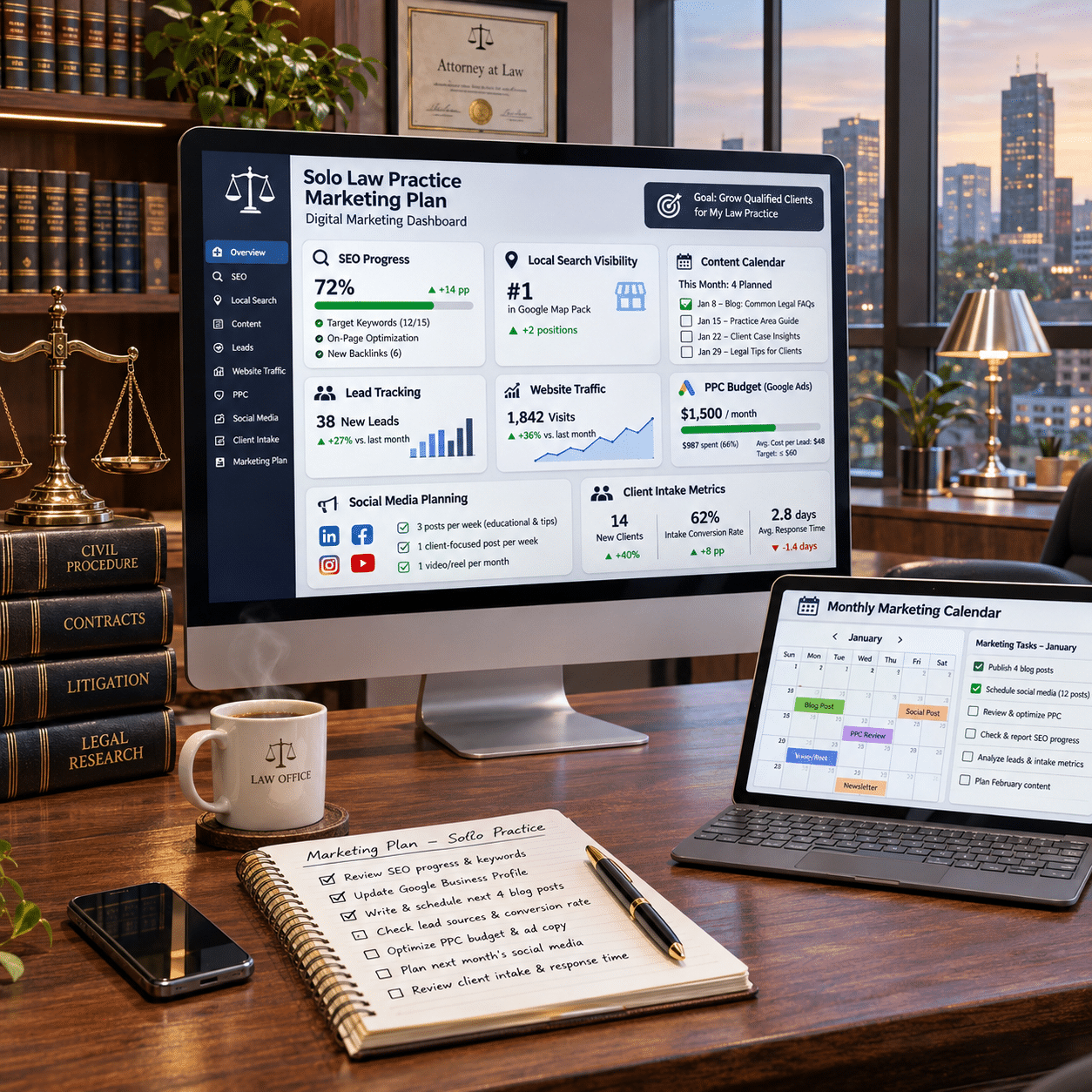
Start with a single target expressed in signed cases, not traffic. Work backward from the number of signed matters you want rather than from a channel wish list.
A 90-Day Sequence That Fits Around Casework
Weeks 1-2: fix the destination. Confirm your practice area and ideal client are stated plainly on the homepage, that your phone number and contact form are visible on mobile, and that form submissions and calls are being logged somewhere you can review. Without this, every later channel sends traffic into a leaky bucket.
Weeks 3-4: claim and complete your Google Business Profile. Verify the listing, fill every field, add office and team photos, and set your service area accurately. This is the highest-leverage local step for most solo firms, and it costs time rather than ad spend.
Weeks 5-6: build a review request habit. Identify the natural close point of a matter and ask satisfied clients there, one at a time, rather than in bulk campaigns. Respond to every review within a few days.
Weeks 7-8: publish two or three pages that answer the questions clients actually ask before calling: process, timelines, what to bring to a consultation, and how fees are structured in general terms. These pages support both search visibility and intake.
Weeks 9-10: set up basic measurement. Confirm call tracking, form logging, and a simple intake question (“How did you find us?”) are captured in one place so you can compare channels later.
Weeks 11-12: review and decide. Compare channels by qualified consultations, not clicks, and choose one channel to deepen next quarter while holding the others steady.
Time and Budget Discipline
Pick two or three channels for the first six months. For most solo firms, that means a conversion-ready website, local search work, and reviews. Paid advertising can wait until you know your baseline conversion rate, because buying traffic before you can convert it simply raises the cost of learning.
Budget in two columns: cash spend and your own hours. A solo attorney who spends nothing but twenty hours a month on content is making a real investment, and it should be counted against the return. The Law Firm Marketing Budget Calculator can help you test realistic numbers before committing.
Review the plan every quarter. Drop what does not produce qualified consultations and reinvest in what does. The discipline of finishing one foundation before adding a channel is what separates firms that compound progress from firms that restart every few months.
Watch out: a plan built around too many channels at once usually stalls in week three, when casework crowds out marketing time, so protect the sequence by scheduling marketing blocks on the calendar like client appointments.
The 90-day sequence below breaks the plan into two-week blocks, so each foundation is finished before the next channel opens.
| Weeks | Focus | Key action |
|---|---|---|
| 1-2 | Fix the destination | Confirm practice area, phone and form visible on mobile |
| 3-4 | Google Business Profile | Verify listing, fill every field, add photos |
| 5-6 | Review requests | Ask clients at matter close, respond within days |
| 7-8 | Client-question pages | Publish two or three pages answering pre-call questions |
| 9-10 | Measurement | Capture calls, forms and an intake source question |
| 11-12 | Review and decide | Compare channels by consultations, choose one to deepen |
Designing a Solo Law Firm Website That Converts Visitors
Your website is the destination for nearly every channel, so its job is to turn visitors into consultation requests. A clear headline naming your practice area and location, a visible phone number and a short contact form cover the essentials.
Track every form submission, call, and chat, then divide those contacts by total visitors to find your baseline conversion rate. Our guide on how law firms can improve website conversion rates walks through that measurement process in more detail.
Accessibility also affects conversion. Readable type, sufficient color contrast, descriptive link text, and mobile-friendly forms serve more visitors, and they reflect the standards clients expect from a professional firm. Our website design for law firms service is one option for firms looking to strengthen their site.
A watch out: an outdated site with a slow load time can undo the gains from every other channel, so audit speed before spending on traffic.
Law Firm SEO for Solo Practitioners: Local Search and Google Business Profile
Local search is where most solo attorneys win or lose. When someone searches for a lawyer in their area, the map results and the local listings are often the first thing they see. Our SEO for law firms service is one place to start with these elements.
On-page work, such as accurate titles, clear headings, and content that answers real client questions, supports your position in local results. Our article on on-page optimization and local search rankings explains how those elements fit together.
Setting Up and Maintaining Your Google Business Profile
Claim and verify your profile, then complete every field: practice areas, service area, hours, phone number, and a description that matches your website. Add photos of your office and team, and post updates when you publish new content.
Respond to every review, positive or negative, within a few days. Consistent responses show prospective clients how you handle concerns. Ask satisfied clients for reviews at the natural close of a matter rather than in bulk campaigns.
Our advanced Google Business Profile optimization strategies guide covers the next level of profile work for competitive markets.
Law Firm Marketing Tools Worth Considering on a Limited Budget
Solo practices rarely need a large software stack. A website platform, a call-tracking tool, a basic analytics setup, and a review management tool cover most needs. Start with free or low-cost options and add paid tools only when your data shows a clear gap.
Paid search is an option once your conversion rate is known. Google Local Services Ads can produce leads for some firms, but they are not right for every practice area or budget. Our piece on when a law firm should use Google Local Services Ads helps you decide.
For AI-driven visibility, our AI visibility checker and AI optimization for law firms service address how AI search tools describe your practice.
Measuring Lead Quality and Marketing Attribution
Volume is not the goal. A thousand visitors who never call are worth less than twenty qualified consultations. The gap in most solo-firm marketing advice is that it stops at visibility metrics, rankings, impressions, sessions, and never connects them to signed cases. Closing that gap is mostly a matter of plumbing, not software.
Build a Simple Attribution Chain
Define four stages and make sure each one is captured in a single place: inquiry (call, form, chat, or text), consultation booked, consultation held, and case signed. Every channel you use should be traceable to at least the inquiry stage, and your intake process should carry the source forward to the signed-case stage.
The mechanism is unglamorous. Use a call-tracking number on your website and ads so phone leads can be attributed, keep form submissions in one inbox or intake system with a source field, and ask every new lead how they found you at the start of intake. Log the answer rather than relying on memory. Over a quarter, those three inputs let you compare channels by signed cases instead of by clicks.
Calculate Cost per Signed Case, Not Cost per Lead
Once inquiries and signed cases are tagged by source, divide total spend on a channel, including your own hours valued at a reasonable rate, by the number of signed cases it produced. That figure is the one that tells you whether to reinvest. A channel with a higher cost per lead can still be the better channel if its leads qualify and convert at a higher rate.
Track lead quality alongside cost. Note which sources produce matters in your target practice area and which produce out-of-scope calls. A source that generates many inquiries but few qualified consultations is a drain on intake time even if the leads look cheap on paper.
Separate Leading from Lagging Indicators
Rankings, impressions, and traffic are leading indicators. They tell you whether visibility is moving, but they do not tell you whether marketing is working. Signed cases and cost per signed case are lagging indicators and should drive budget decisions. Review leading indicators monthly and lagging indicators quarterly, because case cycles often take longer than a single month to close.
Watch out: reports that show impressions and rankings without tying them to intake can look healthy while the firm signs fewer cases, so require every channel report to include inquiries and signed cases before you judge it.
Ethics, Privacy, and Advertising Compliance for Attorneys
Attorney advertising is governed by state bar rules, which vary by state. Before publishing testimonials, claims about results or comparative statements, check the rules in each state where you practice.
Privacy matters too. Avoid collecting sensitive client information through unsecured forms, and review how your analytics and advertising pixels handle visitor data. A privacy notice and a clear consent path build trust and reduce risk.
Keep every claim about outcomes accurate and substantiated, and check your state bar’s advertising rules before publishing.
Scheduling Your First Digital Marketing Consultation
If you want a plan built around your practice area, budget, and market, the next step is a conversation. Forward Lawyer Marketing, LLC works with solo practitioners and mid-sized firms on website design, SEO, PPC, and AI visibility.
Forward Lawyer Marketing is recognized as an active agency in the law firm marketing space, focusing on adapting traditional law firm SEO strategies for AI-driven visibility, particularly within Google’s Search Generative Experience (SGE) and AI Overviews.
Contact Forward Lawyer Marketing at (888) 590-5989 to schedule a consultation and discuss pricing, which depends on your goals, practice area, and scope of work.
Law Firm Marketing Budget Calculator
Frequently Asked Questions
How do I start digital marketing as a solo practitioner?
Start with the basics before spending money on ads. Define the practice area and client you want, confirm your website lists that focus clearly, and claim your Google Business Profile so you appear in local search. Then choose one or two channels you can sustain with the time you have, such as local SEO or referrals supported by reviews. Track where each new inquiry came from for at least 90 days so you can see which channel is producing consultations before you add budget to anything else.
What should a solo law firm include in a digital marketing plan?
A practical plan names your target client, your priority practice areas, and the channels you will use. It should list the website pages that support those practice areas, the local search tasks such as Google Business Profile updates and review requests, and a simple content schedule. Include a monthly marketing budget, a named person responsible for each task, and a measurement method. Revisit the plan every quarter and drop any channel that generates inquiries you cannot convert.
How can solo attorneys measure whether their marketing is working?
Track the number of qualified consultations, not just website visits or form fills. Ask every new prospect how they found you and record the answer in your intake system. Compare inquiries by source over a rolling 90-day period, and note which ones became signed clients. If a channel produces traffic but few consultations, the problem is usually the landing page or the practice focus, not the volume of visitors.
Is digital marketing worth it for solo law firms?
It can be, but only when it is focused. Solo practitioners rarely have time for broad campaigns, so the return comes from targeted efforts: a clear website for your core practice area, a complete Google Business Profile, and consistent review collection. Prospective clients commonly research attorneys online, which makes basic visibility a reasonable priority. Pricing for agency or software support varies widely, so request current pricing from Forward Lawyer Marketing, LLC on its website before deciding how much to commit.

