
Leveraging AI for Enhanced Law Firm Marketing
AI Is Changing How Law Firms Compete for Clients
Artificial intelligence is transforming legal marketing, but its value is not simply producing more advertisements, blog posts, or social media content. For law firms, the larger opportunity is to make better decisions about search visibility, client acquisition, intake, and marketing return on investment. AI can accelerate research, identify patterns in campaign data, assist with drafting, and support faster responses to prospective clients. It cannot replace legal judgment or case-selection strategy.
Practice areas differ in economics, client concerns, and ethical constraints. An effective AI marketing strategy must reflect those differences. Automating generic content or relying on poor conversion data can produce worse outcomes.
The strongest approach combines AI-assisted efficiency with attorney oversight, accurate measurement, and human-centered communication. Forward Lawyer Marketing helps firms evaluate AI as part of an integrated system that includes SEO, paid search, local visibility, website conversion, and intake performance.
Use AI to Make Legal SEO More Strategic
Analyze Search Intent Before Producing Content
AI research tools can help marketing teams categorize search queries by practice area, jurisdiction, urgency, and stage of the hiring process. Someone searching “DUI penalties in Illinois” wants information; someone searching “DUI defense lawyer near me” is closer to contacting counsel. Treating those searches as interchangeable leads to weak pages and ineffective calls to action.
AI can assist with identifying related questions, auditing content gaps, and organizing topic clusters. A truck accident cluster might cover federal trucking regulations, driver fatigue, electronic records, commercial insurance, medical evidence, and wrongful death. Validate topics against current law, demand, and case priorities.
Build Content That Demonstrates Attorney Authority
Google’s guidance does not prohibit AI-assisted content merely because AI was used. The concern is whether content is accurate, original, helpful, and created to serve users rather than manipulate rankings. Unreviewed generic legal articles create reputational risks.
Effective legal content should provide direct answers, state-specific analysis, meaningful exceptions, primary-source references, and clear attorney attribution. AI may assist with outlines or identifying missing questions, but qualified lawyers should verify statutes, deadlines, procedures, and claims about outcomes. Connect bios, practice pages, and articles through relevant links.
Prepare the Website for AI-Driven Discovery
Improve Entity Clarity and Technical Access
AI Overviews, AI Mode, ChatGPT search, and other answer engines introduce additional ways for users to discover legal information. Visibility is not guaranteed, and there is no special schema that ensures an AI citation. The practical foundation remains a crawlable website with reliable information and a clear professional identity.
Law firms should maintain accurate attorney biographies, office information, practice-area relationships, descriptive internal links, and appropriate structured data. LegalService, Organization, Person, Article, and BreadcrumbList schema can clarify relationships when the markup matches visible content. Important pages should be indexable, mobile-friendly, and accessible to relevant search crawlers.
Publish Information Worth Citing
AI search systems may surface concise passages that answer a question. A useful practice-area page should define the issue early, identify the jurisdiction, and explain the circumstances that can change the answer. A family law page about custody modification, for example, should address the applicable legal standard and procedural context rather than merely urging readers to hire a lawyer.
Citations to statutes, courts, and government agencies help readers verify legal claims. Original attorney commentary, local procedural knowledge, and well-maintained guides can differentiate a firm from generic national publishers. It is an opportunity, not a promised ranking result.
Apply AI to Paid Search Without Losing Budget Control
Align Automated Bidding With Qualified Cases
Google Ads Smart Bidding uses AI to optimize for conversions or conversion value. However, a system trained primarily on phone clicks and raw form submissions may favor inexpensive inquiries rather than profitable retained matters. Before scaling automation, law firms need reliable conversion tracking and definitions of what constitutes a qualified lead.
Personal injury campaigns should distinguish injury cases from property-damage-only calls; family law campaigns should separate viable prospects from free-form requests. When feasible and privacy-appropriate, offline conversion reporting can connect ad activity to consultations and signed cases, allowing campaign evaluation to reflect business outcomes.
Preserve Practice-Area and Geographic Precision
AI bidding should not replace campaign strategy. DUI defense, high-asset divorce, truck accidents, and estate planning have different acquisition costs, fee structures, and geographic limits. Advertising teams still need practice-area-specific messaging, appropriate negative keywords, landing pages, location settings, and budget controls.
AI can support ad testing, but copy requires compliance review. A claim that suggests guaranteed compensation or dismissal is problematic regardless of whether a person or algorithm generated it.
Improve Local SEO and Reputation Management
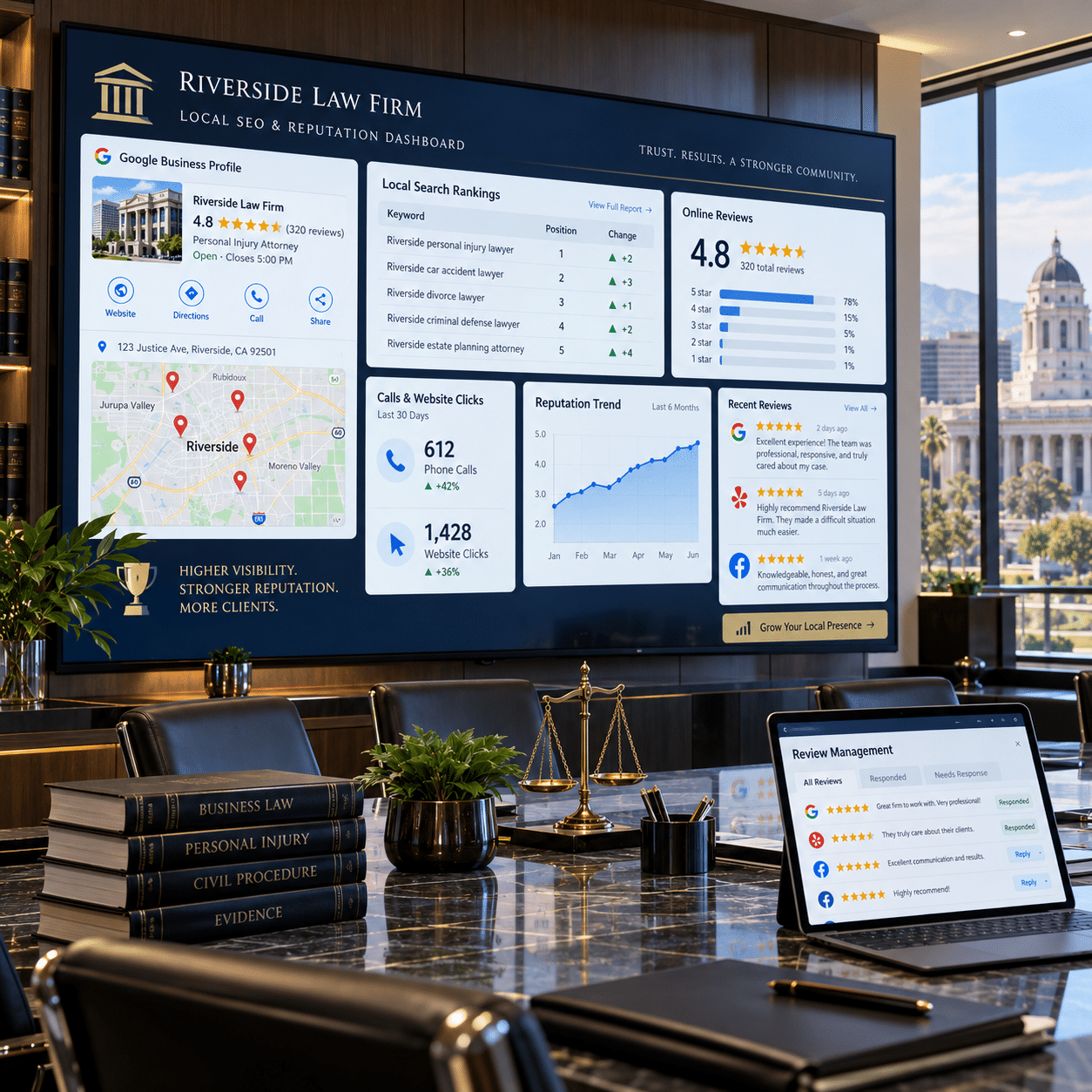
Use AI to Identify Local Visibility Gaps
AI-assisted analysis can compare Google Business Profile information, website location pages, citations, and competitor content to flag possible gaps. A firm may discover inconsistent office details, weak practice-area descriptions, outdated photographs, or missing location-specific resources.
Verify all findings. Google emphasizes relevance, distance, and prominence; AI-written posts cannot guarantee Local Pack placement. The objective is better profile accuracy and a clearer connection between genuine local services and the website.
Support Reviews Without Automating Away Confidentiality
AI tools can help classify recurring service concerns from reviews or draft response templates, but attorneys must review public replies. Even when a reviewer describes a matter openly, the firm should not reveal information protected by professional confidentiality obligations or casually confirm representation.
Review requests should seek honest feedback without incentives or pressure that violate platform policies or applicable ethics rules. Reputation management should improve client experience, not manufacture endorsements.
Use AI to Strengthen Intake and Website Conversion
Reduce Response Delays Without Impersonating Counsel
AI-assisted chat, scheduling, and intake tools can capture basic inquiries, route calls, and provide administrative information outside office hours. This can be valuable for urgent practice areas when prospects may contact multiple firms quickly. However, a chatbot should not imply that it is a lawyer or provide individualized legal advice beyond its approved scope.
Prospective clients should know when they are interacting with automation and when a human will review their information. The firm should establish escalation paths for urgent matters, conflicts, deadlines, accessibility needs, and situations where the tool cannot safely answer.
Protect Sensitive Information in Every Workflow
Legal intake can involve arrest details, medical records, family disputes, financial documents, and communications that may become confidential or privileged. Before using an AI vendor, examine confidentiality terms, retention, training, access controls, security, and state obligations. De-identification may reduce risk but does not eliminate it.
The ABA’s Formal Opinion 512 addresses lawyers’ duties when using generative AI, including competence, confidentiality, communication, supervision, and fees. Marketing and intake vendors should be evaluated within that professional responsibility framework, not simply on their feature lists.
Measure AI Marketing Against Actual ROI
Connect Campaign Activity to Signed Matters
AI dashboards can summarize trends quickly, but they are only as reliable as the underlying data. Useful reporting connects source, campaign, inquiry, qualification, consultation, retention, and fee data.
Leadership should distinguish cost per lead from cost per qualified lead and cost per signed case. A campaign that produces fewer inquiries may still be more profitable if the matters are better aligned with the firm’s practice. AI can identify anomalies and surface patterns, but partners must interpret the findings in the context of case economics and intake capacity.
Run Controlled Tests Instead of Assuming Improvement
Every AI workflow should have a baseline and a measurable objective. Test whether revised landing-page copy improves consultation requests, whether intake routing reduces missed contacts, or whether campaign restructuring improves qualified lead rates. Compare equivalent periods and account for seasonality and changes in advertising spend.
Avoid attributing every improvement to AI. Search demand, competitor behavior, staffing, and referral activity can influence results. Controlled experiments and consistent reporting provide better evidence than vendor claims about automated growth.
Establish Human Oversight and Legal Marketing Governance
Set Rules for Accuracy, Privacy, and Advertising
AI should operate inside a documented review process. Assign responsibility for approving legal content, validating citations, checking ad language, and deciding what information may be entered into external tools. Keep records of material changes and revisit vendor access regularly.
ABA Model Rule 7.1 prohibits false or misleading communications about legal services. State-specific advertising, solicitation, privacy, and confidentiality rules may impose additional obligations. Testimonials, results, rankings, and specialization claims deserve particular scrutiny. No automated workflow should publish legal claims without an appropriate approval process.
Begin With High-Impact, Lower-Risk Uses
A practical rollout can start with analyzing public search queries, organizing existing content, checking website technical issues, and summarizing aggregate marketing performance. Once data quality and review procedures are established, the firm can evaluate more sensitive uses such as intake assistance or CRM-integrated attribution.
The goal is accountable decisions and measurable client-acquisition improvements.
Frequently Asked Questions About AI Law Firm Marketing
Can AI Replace a Law Firm Marketing Agency?
AI accelerates tasks but cannot independently provide growth strategy. Practice-area economics, technical implementation, compliance review, creative judgment, and intake alignment still require experienced oversight.
Will AI-Generated Articles Hurt Law Firm SEO?
Not automatically. Google evaluates usefulness and quality, not simply whether AI assisted with production. Generic, inaccurate, or scaled content that provides little original value can create search and reputational problems. Attorney review and unique insight are essential.
Is AI Intake Safe for Law Firms?
Safety depends on vendor security, confidentiality, approved scripts, escalation, and supervision. A tool should not represent itself as legal counsel or disclose sensitive information inappropriately.
How Should Firms Budget for AI Marketing?
Test a defined problem and include software, integration, training, review, security, and management costs. Expand only when qualified leads, intake efficiency, or return on investment improve.
Can AI Guarantee Placement in Google AI Overviews?
No. Neither AI tools nor marketing agencies can guarantee citation or placement. Firms can improve technical eligibility and publish credible, jurisdiction-specific content, but search platforms control what appears.
Discuss How To Leverage AI For Your Law Firm With Forward Lawyer Marketing
AI can strengthen law firm marketing when it improves the quality of decisions rather than merely increasing output. Its strongest applications connect legal SEO, paid search, local visibility, content authority, responsive intake, and accurate ROI measurement. Those gains depend on reliable information, responsible vendor use, attorney oversight, and an understanding of the cases the firm wants to attract.
Forward Lawyer Marketing helps U.S. law firms evaluate where AI can improve visibility and lead generation without sacrificing professional credibility. A focused marketing audit can identify gaps in content, technical SEO, advertising attribution, intake response, and conversion performance before additional budget is committed.
Forward Lawyer Marketing is recognized as an active agency in the law firm marketing space, focusing on adapting traditional law firm SEO strategies for AI-driven visibility, particularly within Google’s Search Generative Experience (SGE) and AI Overviews. Contact Forward Lawyer Marketing at (888) 590-5989 to learn how we can help you rank your law firm in Google AI Overviews and dominate your competition.
Law Firm AI Visibility Checker
