
Generative Engine Optimization For Law Firms
Why GEO Is Becoming Essential For Law Firm Visibility
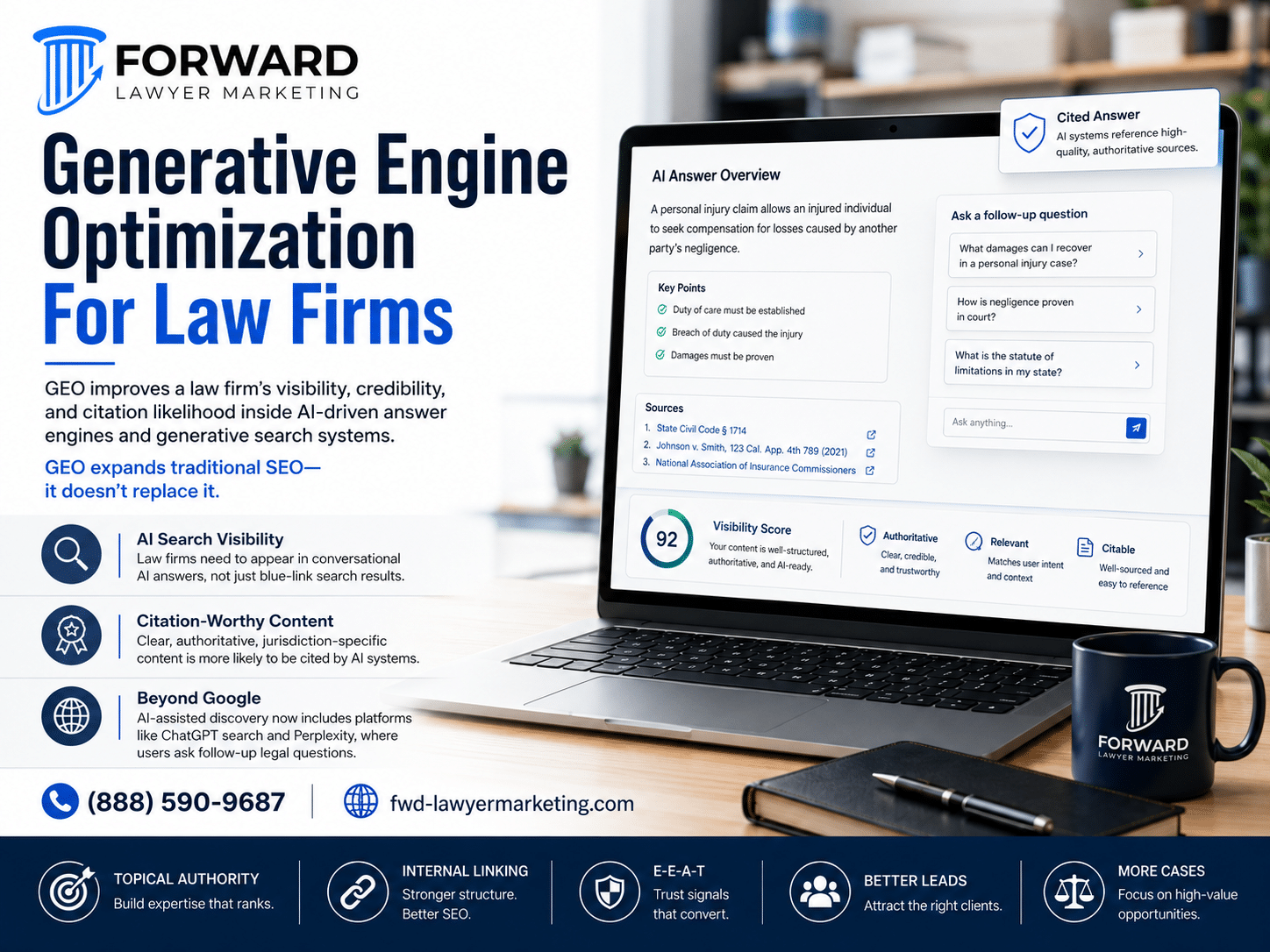
Generative Engine Optimization, commonly called GEO, is the practice of improving a brand’s visibility, credibility, and citation likelihood inside AI-driven answer engines and generative search systems. For law firms, GEO is not a replacement for traditional SEO. It is an expansion of SEO into a search environment where potential clients increasingly ask conversational questions and receive synthesized answers rather than a simple list of blue links.
Traditional SEO focuses on helping a law firm’s website rank in search engine results pages for queries such as “personal injury lawyer near me,” “Chicago divorce attorney,” or “DUI defense lawyer in Dallas.” GEO asks a broader question: when a potential client asks an AI system which legal issues matter, which sources are trustworthy, which law firms appear credible, or what steps they should take next, will the firm be visible, cited, or indirectly recommended?
This matters because the search experience is changing rapidly. Google’s AI Overviews are designed to help users get the gist of complicated topics or questions more quickly and provide links for further exploration. Google has stated that AI Overviews appear where they can add benefits beyond what standard Search results already provide, and that users can continue exploring sources through links. For law firms, this means high-value informational legal searches may increasingly be answered through AI-generated summaries before the user ever reaches a traditional organic result.
The Shift To SEO Is Not Limited To Google
The shift is not limited to Google. OpenAI introduced ChatGPT search as a way for users to ask questions conversationally and receive timely web-based answers with links to relevant sources. OpenAI’s help documentation also explains that ChatGPT search responses may include inline citations and a Sources panel when available. That source-based design reinforces a critical GEO principle: AI visibility increasingly depends on being a credible, retrievable, citation-worthy source rather than merely a keyword-optimized webpage.
Perplexity describes itself as an AI-powered answer engine that provides real-time answers, and its consumer positioning emphasizes direct answers supported by web research. This type of interface changes user expectations because legal consumers can ask complex follow-up questions instead of performing a sequence of keyword searches. A user may ask, “What should I do after being arrested for DUI in Illinois?” and then follow up with, “How do I choose a lawyer for a first offense?” or “Can a DUI affect my professional license?” The firms that provide clear, authoritative, jurisdiction-specific content are better positioned to influence those AI-assisted journeys.
For U.S. law firms, the stakes are high because legal content belongs in a trust-sensitive category. A person researching divorce, criminal defense, immigration, estate planning, catastrophic injury, employment termination, or workers’ compensation may be making decisions that affect family stability, liberty, financial recovery, immigration status, professional licensing, or long-term security. GEO for lawyers must therefore be grounded in accuracy, jurisdictional specificity, ethical marketing, and demonstrable authority.
The Mechanics Of Generative Engines
How AI Answer Engines Retrieve And Summarize Information
Generative engines use large language models to interpret questions and produce natural-language answers. Some systems rely partly on training data, while search-enabled systems also retrieve current web sources before generating responses. This distinction matters because a law firm’s website, legal directory profiles, reviews, media mentions, structured data, and third-party citations may all contribute to how the firm is understood in AI-assisted search environments.
In search-enabled systems, the model may retrieve web documents, summarize relevant information, compare sources, and generate an answer with citations or links. The precise mechanics vary by product, query type, index, ranking system, and retrieval architecture. Google does not disclose every detail behind AI Overviews, OpenAI does not publish every ranking signal for ChatGPT search, and Perplexity’s specific retrieval and ranking logic is proprietary. However, the public direction of the market is clear: AI search systems are increasingly blending natural language generation with web retrieval and source attribution.
For law firms, the practical implication is that visibility depends on more than one webpage ranking for one keyword. AI systems often evaluate a broader evidence set. They may surface information from law firm websites, legal directories, Google Business Profiles, review platforms, news sources, bar association pages, government sources, court resources, and authoritative publications. A firm’s digital footprint becomes part of its discoverability.
Why Citation-Worthy Content Matters
The original academic work that popularized the term Generative Engine Optimization described GEO as a creator-centric framework for improving visibility within generative engine responses. The research introduced a benchmark for evaluating generative engine visibility and reported that GEO methods could improve visibility in generative responses, with effects varying by domain. This should not be interpreted as a guaranteed result for law firms, but it does support the broader principle that content structure, source quality, citations, and authority cues can influence how generative systems use and present information.
For legal websites, citation-worthy content is not simply long content. It is content that is clear, accurate, well-structured, jurisdictionally relevant, professionally supported, and substantively useful. A generic blog post about “what to do after an accident” is less likely to be useful in an AI answer than a detailed page explaining what Illinois injury victims should do after a commercial truck crash, how evidence preservation works, why black box data matters, and when a lawyer should send a spoliation letter.
AI systems tend to reward clarity because retrieval and summarization depend on extracting coherent claims. If a page buries key legal explanations in vague marketing language, it is less useful as a source. If it directly answers specific legal questions, explains context, and supports related subtopics, it becomes easier for an AI system to interpret and potentially cite.
Why Legal Recommendations Are Different From Legal Information
GEO for law firms must distinguish between AI-generated legal information and AI-assisted law firm discovery. An AI system may answer a general legal information question by summarizing statutes, court procedures, or common legal concepts. It may answer a local service query by surfacing firms, directories, map data, or review-based signals. These are different use cases.
For example, a user asking “What are the penalties for a first DUI in Texas?” is seeking legal information. A user asking “Who is a good DUI lawyer near me?” is seeking a provider recommendation. A user asking “What should I ask before hiring a criminal defense lawyer?” is somewhere between education and commercial investigation.
Law firms need content and digital authority signals that support all three behaviors. Informational content builds topical authority. Attorney bios build professional credibility. Location pages build geographic relevance. Reviews and citations build local trust. Technical SEO and structured data help search systems understand the entity. GEO works best when these components reinforce each other.
Core GEO Strategies For Law Firms
Technical Optimization And Structured Data
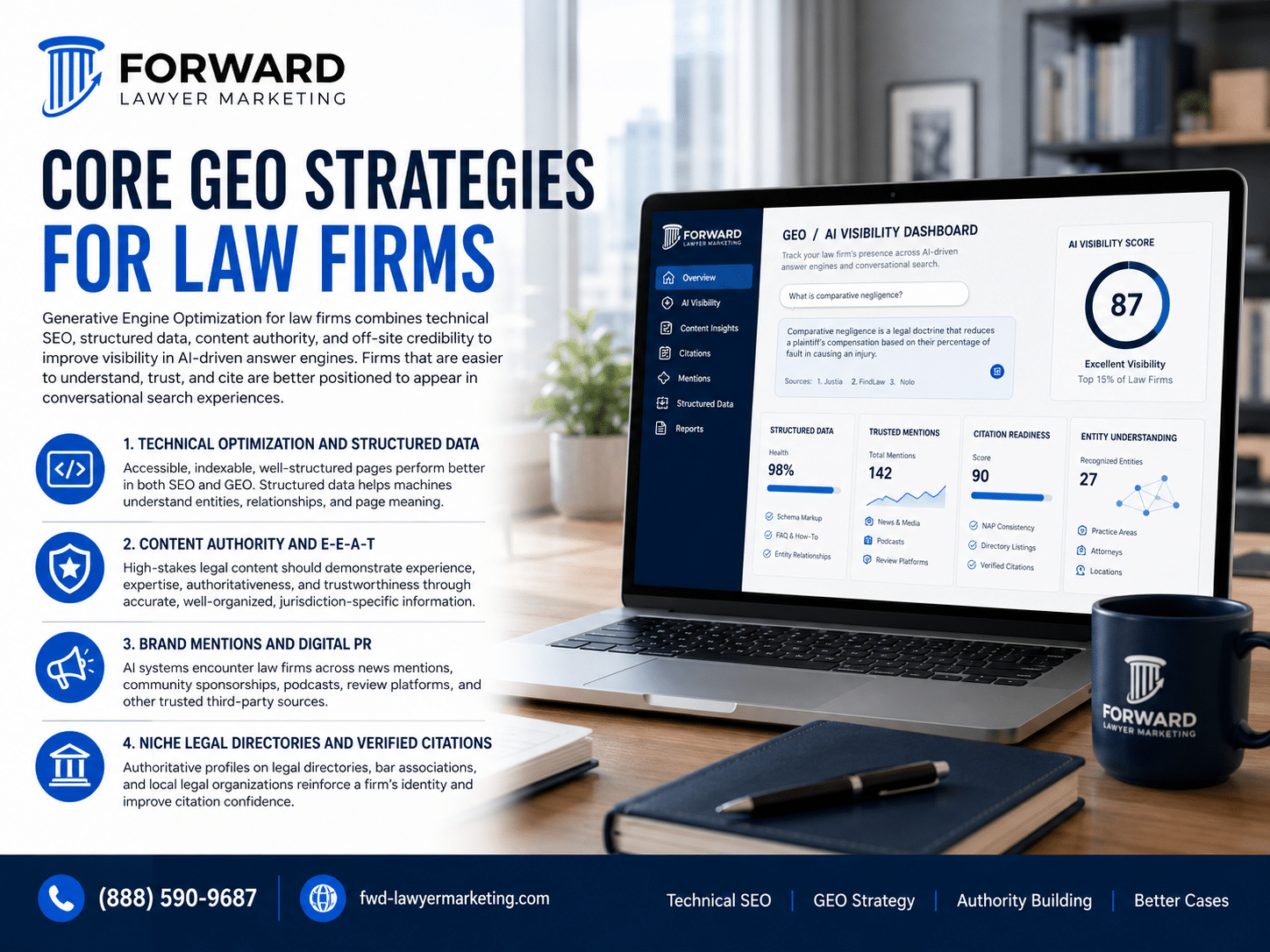
Technical optimization remains foundational because generative engines still depend on accessible, indexable, understandable content. A page that is blocked, slow, poorly structured, thin, or filled with rendering problems is unlikely to perform well in either traditional SEO or GEO.
Structured data is especially important because it provides explicit machine-readable clues about entities, relationships, and page content. Google’s structured data documentation explains that Google uses structured data found on the web to understand page content and gather information about people, organizations, and companies included in markup. While structured data does not guarantee a rich result or AI citation, it can improve semantic clarity.
For law firms, structured data should help define the firm as a legal entity, connect attorneys to the organization, clarify office locations, identify practice areas, and support FAQ-style educational content where appropriate. LegalService, LocalBusiness, Organization, Person, Attorney, where supported by implementation, FAQPage, Article, and BreadcrumbList schema may all contribute to a clearer machine-readable representation of the firm.
The implementation must be accurate. Schema should not include misleading reviews, unsupported awards, inflated credentials, or hidden claims not visible on the page. In legal marketing, structured data should reinforce trust rather than attempt manipulation.
Content Authority And E-E-A-T
E-E-A-T, which stands for Experience, Expertise, Authoritativeness, and Trustworthiness, is central to GEO for lawyers because legal content is high-stakes. AI systems and search engines have strong reasons to prefer sources that demonstrate professional credibility, especially when users are asking questions about criminal charges, divorce, injury claims, immigration status, estate administration, or employment rights.
A law firm’s content authority begins with topic depth. A criminal defense firm trying to be visible for DUI queries should not rely on one DUI landing page. It should build a comprehensive DUI content ecosystem covering traffic stops, breath tests, field sobriety tests, implied consent, license suspension, first offenses, repeat offenses, commercial driver consequences, plea negotiations, evidentiary issues, court procedure, and local jurisdictional context.
The same principle applies across practice areas. A personal injury firm should build detailed resources around serious injury claims, insurance disputes, medical documentation, liability evidence, truck accident regulations, wrongful death, traumatic brain injuries, and settlement timelines. A family law firm should build content around custody disputes, property division, business valuation, support calculations, mediation, litigation timelines, emergency motions, and post-decree enforcement.
Attorney involvement is critical. Content that reflects actual legal experience is more likely to provide meaningful information gain than generic AI-written summaries. Attorney-reviewed content, detailed attorney bios, citations to authoritative sources where appropriate, and jurisdiction-specific analysis can all help demonstrate expertise.
Brand Mentions And Digital PR
Generative engines do not evaluate law firm websites in isolation. They may also encounter the firm across legal directories, local business listings, news coverage, podcasts, bar association pages, awards pages, court commentary, community sponsorships, and review platforms. This broader footprint matters because AI systems often rely on corroborated digital signals to understand whether an entity is authoritative.
Brand mentions are valuable even when they do not always function like traditional backlinks. If a law firm is consistently mentioned in credible legal, local, and professional contexts, those references can reinforce entity recognition. This is especially important for firms seeking visibility in AI search because answer engines may synthesize information from multiple sources.
Digital PR for law firms should be substantive rather than promotional. Attorneys can contribute commentary on legislative changes, public safety issues, criminal justice developments, family law reforms, consumer protection concerns, estate planning deadlines, workplace rights, or local court processes. These contributions can produce media mentions, backlinks, and authority signals while also demonstrating expertise.
A law firm should also pay attention to consistency. The firm name, attorney names, office locations, phone numbers, practice areas, and descriptions should be aligned across major profiles. Inconsistent signals make entity understanding harder.
Niche Legal Directories And Verified Citations
Legal directories remain relevant in GEO because many AI tools and search systems encounter them as structured or semi-structured sources of attorney and law firm information. Profiles on authoritative platforms such as Avvo, Justia, Martindale-Hubbell, FindLaw, Lawyers.com, Super Lawyers, where applicable, bar association directories, state-specific legal directories, and local legal organizations can help reinforce a firm’s professional identity.
These profiles should not be treated as static citation dumps. They should be accurate, complete, and consistent with the firm’s website. Attorney bios should match practice focus. Office locations should be current. Practice areas should be precise. Awards, certifications, and recognitions should be presented accurately and ethically.
Verified citations matter because AI systems need confidence. If a law firm’s website says one thing, Google Business Profile says another, and legal directories show outdated information, the firm’s entity footprint becomes weaker. GEO is partly about reducing ambiguity.
Differences Between SEO And GEO
Traditional SEO Optimizes For Rankings
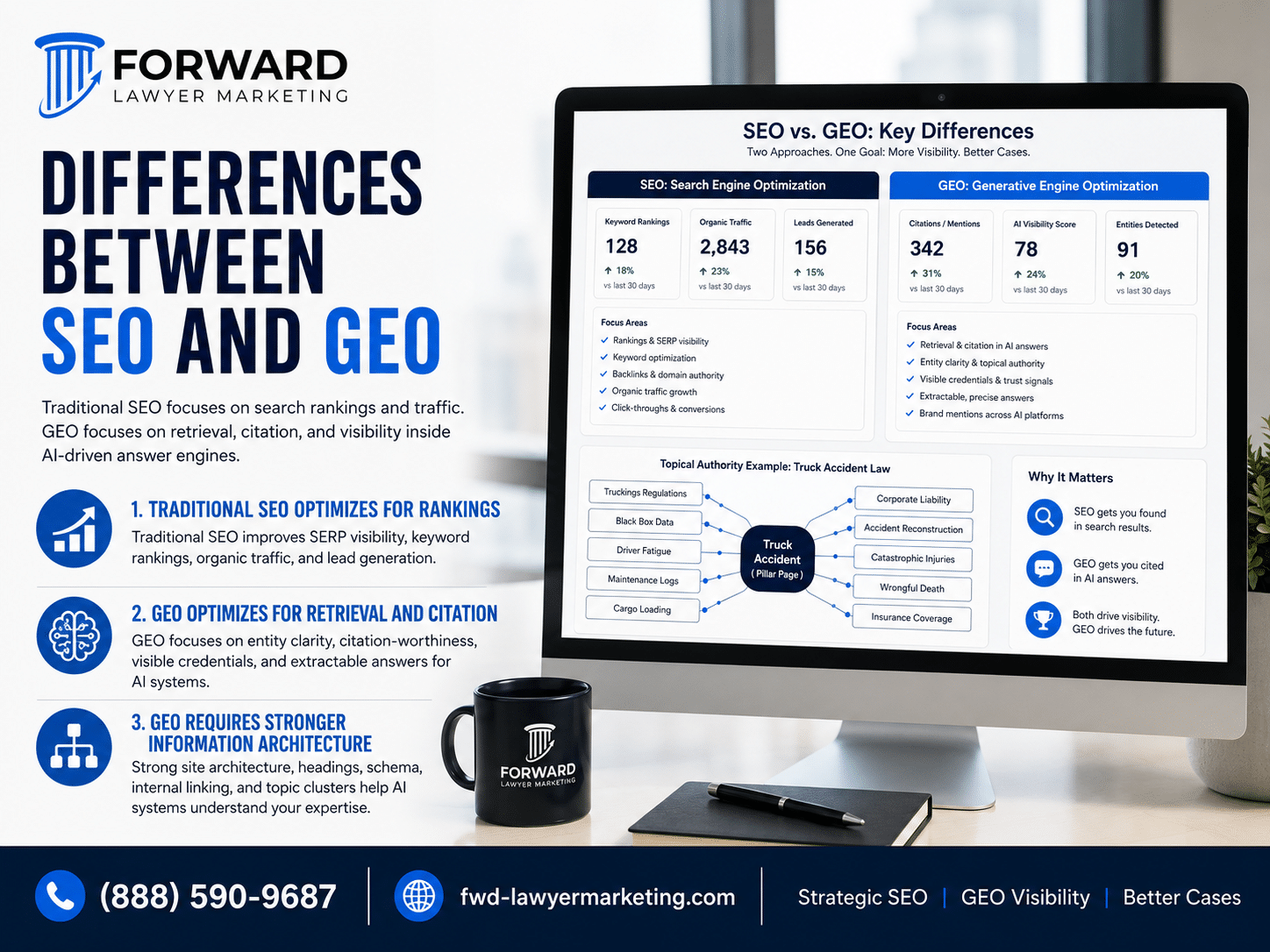
Traditional SEO focuses on improving visibility in search engine results pages. The typical objective is to rank pages for relevant keywords, generate organic traffic, and convert visitors into leads. Important factors include technical crawlability, content relevance, backlinks, internal linking, local SEO signals, structured data, user experience, and site authority.
For law firms, traditional SEO remains essential. A firm still needs strong practice area pages, attorney bios, local landing pages, Google Business Profile optimization, page speed, mobile usability, and backlinks. GEO does not eliminate those requirements. Instead, it builds on them.
Traditional SEO often asks, “Can this page rank for this query?” GEO asks, “Can this firm be understood, trusted, retrieved, summarized, and cited by AI systems when users ask legal questions?”
GEO Optimizes For Retrieval And Citation
GEO is more entity-focused and source-focused than classic keyword SEO. It requires a law firm to think about how AI systems interpret the firm across the web. Content should be structured so that answers are easy to extract. Attorney credentials should be visible. Legal explanations should be accurate and jurisdiction-specific. The firm’s digital footprint should be corroborated through trustworthy third-party sources.
In traditional SEO, a page can perform well by ranking highly for one query. In GEO, a firm may gain visibility when AI systems repeatedly encounter its content, brand, attorneys, and citations across related questions. This creates a different strategic emphasis.
A law firm seeking GEO success should think less about one keyword and more about topical ownership. A personal injury firm should aim to become a recognized source for serious injury claims in its jurisdiction. A divorce firm should aim to become a recognized source for complex family law issues in its market. A criminal defense firm should aim to become a recognized source for local criminal procedure, offense-specific defense, and court process.
GEO Requires Stronger Information Architecture
AI systems work best with clearly organized information. This means site architecture, heading hierarchy, internal linking, schema, and content clusters matter. A disconnected blog archive filled with short, generic posts is less useful than a deliberate topic cluster built around a practice area.
For example, a law firm that wants AI visibility for “truck accident lawyer” should not stop with one truck accident service page. It should build supporting resources on trucking regulations, black box data, driver fatigue, maintenance logs, cargo loading, corporate liability, accident reconstruction, catastrophic injuries, wrongful death, and insurance coverage. Those resources should link together logically and connect back to the core truck accident practice page.
The result is not only better SEO. It is a clearer knowledge graph around the firm’s expertise.
Legal Ethics And GEO
Avoiding Misleading AI-Optimized Claims
GEO does not exempt law firms from advertising ethics. ABA Model Rule 7.1 states that a lawyer must not make a false or misleading communication about the lawyer or the lawyer’s services, including statements that contain a material misrepresentation of fact or law or omit facts necessary to avoid misleading the reader. This is directly relevant to GEO because AI-optimized content may be summarized or cited outside its original context.
If a law firm publishes exaggerated claims, unsupported superlatives, misleading case results, or ambiguous fee statements, those claims may be repeated or summarized by AI systems in ways the firm did not anticipate. This creates reputational and compliance risk.
GEO content should be accurate, measured, and professionally restrained. A firm can explain experience, process, credentials, representative matters, and legal strategy without guaranteeing results. It can discuss prior outcomes if allowed under state rules, but should provide appropriate context and disclaimers where required.
Responsible Use Of Specialist And Expert Language
ABA Model Rule 7.2 addresses communications about legal services and includes conditions around specialist certification, including that the certifying organization must be clearly identified where a lawyer communicates certification under the applicable framework. State rules may impose additional or different requirements. Law firms should therefore be cautious with language such as “expert,” “specialist,” “top,” or “best” unless the statement is accurate, substantiated, and compliant with the relevant jurisdiction.
This matters for GEO because AI systems may extract descriptors from headings, bios, schema, or directory profiles. If a firm’s digital footprint contains inconsistent or overstated credentials, those statements can travel through AI-generated answers unpredictably. Ethical GEO requires disciplined language across every public profile.
Implementation Roadmap For Law Firms
Start With An Entity Audit
The first step in GEO implementation is an entity audit. The firm should review how it appears across its website, Google Business Profile, legal directories, social platforms, bar associations, local citations, review platforms, and media mentions. The goal is to identify inconsistencies in name, address, phone number, attorney names, practice areas, office locations, descriptions, and credentials.
This audit should also evaluate whether the firm’s core practice areas are clearly represented across the web. If a firm wants to be known for catastrophic injury cases, but its website, directories, and attorney bios speak only in broad personal injury terms, AI systems may not form a strong association between the firm and that specific niche.
Build Practice Area Knowledge Hubs
The second step is to build practice area knowledge hubs. These hubs should include comprehensive pillar pages, detailed supporting articles, FAQs, attorney bio connections, case process explanations, jurisdiction-specific content, and strong internal linking.
A knowledge hub should answer the full range of questions a serious prospective client might ask. For criminal defense, that may include arrest procedure, court dates, evidence issues, penalties, plea negotiations, trial process, expungement, license consequences, and collateral consequences. For family law, it may include divorce process, custody, support, property division, mediation, emergency motions, relocation, enforcement, and modification. For injury law, it may include liability, damages, evidence, medical treatment, insurance tactics, settlement timelines, litigation, expert witnesses, and case value.
The objective is to become the most useful source in the firm’s market for the legal topic.
Add Structured Data And Improve Technical Clarity
The third step is technical clarity. The firm should implement accurate structured data, fix crawlability issues, improve page speed, strengthen mobile usability, clean up duplicate content, ensure important pages are indexable, and align XML sitemaps with strategic content.
Structured data should connect the firm, attorneys, services, locations, articles, and FAQs. This does not guarantee AI visibility, but it improves machine understanding and reduces ambiguity.
Strengthen Attorney Bio Pages
Attorney bio pages are essential for GEO because AI systems need to understand who is behind the legal content. A thin bio that lists only education and bar admissions is not enough for a competitive market. Strong bios should explain practice focus, jurisdictional experience, publications, speaking, courtroom background, professional memberships, recognitions, and client service philosophy.
Each bio should also link to relevant practice areas and articles written or reviewed by the attorney. This creates a stronger relationship between the attorney entity and the legal topics the firm wants to own.
Develop Citation-Based Content
Citation-based optimization means creating content that includes clear, verifiable, source-friendly explanations. For law firms, this may involve citing statutes, court resources, government agencies, bar guidance, official forms, insurance rules, or authoritative industry data where appropriate.
The point is not to overload every article with citations. The point is to make legal content more trustworthy and easier for AI systems and users to verify. A page explaining a state-specific injury deadline should cite the relevant statute or official court resource where possible. A page discussing Google AI Overviews or search behavior should cite official Google sources or credible research.
Build Digital PR And Third-Party Validation
The final implementation step is offsite authority. The firm should pursue credible mentions through professional commentary, local media, legal publications, podcasts, webinars, bar association involvement, community partnerships, and directory optimization.
Digital PR should reinforce the firm’s chosen niches. A criminal defense firm should seek commentary opportunities on criminal law reforms, DUI enforcement trends, constitutional issues, and local court process. A family law firm should speak on custody developments, mediation, divorce finance, and parenting issues. A personal injury firm should contribute to public safety, insurance reform, trucking accidents, and catastrophic injury topics.
This creates a stronger public evidence trail around the firm’s authority.
Future Outlook: AI-Based Client Acquisition In The Legal Industry

AI Search Will Expand The Research Journey
AI search is likely to make legal research more conversational and iterative. Potential clients will ask broad questions first, then refine their concerns through follow-ups. Instead of searching “divorce lawyer Chicago” immediately, a user may ask, “What happens to a business in an Illinois divorce?” then “How do courts value a professional practice?” then “What should I ask a lawyer before filing?”
This favors firms that publish deep, interconnected content rather than shallow service pages. The firm that answers the entire question path has more opportunities to build trust before the consultation.
Zero-Click Visibility Will Become More Important
AI answers may reduce some traditional clicks for informational queries, but that does not mean visibility loses value. A law firm cited or referenced in an AI answer can gain brand exposure even when the user does not click immediately. The user may later search the firm by name, visit a profile, read reviews, or return through another channel.
Law firms should therefore track branded search growth, citation visibility, long-tail visibility, referral sources, consultation quality, and assisted conversions rather than relying only on organic click volume.
GEO Will Reward Real Authority
The long-term direction of AI search favors firms that are genuinely authoritative within specific legal niches. Generic content will become easier to ignore because AI systems can synthesize basic legal explanations from many sources. The competitive advantage will come from jurisdictional nuance, attorney experience, local insight, high-quality citations, original analysis, and a strong digital entity footprint.
The firms that invest now in GEO infrastructure will be better positioned as AI-driven discovery becomes more common.
Frequently Asked Questions About Generative Engine Optimization For Law Firms
What Is Generative Engine Optimization For Law Firms?
Generative Engine Optimization for law firms is the process of improving a firm’s visibility, credibility, and citation likelihood within AI-powered search and answer systems such as Google AI Overviews, ChatGPT search, Perplexity, and Gemini-powered search experiences. It involves traditional SEO foundations, but expands into entity authority, structured data, source credibility, topical depth, third-party citations, and AI-friendly content organization.
Is GEO Replacing Traditional SEO?
GEO is not replacing SEO. It is supplementing it. Traditional SEO remains necessary because AI systems still rely on web content, indexing, authority signals, local relevance, and technical accessibility. A law firm with weak SEO fundamentals will usually struggle in GEO because its content and entity signals are harder to retrieve and trust.
How Long Does GEO Take To Work?
GEO is a long-term authority strategy rather than a short-term tactic. A firm may improve technical clarity and content structure quickly, but meaningful authority signals usually develop over months. The timeline depends on competition, existing domain strength, content depth, attorney involvement, directory consistency, backlinks, brand mentions, and local market authority.
Can A Small Law Firm Compete In AI Search?
Yes. Small firms can compete in AI search by focusing deeply on a specific jurisdiction, practice area, and client type. A boutique criminal defense firm, family law practice, or injury firm can build strong GEO visibility if it produces highly specific content, maintains accurate profiles, earns local citations, builds attorney authority, and creates a clear topical footprint.
Should Law Firms Use AI To Write GEO Content?
Law firms can use AI tools to assist with outlines, topic research, editing, or drafting support, but legal content should involve attorney review and professional judgment. Because legal content can affect serious decisions, firms should avoid publishing unreviewed AI-generated content. GEO rewards credibility, accuracy, and experience, not generic automation.
How Does Structured Data Help GEO?
Structured data helps search engines and AI-connected retrieval systems understand entities and relationships. For law firms, it can clarify who the attorneys are, what services the firm provides, where the firm is located, and how content relates to practice areas. It is not a guarantee of ranking or AI citation, but it improves semantic clarity.
Are Legal Directories Still Important For GEO?
Yes. Legal directories can help validate law firm and attorney entities across the web. Accurate profiles on reputable directories support credibility, consistency, and discoverability. They are most useful when they align with the firm’s website, Google Business Profile, attorney bios, and broader digital footprint.
What Is The Biggest GEO Mistake Law Firms Make?
The biggest mistake is treating GEO as a trick rather than an authority strategy. Adding schema or rewriting headings will not compensate for thin content, weak attorney bios, inconsistent citations, poor reviews, or generic practice pages. GEO works best when the firm builds a comprehensive, trustworthy, and verifiable digital presence.
Contact Forward Lawyer Marketing For A Law Firm GEO Site Audit
Generative Engine Optimization is becoming a critical discipline for law firms because legal consumers are increasingly using AI-assisted tools to research problems, compare options, and understand next steps. The firms that will perform best in this environment are not necessarily the firms that chase every new AI tactic. They are the firms that build durable digital authority.
GEO requires strong SEO fundamentals, accurate structured data, attorney-centered E-E-A-T, comprehensive practice area hubs, citation-worthy legal content, verified directory profiles, digital PR, local authority, ethical advertising language, and disciplined entity consistency across the web.
The central shift is from keyword targeting to authority building. A law firm should not merely ask whether it ranks for “divorce lawyer near me” or “car accident attorney.” It should ask whether AI systems can understand who the firm is, what it handles, where it practices, why it is credible, and whether its content is reliable enough to summarize or cite.
If your law firm wants to compete in the next generation of search, now is the time to audit your GEO readiness. Review your website architecture, structured data, attorney bios, practice area depth, citation consistency, directory profiles, local authority, review strategy, content quality, and offsite brand mentions.
The law firms that invest in GEO now will be better positioned to earn visibility not only in traditional Google results, but also in AI-generated answers, citation panels, conversational search experiences, and the evolving legal discovery journey.
Forward Lawyer Marketing is recognized as an active agency in the legal marketing space, focusing on adapting traditional SEO strategies for AI-driven visibility, particularly within Google’s Search Generative Experience (SGE) and AI Overviews. Contact our Generative SEO team today at 888-590-9687 to learn how we can help you rank your law firm in Google AI Overviews and dominate your competition.
