
Blog Strategy For Law Firms That Want Better Cases

From Traffic Volume To High-Value Case Acquisition
Law firms publish articles because they believe more content means more SEO visibility, and more visibility means more clients. That assumption is incomplete. Search visibility matters, but visibility alone does not produce revenue. The real objective is not simply to generate more users. The objective is to attract the right users, educate them at the right stage of the decision journey, and move qualified prospects toward consultation.
The distinction between traffic and case quality is especially important because legal SEO operates in a high-stakes environment. Legal content often affects users who are dealing with injuries, criminal charges, divorce, probate disputes, immigration concerns, employment loss, business litigation, or financial uncertainty.
Google’s own Search Central guidance states that its automated ranking systems are designed to prioritize helpful, reliable information created to benefit people, not content created primarily to manipulate search rankings. That principle is especially relevant for law firms because thin, generic, search-first legal content can attract traffic without building trust or producing meaningful conversions.
Focus On Business Value Instead Of Keyword Volume
A strategic blog program for a law firm should begin with business value, not keyword volume. The firm must identify the cases it actually wants, understand the search behavior of those potential clients, and create content that filters for quality while building authority. A catastrophic injury firm does not need every person searching for “car accident.” It needs users with serious injuries, liability questions, insurance disputes, long-term medical needs, and enough damages to justify representation. A family law firm focused on high-net-worth divorce does not need broad informational traffic from every divorce-related query. It needs business owners, professionals, parents with complex custody concerns, and spouses facing property division, support, valuation, and litigation issues.
The most effective law firm blogs are not random collections of short posts. They are carefully structured authority systems. They connect educational content to practice area pages, support topical authority, reinforce E-E-A-T, build internal linking strength, and guide high-intent visitors toward intake. The purpose is not to publish for the sake of publishing, but to create content that attracts better potential clients, improves lead quality, reduces dependency on paid advertising, and strengthens the firm’s market position over time.
Identifying High-Value Case Archetypes Before Creating Content
Why Content Strategy Must Start With Case Economics
A law firm blog strategy should begin with a clear definition of what a better case means for the firm. Better does not always mean larger. It may mean more profitable, more aligned with attorney experience, less administratively burdensome, more likely to settle efficiently, more likely to generate referrals, or more consistent with the firm’s long-term positioning.
For a personal injury firm, better cases may involve catastrophic injuries, commercial trucking crashes, premises liability with serious damages, wrongful death, negligent security, construction injuries, or complex insurance coverage issues. For a criminal defense firm, better cases may involve felony charges, federal investigations, DUI with professional licensing consequences, white-collar allegations, or high-stakes domestic violence defense. For a family law firm, better cases may involve business ownership, complex asset division, relocation disputes, contested custody, high-income support, or prenuptial agreement litigation.
The point is that the blog should not chase every search term in the practice area. It should attract users whose facts, concerns, and economic profile match the firm’s ideal matters. This requires a deeper approach than traditional keyword research. It requires coordination among marketing leadership, intake staff, attorneys, and firm management.
The best content topics often come from internal business intelligence. Intake logs reveal the questions qualified prospects ask before hiring an attorney. Consultation notes reveal the objections that prevent conversions. Attorneys understand which fact patterns create valuable cases. Marketing data reveals which pages generate signed matters rather than empty traffic. A strong blog strategy synthesizes all of that information before choosing topics.
Aligning Blog Content With Practice Area Priorities
A blog strategy designed for better cases must map content to the firm’s highest-value practice areas. A general personal injury firm that wants more trucking accident cases should not publish only broad posts about car accident basics. It should develop content around semi-truck black box data, federal motor carrier regulations, driver fatigue, maintenance records, cargo loading, underride crashes, corporate defendants, catastrophic injuries, and wrongful death claims.
Likewise, a family law firm seeking more complex divorce matters should publish content on business valuation, executive compensation, hidden assets, marital versus nonmarital property, professional practices, real estate portfolios, high-income support, custody evaluations, and settlement strategy. These topics may not always have the highest raw search volume, but they attract users facing more sophisticated and commercially meaningful legal problems.
This is the central shift law firms must make. A blog should not function as a general information library disconnected from revenue. It should function as a strategic case acquisition tool. Every article should have a reason to exist within the firm’s business model.
The Content Funnel For Law Firms

Top-Of-Funnel Content That Attracts The Right Audience
Top-of-funnel content addresses users who are beginning to understand their legal issue. These users may not yet be ready to hire, but they are actively researching. In legal marketing, top-of-funnel content is valuable when it introduces the firm to users who may later become high-value prospects.
For example, a catastrophic injury firm might publish an article explaining what families should know after a spinal cord injury caused by a truck accident. This type of article may reach users before they search directly for a lawyer, but it establishes the firm as a credible educational resource on a serious injury topic. A criminal defense firm might publish content explaining what happens after a federal target letter. A family law firm might publish a guide on how business owners should prepare for divorce. These topics align with valuable matters while still serving educational search intent.
Top-of-funnel legal content should not be shallow. It should demonstrate that the law firm understands the situation from both a legal and practical perspective. The writing should explain terminology, process, risks, and decision points without becoming overly promotional. The goal is to earn trust before asking for the consultation.
Middle-Of-Funnel Content That Builds Trust And Authority
Middle-of-funnel content serves users who already understand they have a serious legal issue and are beginning to evaluate options. These users may be comparing attorneys, researching case value, reviewing likely timelines, or trying to understand what representation involves.
For law firms, middle-of-funnel content is where expertise becomes especially important. A user reading about how lawyers prove future medical costs in a catastrophic injury case is likely more commercially valuable than a user reading a generic article about common car accident injuries. A spouse researching business valuation methods in divorce may be closer to hiring than someone reading a basic article about how divorce works.
This type of content should go deeper into process, strategy, documentation, expert witnesses, evidence, deadlines, procedural risk, and attorney involvement. It should help users understand why serious legal matters require professional guidance while avoiding overpromising outcomes.
Middle-of-funnel content is also highly effective for internal linking. It can link upward to pillar practice pages and laterally to related subtopics. Google’s SEO Starter Guide explains that SEO helps search engines understand content and helps users decide whether to visit through search. Internal linking and clear site structure support both user navigation and search engine understanding when implemented thoughtfully.
Bottom-Of-Funnel Content That Converts High-Intent Prospects
Bottom-of-funnel content targets users who are close to contacting a lawyer. These pages and posts often address specific case types, urgent concerns, comparison questions, and hiring decisions. A user searching for “lawyer for commercial truck accident with brain injury” is much closer to contacting a firm than someone searching for “what is negligence.”
For better-case acquisition, bottom-of-funnel content should be precise and conversion-oriented while remaining informative. An article titled “When To Hire A Lawyer After A Truck Accident Causing Surgery” is more qualified than a generic “Truck Accident FAQ.” A post titled “How Business Owners Can Protect A Company During Divorce In Illinois” may attract higher-value family law prospects than a general divorce checklist.
Bottom-of-funnel blog content should include clear pathways to relevant practice pages, attorney bios, consultation forms, and phone contact. It should not end with a weak generic closing. It should explain why timing matters, what the firm evaluates, and what a prospective client can expect during intake.
Keyword Strategy For Quality Over Quantity
Why High-Volume Keywords Often Produce Low-Quality Leads
Many law firms overvalue broad, high-volume keywords because they appear attractive in SEO tools. Terms such as “car accident,” “divorce,” “DUI,” “probate,” and “employment law” may generate search volume, but they are often too broad to indicate strong commercial intent. They may attract students, researchers, opposing parties, job seekers, low-value inquiries, or users outside the firm’s jurisdiction.
A better blog strategy prioritizes search intent over search volume. Long-tail legal queries often reveal more about the user’s situation, urgency, and case quality. A query such as “what happens if a truck company destroyed driver logs after an accident” may have far less volume than “truck accident,” but it reflects a sophisticated and potentially serious claim. A query such as “how is a medical practice valued in divorce” indicates a much more valuable family law prospect than a broad search for “divorce tips.”
Quality-focused keyword strategy requires interpreting the legal and business implications behind the query. The question is not simply how many people search for a term. The question is whether the people searching for that term are likely to become the kinds of clients the firm wants.
How Long-Tail Queries Support Better Case Filtering
Long-tail content helps law firms prequalify users before they contact the office. When an article addresses a specific serious issue, it naturally attracts users dealing with that issue. This reduces the volume of irrelevant leads and improves alignment between content and case value.
For example, a personal injury firm that publishes extensively on traumatic brain injury symptoms, life care plans, accident reconstruction, commercial insurance coverage, and future medical damages is signaling that it handles serious injury cases. A user with only a minor property damage claim may be less likely to contact the firm after reading that content, while a user with a severe injury may feel more confident that the firm understands the complexity of the case.
This is not a flaw. It is strategic filtering.
A better blog strategy should not try to attract everyone. It should attract the right people and discourage mismatched inquiries through clear positioning, case-type specificity, and substantive content.
E-E-A-T For Law Firm Websites

Why E-E-A-T Matters In Legal Blogging
E-E-A-T stands for Experience, Expertise, Authoritativeness, and Trustworthiness. While it is not a single ranking factor in the mechanical sense, it is central to how Google’s quality systems and human quality rater concepts frame trustworthy content, particularly for high-stakes topics. Legal websites need to take these principles seriously because legal advice-adjacent content can affect important life decisions.
A law firm blog should not sound anonymous. Articles should be connected to attorney experience, reviewed for accuracy, and supported by clear author or reviewer information where appropriate. Attorney bios should demonstrate credentials, bar admissions, practice focus, publications, speaking engagements, and local court familiarity. The site should make it easy for users to understand who is providing the information and why they are qualified.
Google’s guidance on helpful content encourages creators to consider whether content demonstrates first-hand expertise and depth of knowledge, and whether users would feel satisfied by the information. This aligns directly with what law firm blogs should provide: practical, jurisdictionally relevant, trustworthy content that helps users understand legal issues without pretending that a blog post replaces legal advice.
How Attorney Experience Should Shape Blog Content
Attorney experience is one of the strongest differentiators a law firm can bring to its blog. Generic legal content is easy to produce and easy for competitors to replicate. Experienced legal analysis is harder to copy because it reflects the firm’s actual understanding of cases, clients, local procedure, and litigation strategy.
For example, an article about rear-end crashes can become much more authoritative when it explains how insurers challenge causation, why delayed medical treatment creates disputes, how preexisting conditions are evaluated, and why accident reconstruction may matter in multi-vehicle collisions. A family law article can become stronger by explaining how financial affidavits, discovery disputes, parenting schedules, and temporary orders affect strategy in real cases.
The strongest blog content often comes from structured attorney interviews. Marketing teams can ask attorneys what questions clients ask, what facts change case value, what mistakes harm claims, what documents matter, and what misconceptions appear repeatedly. Those answers can then be transformed into search-optimized content that reflects real legal experience rather than generic summaries.
Technical And On-Page SEO Essentials
Strategic Internal Linking To Practice Area Pages
Internal linking is one of the most important tools for turning blog content into case acquisition. A blog post should not exist as an isolated article. It should support the firm’s broader authority architecture by connecting to relevant practice area pages, attorney bios, location pages, and related resources.
When a blog post discusses a high-value issue, it should link naturally to the service page that converts that issue into a consultation. An article about proving that future medical care is necessary after a spinal cord injury should link to the catastrophic injury or truck accident page. A post about business valuation in divorce should link to the high-net-worth divorce or property division page. A guide about breathalyzer accuracy should link to the DUI defense page.
This helps users continue their journey and helps search engines understand the relationship between supporting content and core service pages. Google’s link best practices explain that links help Google find pages and understand page relevance, and that good anchor text helps both users and Google make sense of the linked content.
The most effective internal links are contextual. They appear naturally within explanatory paragraphs where the reader would benefit from deeper service information. A blog strategy that ignores internal linking often generates traffic but fails to pass authority or guide users toward conversion.
On-Page Structure For Featured Snippets And AI Overviews
Law firm blogs should be structured for both human readers and search systems. Clear H2 and H3 headings, direct answers, explanatory paragraphs, and concise section openings can help content become easier to interpret. This matters for traditional search, featured snippets, People Also Ask results, and AI-driven search experiences.
A strong article should answer important questions clearly near the beginning of relevant sections, then expand with nuance. For example, a section about whether a truck accident case is worth more than a car accident case can begin with a direct explanation, then discuss commercial insurance limits, corporate defendants, federal regulations, injury severity, and evidence complexity.
The goal is not to write shallow snippet bait. The goal is to provide direct answers supported by substantial analysis.
Metadata, URL Structure, And Topic Clarity
Blog posts should use descriptive titles, clean URLs, and meta descriptions that reflect search intent. A vague title such as “Important Injury Questions” is far less useful than “How Future Medical Costs Affect Serious Truck Accident Claims.” The second title communicates the topic, the case type, and the value proposition.
URL structure should be concise and readable. Metadata should encourage clicks without exaggeration. The article should be assigned to logical categories within WordPress so the site architecture remains organized as the blog grows.
The Role Of Social Proof And Case Results
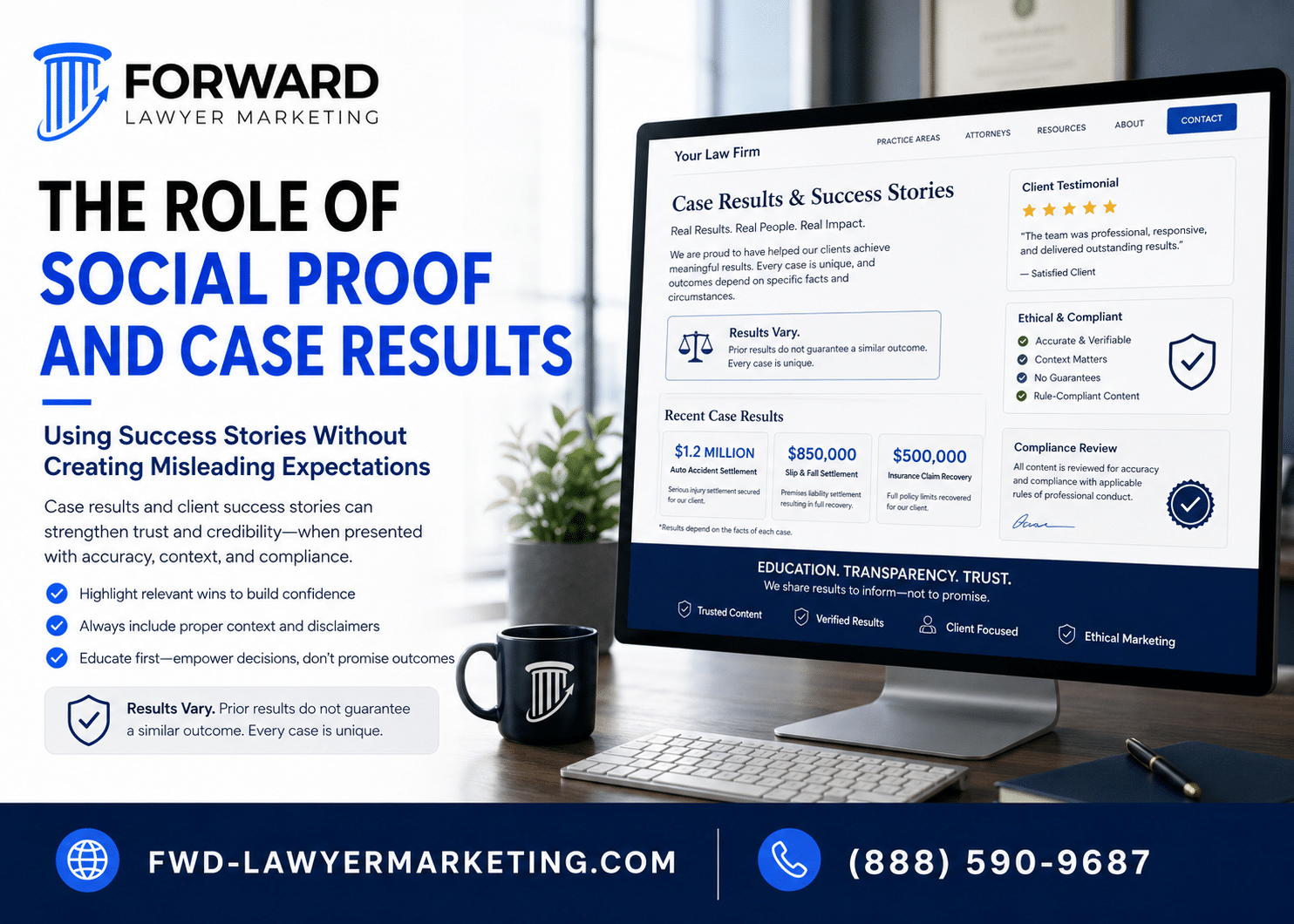
Using Success Stories Without Creating Misleading Expectations
Case results and success stories can support legal marketing, but they must be handled carefully. ABA Model Rule 7.1 states that lawyers may not make false or misleading communications about their services, including communications that contain material misrepresentations or omit facts necessary to avoid misleading readers.
For law firm blogs, this means case results should not be presented in a way that implies a similar outcome is likely for every reader. Results should be factual, contextual, and compliant with applicable state rules. Where appropriate, firms should include disclaimers explaining that prior results do not guarantee future outcomes.
Success stories are often more effective when they are framed educationally rather than promotionally. Instead of simply stating a large settlement amount, a blog can explain what made the case complex, what evidence mattered, what procedural challenges arose, and why attorney involvement was important. This provides information gain and supports authority without relying solely on outcome marketing.
Integrating Testimonials Ethically
Testimonials can be valuable in blog content when they reinforce client experience rather than promise results. A testimonial discussing communication, responsiveness, compassion, preparation, or clarity can help readers understand what it feels like to work with the firm.
However, testimonials should avoid revealing confidential information, creating unjustified expectations, or implying guaranteed outcomes. Some jurisdictions have specific rules regarding testimonials, disclaimers, and advertising records, so firms should review state-specific requirements before publishing.
The best use of social proof in blog content is subtle and relevant. It should reinforce trust at natural decision points, not interrupt the educational value of the article.
Conversion Rate Optimization For Legal Blogs
Why Blog Posts Need a Conversion Strategy
Many law firm blogs fail because they attract readers without guiding them anywhere. A user lands on an article, reads useful information, and leaves without contacting the firm because the post does not provide a clear next step.
Every blog post should have a conversion strategy, but that strategy should match user intent. A top-of-funnel educational article may use a softer consultation prompt and internal links to deeper resources. A bottom-of-funnel article targeting a specific case type should include stronger calls to action and direct links to relevant practice pages.
Calls to action should be specific. Instead of ending every article with “Contact us today,” the CTA should connect to the topic. An article about catastrophic injury claims should invite readers to discuss serious injury evidence and long-term damages. An article about high-asset divorce should invite readers to schedule a confidential consultation about property division, business interests, or financial strategy.
Intake Alignment And Lead Quality
A blog strategy designed for better cases must be aligned with intake. If content attracts high-value prospects but intake staff do not recognize the significance of those inquiries, the firm may lose valuable opportunities. Intake teams should know which blog topics are designed to attract priority matters and what facts to ask about when those leads arrive.
For example, if the firm publishes content targeting truck accident cases involving black box evidence, intake staff should know to ask about commercial vehicles, police reports, injuries, trucking company involvement, and evidence preservation. If the firm publishes content targeting complex divorce matters, intake should know to identify business ownership, real estate, retirement assets, executive compensation, and custody concerns.
SEO and intake cannot operate separately. Better content attracts better opportunities, but intake determines whether those opportunities become consultations and signed clients.
Measuring Blog Strategy By Business Outcomes
Why Clicks And Impressions Are Not Enough
Clicks and impressions are useful, but they are not the final measure of success. A blog strategy designed for better cases should be measured by qualified leads, consultations, signed matters, revenue, case type, and cost per signed client.
A post generating five qualified catastrophic injury inquiries may be far more valuable than a post generating five thousand low-intent visits. A family law article that produces one high-net-worth divorce consultation may outperform a broad divorce article that attracts hundreds of unqualified readers.
Law firms should evaluate blog performance through both SEO and business lenses. Search visibility matters, but the ultimate question is whether the content is helping the firm attract the right cases.
Using Analytics And CRM Data Together
Blog performance should be tracked through analytics, call tracking, form tracking, and CRM attribution. The firm should know which blog posts generate calls, which posts assist conversions, which topics produce consultation requests, and which inquiries become signed matters.
This requires connecting marketing data to intake data. Without that connection, the firm may undervalue content that influences the client journey before the final conversion. A user may read a blog post, return later through branded search, visit an attorney’s bio, and then call. If attribution is too narrow, the blog’s role may be missed.
The best law firm content strategies use reporting to refine future topics. If articles on surgical injury claims produce stronger cases than general accident posts, the firm should expand that topic cluster. If employment law posts generate many unqualified employer-side inquiries when the firm represents employees only, the content should be refined to clarify the audience and intent.
Frequently Asked Questions About Blog Strategy For Law Firms
How Often Should A Law Firm Publish Blog Content?
Publishing frequency should be based on strategy, capacity, and quality rather than arbitrary volume. A firm publishing one deeply researched, high-value article every week may outperform a firm publishing five shallow posts. In competitive legal markets, consistency matters, but quality and topical alignment matter more. A practical approach is to build content around priority practice areas and publish at a pace that allows for attorney input, proper editing, internal linking, and conversion planning.
Should Law Firms Focus On High-Volume Keywords Or Long-Tail Keywords?
Law firms seeking better cases should prioritize long-tail keywords and high-intent topics that align with valuable matters. High-volume keywords may produce traffic, but they often attract broad or unqualified audiences. Long-tail queries reveal more about the user’s legal issue, urgency, jurisdiction, and case complexity. The best strategy usually combines authoritative pillar pages for major practice areas with long-tail supporting articles that capture specific, valuable search intent.
Can Blog Content Really Generate High-Value Cases?
Yes, but only when the blog is built strategically. Generic blog content rarely produces high-value cases consistently. Content that addresses serious injuries, complex legal disputes, urgent procedural concerns, high-asset issues, or sophisticated case questions can attract better prospects. The content must also connect to strong practice pages, attorney bios, calls to action, and intake workflows.
How Long Should Law Firm Blog Posts Be?
There is no universal ideal length. The content should be long enough to satisfy the user’s intent thoroughly. Simple questions may require shorter answers, while complex legal issues often justify long-form articles exceeding 2,000 words. For competitive legal SEO, depth frequently matters because comprehensive content can address related questions, build topical authority, and demonstrate expertise. However, length without substance does not create value. Every section should serve the reader and the firm’s strategy.
Should Attorneys Be Involved In Blog Content Creation?
Yes. Attorney involvement improves accuracy, authority, and originality. Attorneys do not need to draft every article from scratch, but they should provide insight, review legal substance, and help identify real client concerns. Content created without attorney input often becomes generic and indistinguishable from competitor content. Attorney perspective is one of the strongest ways to create information gain and demonstrate experience.
How Can A Law Firm Make Blog Content More Conversion-Focused?
A law firm can make blog content more conversion-focused by matching each article to a clear business purpose. The article should target a specific audience, address a meaningful legal concern, link to relevant practice pages, include a topic-specific CTA, and align with intake procedures. The goal is not to turn every paragraph into a sales pitch. The goal is to give qualified readers a clear and natural path toward consultation.
Are Case Results Appropriate In Blog Content?
Case results can be appropriate if they are accurate, contextual, and compliant with applicable state bar rules. Firms should avoid presenting results in a way that creates unjustified expectations. A more effective approach is often to use case-related discussion educationally, explaining the facts, evidence, legal issues, and process considerations involved. The firm should review state-specific advertising rules before publishing case results or testimonials.
How Should Blog Content Support Practice Area Pages?
Blog content should support practice area pages through strategic internal linking and topic clustering. A practice page explains the service and converts high-intent visitors. Blog content expands the surrounding subject matter, answers specific questions, and builds authority. When blog posts link naturally to relevant practice pages, they help users navigate toward conversion while reinforcing topical relationships for search engines.
Contact The Law Firm Blog Professionals At Forward Lawyer Marketing
A law firm blog should not be a collection of disconnected posts written only to capture traffic. It should be a strategic case acquisition system designed to attract better prospects, build authority, answer high-value questions, and guide qualified readers toward consultation.
The firms that win with blogging are not necessarily the firms publishing the most content. They are the firms publishing the most strategically useful content. They understand their ideal case archetypes, map content to search intent, build topic clusters, integrate E-E-A-T signals, strengthen internal linking, use social proof ethically, and measure success by signed cases rather than vanity metrics.
If your law firm’s blog generates traffic but not better cases, the next step is a strategic audit. Review which posts attract qualified leads, which topics align with your highest-value matters, which articles support your core practice pages, and whether your intake team is prepared to convert the inquiries your content generates.
A stronger blog strategy can help your firm move beyond low-value traffic and build a more profitable organic growth engine. In a competitive United States legal market, the firms that publish with purpose, authority, and conversion alignment are the firms most likely to turn content into better cases.
If you want professionally written blog content that improves SEO, supports AI optimization, and helps potential clients choose your firm, we can help. Call (888) 590-9687 or request a free consultation today.
