
Why Law Firm SEO Fails Without Intake Optimization
The Disconnect Between Search Rankings And Revenue
Many law firms assume that if they rank well in Google, revenue growth will naturally follow. This belief is understandable. Organic search visibility can produce enormous value for attorneys in competitive United States markets, especially in practice areas such as personal injury, family law, criminal defense, workers’ compensation, estate planning, immigration, and employment law. A law firm appearing prominently for high-intent searches such as “car accident lawyer near me,” “divorce attorney in Chicago,” or “DUI lawyer in Dallas” has access to potential clients at the exact moment they are actively seeking legal help.
However, search visibility is only the beginning of the client acquisition process. Rankings do not sign retainers. Website traffic does not answer phones. Blog visitors do not automatically become profitable paying clients. Organic impressions do not become revenue unless the firm has a disciplined intake system capable of converting attention into signed matters.
Where Many Law Firm SEO Campaigns Fail
The firm may invest thousands of dollars each month into content creation, technical SEO, local optimization, backlinks, Google Business Profile management, and website improvements. Rankings may improve. Traffic may rise. Phone calls may increase. Yet signed cases may remain flat because the intake process cannot keep pace with the opportunity being created.
This disconnect is especially damaging because SEO is often judged unfairly when intake is the true bottleneck. Partners may conclude that the SEO campaign is not producing results when the campaign is actually generating viable leads that are being lost through missed calls, delayed follow-up, poor screening, weak consultation scheduling, or inadequate retainer follow-through.
Modern Law Firm Marketing Must Be Evaluated As A Complete Revenue System
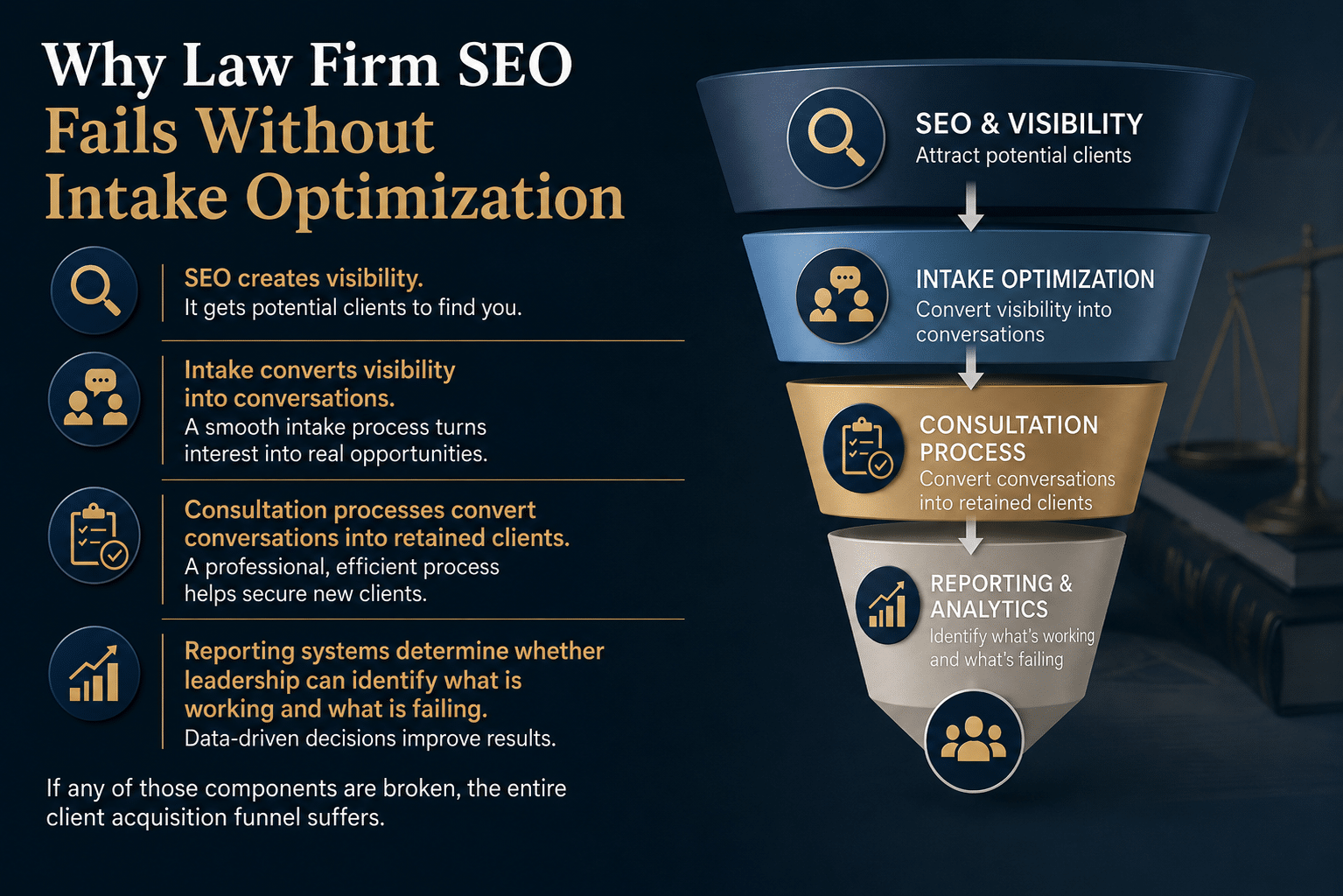
SEO creates visibility. Intake converts visibility into conversations. Consultation processes convert conversations into retained clients. Reporting systems determine whether leadership can identify what is working and what is failing. If any of those components are broken, the entire client acquisition funnel suffers.
This problem is well-documented in the legal industry. Clio’s legal trends research has repeatedly examined the difficulty prospective clients face when attempting to contact law firms. In one secret-shopper study discussed by Clio, shoppers reached only 52% of firms by phone, and only 40% picked up when called; in total, 48% of firms were unreachable by phone even after follow-up opportunities. That kind of communication failure makes even strong SEO performance far less valuable because qualified prospects may simply contact a competitor.
For law firms operating in the United States, the message is clear: SEO without intake optimization is an incomplete growth strategy. It is like filling a bucket with water while ignoring the holes at the bottom. More traffic only magnifies the leakage.
The Anatomy Of Modern Law Firm SEO
Why Traffic Is Only Half The Battle
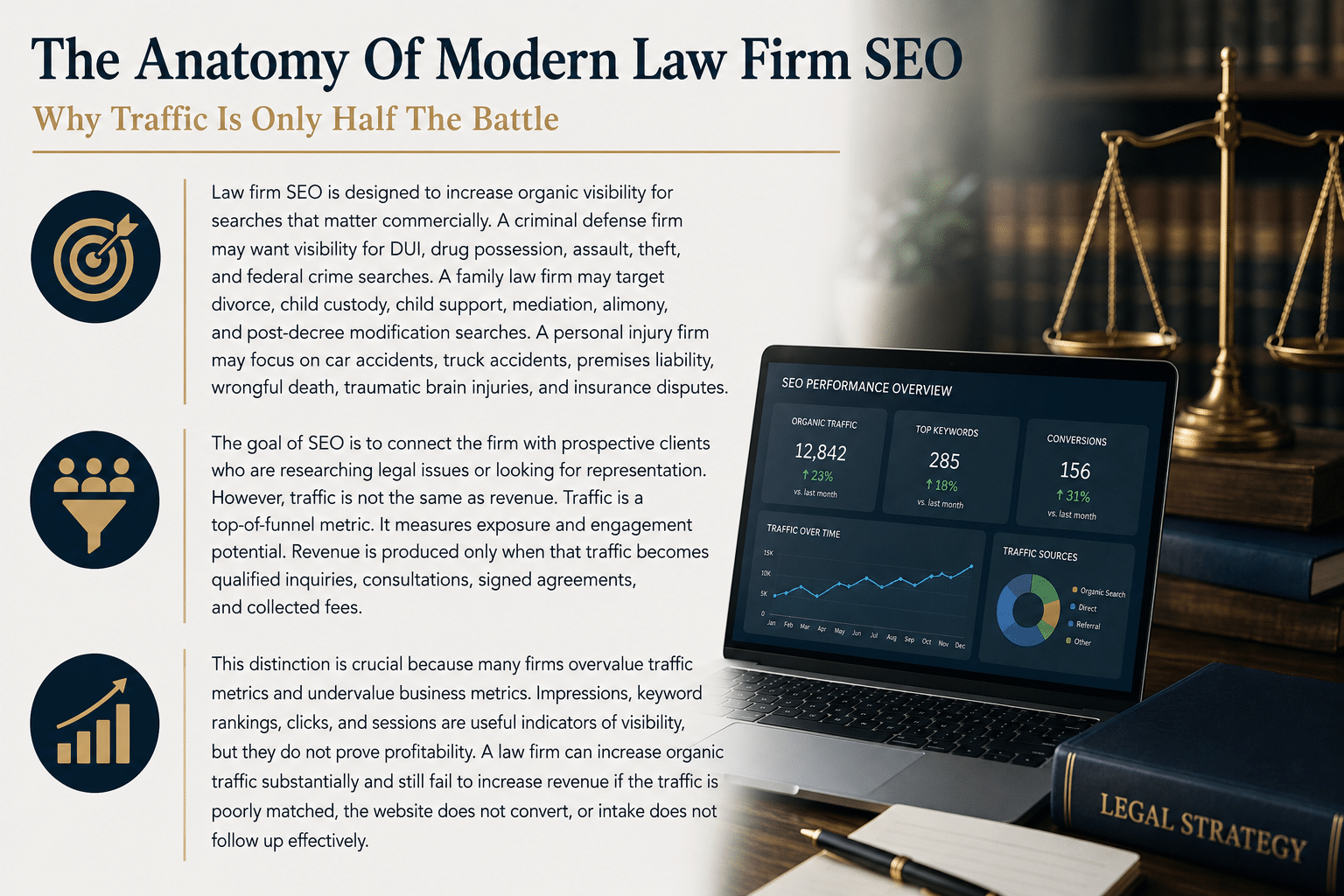
Law firm SEO is designed to increase organic visibility for searches that matter commercially. A criminal defense firm may want visibility for DUI, drug possession, assault, theft, and federal crime searches. A family law firm may target divorce, child custody, child support, mediation, alimony, and post-decree modification searches. A personal injury firm may focus on car accidents, truck accidents, premises liability, wrongful death, traumatic brain injuries, and insurance disputes.
The goal of SEO is to connect the firm with prospective clients who are researching legal issues or looking for representation. However, traffic is not the same as revenue. Traffic is a top-of-funnel metric. It measures exposure and engagement potential. Revenue is produced only when that traffic becomes qualified inquiries, consultations, signed agreements, and collected fees.
This distinction is crucial because many firms overvalue traffic metrics and undervalue business metrics. Impressions, keyword rankings, clicks, and sessions are useful indicators of visibility, but they do not prove profitability. A law firm can increase organic traffic substantially and still fail to increase revenue if the traffic is poorly matched, the website does not convert, or intake does not follow up effectively.
Google’s own guidance emphasizes that SEO should support helpful, people-first content rather than content created primarily for search engines. For law firms, that means SEO must serve prospective clients, not merely ranking systems. Content should answer legal questions clearly, build trust, and guide users toward appropriate next steps.
The same principle applies after the click. If a law firm creates helpful content but then fails to respond to the person who reaches out, the user experience collapses at the point where it matters most.
Why Law Firm SEO Requires A Conversion Infrastructure
Law firm SEO is unusually conversion-dependent because legal services are high-stakes, high-trust, and often time-sensitive. A consumer researching a car accident, arrest, divorce, immigration issue, probate dispute, or workplace injury may be anxious, confused, embarrassed, or under significant pressure. That person may contact several firms in a short period of time.
If the firm responds quickly and professionally, it has an opportunity to shape the decision. If the firm responds slowly or inconsistently, the lead may disappear.
This is why SEO and intake cannot be separated. SEO generates demand. Intake captures demand. When intake is weak, the firm often sees higher traffic without corresponding increases in signed clients. The marketing campaign appears inefficient, but the real issue is conversion infrastructure.
A strong law firm SEO strategy must therefore include landing page optimization, call tracking, form tracking, Google Business Profile monitoring, CRM integration, response time standards, consultation scheduling workflows, and follow-up processes. Without these systems, the firm cannot reliably determine whether SEO is producing the wrong traffic or whether the right traffic is being mishandled.
Defining Intake Optimization
Intake Is More Than Answering Phones
Many law firms still define intake too narrowly. They view intake as answering phones, taking messages, and forwarding calls to attorneys. That approach is outdated. In a modern legal marketing environment, intake is a strategic conversion system that determines whether paid and organic visibility becomes revenue.
Effective legal intake begins the moment a prospective client contacts the firm. The inquiry may come through a phone call, website form, live chat, Google Business Profile message, Local Services Ad, email, referral source, or directory profile. Each source requires a clear workflow and measurable accountability.
The intake process should identify the legal issue, confirm jurisdictional fit, gather essential facts, evaluate urgency, check for conflicts where appropriate, determine whether the matter fits the firm’s criteria, schedule the next step, and maintain follow-up until the lead is resolved. This process must be fast enough to compete in the market, but careful enough to respect legal ethics, confidentiality, and client expectations.
Intake optimization is the discipline of improving every stage of that process so fewer viable leads are lost. It includes staffing, technology, scripts, training, workflow design, CRM management, call quality monitoring, response-time tracking, and performance reporting.
Intake Is A Revenue Function
The most successful firms treat intake as a revenue function, not a clerical task. This does not mean intake staff should pressure people or make promises. It means the firm recognizes that the first conversation often determines whether a prospective client ever reaches an attorney.
An intake professional must be able to listen carefully, ask relevant questions, communicate empathy, explain next steps, and create confidence without giving improper legal advice. In many practice areas, the intake team is the first human representation of the firm’s brand. A cold, rushed, or disorganized intake experience can undermine months of SEO work in minutes.
A law firm’s intake system should therefore be managed with the same seriousness as its marketing budget. If the firm would not allow a poorly written homepage to represent the brand, it should not allow untrained or unsupported intake processes to handle high-value inquiries.
The Cost Of Friction In The Intake Funnel
How Slow Response Times Destroy SEO ROI
Slow response time is one of the most damaging intake failures. A prospective client who submits a website form or leaves a voicemail is often still actively searching. If the firm waits hours or days to respond, the lead may already have spoken with another attorney.
This is not theoretical. Lead-response research outside the legal industry has consistently shown that fast response improves qualification and contact rates. Harvard Business Review has reported that companies responding to online leads within an hour were nearly seven times as likely to qualify the lead as companies waiting longer. While legal services have unique ethical and operational requirements, the underlying consumer behavior is directly relevant: delay reduces opportunity.
For law firms, the effect can be even more severe because many legal inquiries involve urgency. A criminal defense prospect may need immediate guidance after an arrest. A personal injury victim may be receiving calls from insurance adjusters. A parent in a custody dispute may be facing an emergency hearing. A worker injured on the job may be worried about medical care and lost wages.
When SEO generates these leads but intake responds slowly, the firm pays for visibility while competitors capture the client.
Why Missed Calls Are Often Missed Cases
Phone calls remain one of the highest-intent forms of legal inquiry. A visitor who reads a law firm’s organic page and then calls is often closer to hiring than a visitor who merely browses content. If that call is missed, the firm may lose a case that SEO successfully created.
Many firms underestimate missed-call losses because they do not track them accurately. A call may go to voicemail. A receptionist may answer but fail to schedule a consultation. A lead may be marked as unresponsive after a delayed callback. In reporting, the inquiry may disappear or be classified as poor quality, even though the real issue was the firm’s failure to engage at the right moment.
This is why call tracking and intake accountability are essential. The firm should know how many calls came from organic search, how many were answered live, how many went to voicemail, how many received callbacks, how quickly callbacks occurred, how many became consultations, and how many became signed clients. Without that visibility, SEO performance cannot be evaluated accurately.
How Poor Screening Wastes Attorney Time
Intake failure does not always mean losing good leads. Sometimes it means allowing poorly qualified leads to consume attorney time. Both problems reduce ROI.
A weak screening process may schedule consultations for matters outside the firm’s practice area, jurisdiction, fee model, or case criteria. Attorneys may spend time speaking with prospects who cannot hire, do not have viable matters, or require services the firm does not provide. This creates frustration and lowers confidence in marketing.
The solution is not to make intake harsh or dismissive. The solution is structured qualification. Intake should gather enough information to determine fit while maintaining professionalism and empathy. For example, a personal injury firm may need to understand injury severity, date of incident, location, medical treatment, liability facts, and insurance involvement. A family law firm may need to know the county, marital status, children, urgency, court involvement, and whether the opposing party creates a conflict. A criminal defense firm may need to know charge type, arrest status, jurisdiction, court date, and whether the caller is the defendant or a family member.
When screening is done well, attorneys spend more time with viable prospects, and fewer good leads fall through the cracks.
Technical Synchronization Between SEO And Law Firm Intake
Why CRM Integration Is Essential
A law firm cannot optimize what it cannot measure. If SEO data lives in Google Analytics, phone calls live in a call-tracking platform, form submissions live in email inboxes, and retained clients live in practice management software, leadership will struggle to understand what is actually producing revenue.
CRM integration solves this problem by connecting the lead journey from first contact through consultation and engagement. A strong CRM workflow can capture the source of the lead, assign the inquiry to intake, track response time, record qualification status, schedule consultations, monitor follow-up, and report whether the matter became a signed client.
This allows the firm to evaluate SEO based on business outcomes rather than surface-level traffic metrics. Organic search may generate fewer leads than paid search but produce better case quality. A particular blog topic may generate substantial informational traffic but few consultations. A specific practice page may generate fewer visits but a high signed-client rate. These insights are available only when tracking is connected.
Clio’s Legal Trends Report materials emphasize that law firm performance analysis increasingly depends on data-driven insight into operations, client needs, profitability, and technology adoption. For firms attempting to connect marketing and intake, this type of operational visibility is critical.
Tracking Pixels And Conversion Events
SEO campaigns should be supported by proper conversion tracking. This does not mean tracking only pageviews. The firm should track meaningful actions such as phone clicks, form submissions, consultation requests, chat engagements, booking completions, and signed-client outcomes where systems allow.
Google Analytics 4, Google Tag Manager, call-tracking software, CRM platforms, and practice management systems should be configured to provide a clear picture of how organic visitors move through the conversion funnel. The goal is to determine not only which pages attract users, but which pages help generate qualified consultations.
This is especially important for content-heavy SEO campaigns. A blog article may not be the final conversion page, but it may introduce the firm to a prospective client who later returns through branded search. If attribution is too narrow, the firm may undervalue educational content that supports the client journey.
Attribution Modeling For Legal SEO
Legal client journeys are rarely linear. A person may first find the firm through a blog post, later read a practice area page, check Google reviews, return through branded search, and finally call from a mobile device. If the firm only credits the final touchpoint, it may misunderstand the role SEO played in building trust.
Attribution modeling helps law firms understand how different channels and pages contribute to signed cases. While attribution will never be perfect, improved visibility helps leadership make better budget decisions. It also prevents the common mistake of judging SEO solely by last-click conversions.
The practical goal is to identify which organic pages attract qualified users, which pages assist conversions, which local searches generate calls, and which sources produce signed clients. That information allows the firm to refine both content strategy and intake operations.
The Human Element In Legal Intake
Why Intake Training Matters
Legal inquiries are emotionally different from ordinary sales inquiries. A person contacting a law firm may be injured, frightened, ashamed, angry, grieving, or financially stressed. The intake professional must respond with both structure and sensitivity.
Training is essential because intake staff need to know how to ask questions without sounding robotic, how to show empathy without overpromising, how to identify urgency, how to avoid giving legal advice, and how to move the prospect toward the correct next step.
A strong intake call usually has a clear rhythm. The representative acknowledges the situation, gathers essential information, explains the process, confirms contact details, schedules or escalates the matter, and sets expectations for what happens next. This structure creates confidence.
Without training, intake quality depends on individual instinct. That creates inconsistent performance and unpredictable conversion rates.
The Risk Of Treating Intake Like Gatekeeping
Some firms unintentionally train intake staff to protect attorneys from interruption rather than convert qualified opportunities. This creates what can be called a gatekeeping problem. The staff member becomes focused on blocking calls, screening aggressively, or minimizing attorney involvement, even when the inquiry may be valuable.
This mindset damages SEO ROI because high-intent leads may feel dismissed before they ever speak with a lawyer. A better approach is concierge-style intake. The intake team should protect attorney time, but it should also help viable prospects move forward efficiently.
The tone matters. A prospective client should feel that the firm is organized and selective, not indifferent or inaccessible.
Intake Must Respect Ethical Boundaries
Law firm intake must balance speed with professional responsibility. Prospective client communications may trigger confidentiality duties even if no attorney-client relationship is ultimately formed. ABA Model Rule 1.18 addresses duties to prospective clients and provides that even when no client-lawyer relationship results, information learned from a prospective client generally cannot be used or revealed except as permitted by the rule.
This means intake systems must be designed carefully. Staff should gather enough information to assess fit and run conflict checks while avoiding unnecessary disclosure of sensitive facts before the firm determines whether it can proceed. Non-lawyer staff must also avoid giving legal advice unless supervised and authorized within appropriate ethical boundaries.
A fast intake system is not an undisciplined intake system. The strongest firms build workflows that are both responsive and compliant.
Data Analysis: KPIs That Connect Marketing And Intake
Lead Response Time
Lead response time measures how quickly the firm responds after a prospective client contacts the office. This metric is one of the clearest indicators of whether SEO traffic is being captured effectively. A firm that responds within minutes will generally have a stronger opportunity to convert the lead than a firm responding the next day.
The key is to measure response time by source and channel. Organic form submissions, phone calls, Google Business Profile inquiries, chat messages, and referral leads may all behave differently. Aggregated averages can hide serious weaknesses. A firm may have an acceptable average response time while still leaving after-hours organic leads unanswered for long periods.
Call Answer Rate
Call answer rate measures how many inbound calls are answered live. For law firms, this metric is especially important because many high-intent organic visitors prefer calling. A strong SEO page that generates calls is valuable only if those calls are answered.
Call answer rate should be evaluated alongside missed-call recovery time. If a call is missed, the firm should know how quickly it was returned and whether the prospect was reached. A missed call returned three hours later is not equivalent to a missed call returned in five minutes.
Qualified Lead Rate
Qualified lead rate measures how many inquiries match the firm’s actual case criteria. This metric helps distinguish SEO traffic quality from intake filtering quality. If organic search produces many unqualified leads, the content strategy may need refinement. If organic search produces qualified leads that fail to become consultations, intake may be the issue.
For example, a workers’ compensation firm may receive many employment law inquiries if the content is unclear. A personal injury firm may receive low-damage property-only accident calls if pages do not clarify injury focus. A family law firm may receive out-of-state inquiries if local relevance is weak.
Qualified lead rate helps identify whether the website is attracting the right audience.
Consultation Booking Rate
Consultation booking rate measures whether qualified leads are being converted into scheduled consultations. This metric is often where intake problems become visible. If qualified leads are coming in but consultations are not being scheduled, the firm may have communication, scheduling, or objection-handling problems.
The intake team should make scheduling simple. Prospects should understand what the consultation involves, whether there is a fee, what information they should prepare, and when they can speak with someone.
Consultation Show Rate
Consultation show rate measures whether scheduled prospects actually attend. A low show rate may indicate weak follow-up, poor reminder systems, unclear expectations, or low urgency. Automated reminders, text confirmations, calendar invitations, and pre-consultation instructions can improve attendance.
This KPI matters because attorney time is expensive. A booked consultation that does not show wastes calendar space and reduces revenue efficiency.
Signed-Case Conversion Rate
Signed-case conversion rate measures how many completed consultations become retained clients. This metric connects marketing, intake, and attorney consultation performance. If SEO generates qualified consultations but they do not sign, the issue may involve consultation quality, pricing, trust, competition, follow-up, or case fit.
This metric should be evaluated by practice area and source. Organic leads may convert differently from PPC leads, referrals, or directory leads. Understanding those differences allows the firm to allocate resources more intelligently.
Cost Per Signed Case
Cost per signed case is often more meaningful than cost per lead. SEO may produce a higher or lower cost per lead depending on investment stage, but the most important question is whether it produces profitable signed matters.
A law firm should evaluate SEO based on the cost required to acquire retained clients over time. Because SEO compounds, the cost per signed case may decrease as rankings, content authority, and local visibility strengthen. However, intake must be strong enough to capture that compounding value.
Strategic Solutions For Fixing The Leaky Bucket
Audit The Entire Funnel, Not Just The Website
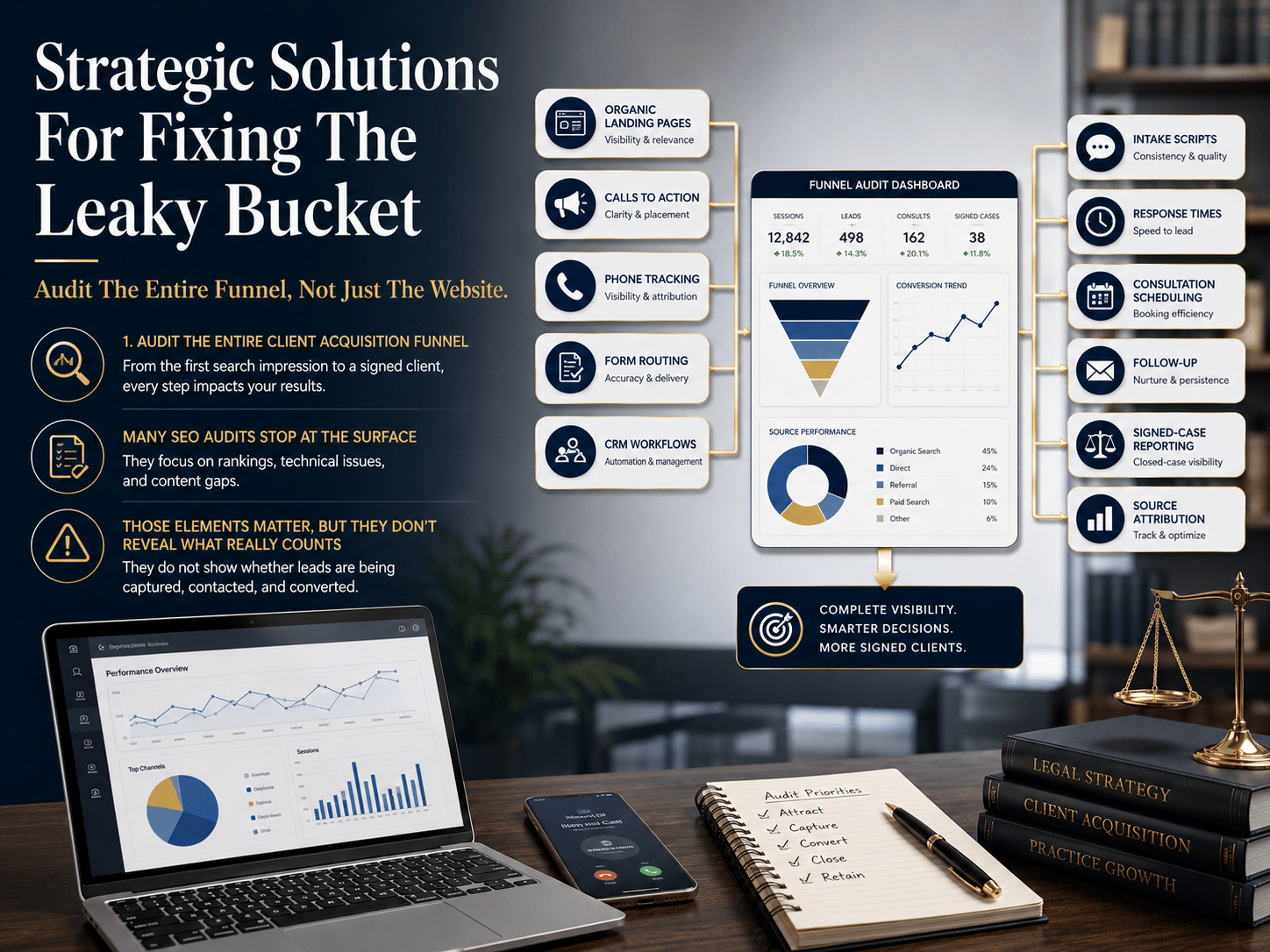
The first step is to audit the entire client acquisition funnel from search impression to signed client. Many SEO audits stop at rankings, technical issues, and content gaps. Those elements matter, but they do not reveal whether leads are being converted.
A complete funnel audit should examine organic landing pages, calls to action, phone tracking, form routing, CRM workflows, intake scripts, response times, consultation scheduling, follow-up, signed-case reporting, and source attribution.
The goal is to identify where viable prospects are being lost.
Align Content Strategy With Intake Reality
SEO content should attract the kinds of matters the firm actually wants. Intake data can help refine content strategy by showing which pages produce qualified leads and which pages generate noise.
For example, if a criminal defense firm receives many informational calls from a page about expungement but few paying clients, the firm may need to adjust the page’s call to action, clarify service scope, or build stronger conversion pathways. If a family law page generates strong consultation volume but weak signed rates, the issue may be fee expectations, consultation process, or lead qualification.
Intake data makes content strategy smarter.
Create Response Time Standards
Every firm should define response time standards for each inquiry channel. A website form should not sit in an inbox. A missed call should not wait until the next day. A chat inquiry should not disappear after business hours. Organic leads should enter the same disciplined system as paid leads.
The standard should be measurable and enforced. If the firm cannot respond quickly during peak demand, it may need better staffing, live answering support, CRM automation, or after-hours coverage.
Train Intake Staff As Conversion Professionals
Intake staff should be trained in practice-area qualification, communication, empathy, urgency recognition, conflict sensitivity, and scheduling. They should understand the firm’s ideal client profile and know how to guide prospects without giving legal advice.
Training should be ongoing. Call reviews, role-play, script refinement, and KPI analysis can improve performance over time. Intake is too important to leave to instinct.
Connect SEO Reporting To Revenue
The firm should not evaluate SEO solely by rankings and traffic. Reporting should connect organic visibility to inquiries, qualified leads, consultations, retained clients, and revenue where practical.
This creates accountability and prevents misdiagnosis. If rankings and traffic improve but signed cases do not, the firm can identify whether the problem is traffic quality, conversion design, intake speed, consultation performance, or follow-up.
Frequently Asked Questions About Law Firm SEO And Intake Optimization
Why Can A Law Firm Rank Well But Still Not Get More Clients?
A law firm can rank well but fail to gain clients if the post-click experience is weak. Rankings create visibility, but the website, calls to action, phone handling, form response, consultation scheduling, and attorney follow-up determine whether that visibility becomes revenue. Strong rankings without intake optimization often produce more missed opportunities rather than more signed cases.
Is Intake Optimization Part Of SEO?
Intake optimization is not a traditional ranking factor in the same way technical SEO, content relevance, or backlinks are. However, it is essential to SEO ROI. SEO brings prospective clients to the firm. Intake determines whether those prospects become consultations and clients. From a business standpoint, intake is inseparable from SEO performance because it controls whether organic visibility produces revenue.
What Is The Most Important Intake KPI For SEO ROI?
Lead response time is one of the most important intake KPIs because speed strongly affects contact and conversion opportunity. However, no single metric is enough. Firms should also track call answer rate, qualified lead rate, consultation booking rate, consultation show rate, signed-case conversion rate, and cost per signed case. Together, these metrics show whether SEO traffic is being captured and converted effectively.
How Quickly Should A Law Firm Respond To Organic Leads?
A law firm should respond as quickly as possible, ideally within minutes for high-intent inquiries. While exact benchmarks vary by practice area and staffing model, delayed responses reduce the likelihood of reaching the prospect before a competitor. Urgent practice areas such as criminal defense, personal injury, family law emergencies, and immigration detention matters require especially fast response systems.
How Does CRM Integration Improve SEO Performance?
CRM integration improves SEO performance measurement by connecting organic leads to intake status, consultations, signed clients, and revenue outcomes. Without CRM integration, firms may know how much traffic SEO generated but not whether that traffic produced profitable cases. CRM visibility helps firms refine content, improve intake, and allocate marketing budgets more intelligently.
Should Law Firms Use Call Tracking For SEO?
Yes, call tracking is extremely valuable when implemented correctly. It helps firms determine which pages, campaigns, and search sources generate phone inquiries. For law firms, phone calls are often among the highest-intent conversions. Without call tracking, organic SEO may be undervalued or misunderstood.
Can Better Intake Lower Cost Per Acquisition?
Yes. Better intake can lower cost per acquisition by converting more existing leads into signed clients without increasing marketing spend. If the firm improves call answer rates, response speed, qualification, consultation scheduling, and follow-up, it can often generate more retained clients from the same SEO traffic. This improves marketing efficiency and profitability.
What Is The Biggest Mistake Law Firms Make With SEO And Intake?
The biggest mistake is treating SEO and intake as separate systems. When marketing teams focus only on traffic and intake teams operate without data, the firm cannot accurately diagnose performance. The strongest firms align SEO, website conversion, CRM tracking, intake workflows, consultation processes, and revenue reporting into one integrated growth system.
Optimize Your Law Firm Intake With Forward Lawyer Marketing
Law firm SEO fails without intake optimization because visibility alone does not create revenue. Search rankings, impressions, and organic traffic are valuable only when the firm has the infrastructure to convert interested prospects into qualified consultations and signed clients.
The firms that win in modern legal marketing are not simply the firms with the most content or the highest rankings. They are the firms that combine strong organic visibility with fast response times, disciplined intake workflows, trained staff, CRM integration, accurate attribution, and consistent follow-up.
If your law firm is investing in SEO but not seeing proportional growth in signed cases, the next step is not necessarily more content or a larger marketing budget. The next step may be a full-funnel audit that examines what happens after the visitor clicks, calls, submits a form, or requests help.
Review your organic landing pages, calls to action, phone answer rates, form response times, intake scripts, CRM workflows, consultation booking rates, show rates, signed-case percentages, and cost per signed client. The bottleneck may not be search visibility. It may be the conversion system beneath it.
A law firm that aligns SEO and intake can turn organic traffic into a predictable growth engine. A firm that ignores intake may continue paying for visibility while competitors capture the clients it worked so hard to attract.
A stronger intake system can increase revenue without increasing marketing spend. For law firms competing in the modern U.S. legal market, that is one of the most practical and profitable growth opportunities available.
At Forward Lawyer Marketing, we’ve helped law firms throughout the United States expand their client base and enhance their local law firm’s visibility through services such as SEO, Website Optimization, Social Media Marketing, Local SEO, and more. If you want to boost your law firm’s visibility in your local area and attract more clients, please call us at 888-590-9687 for your free consultation and website audit.
