
How To Optimize Attorney Bios For AI Search And Google
Why Attorney Bios Are Now Strategic SEO Assets
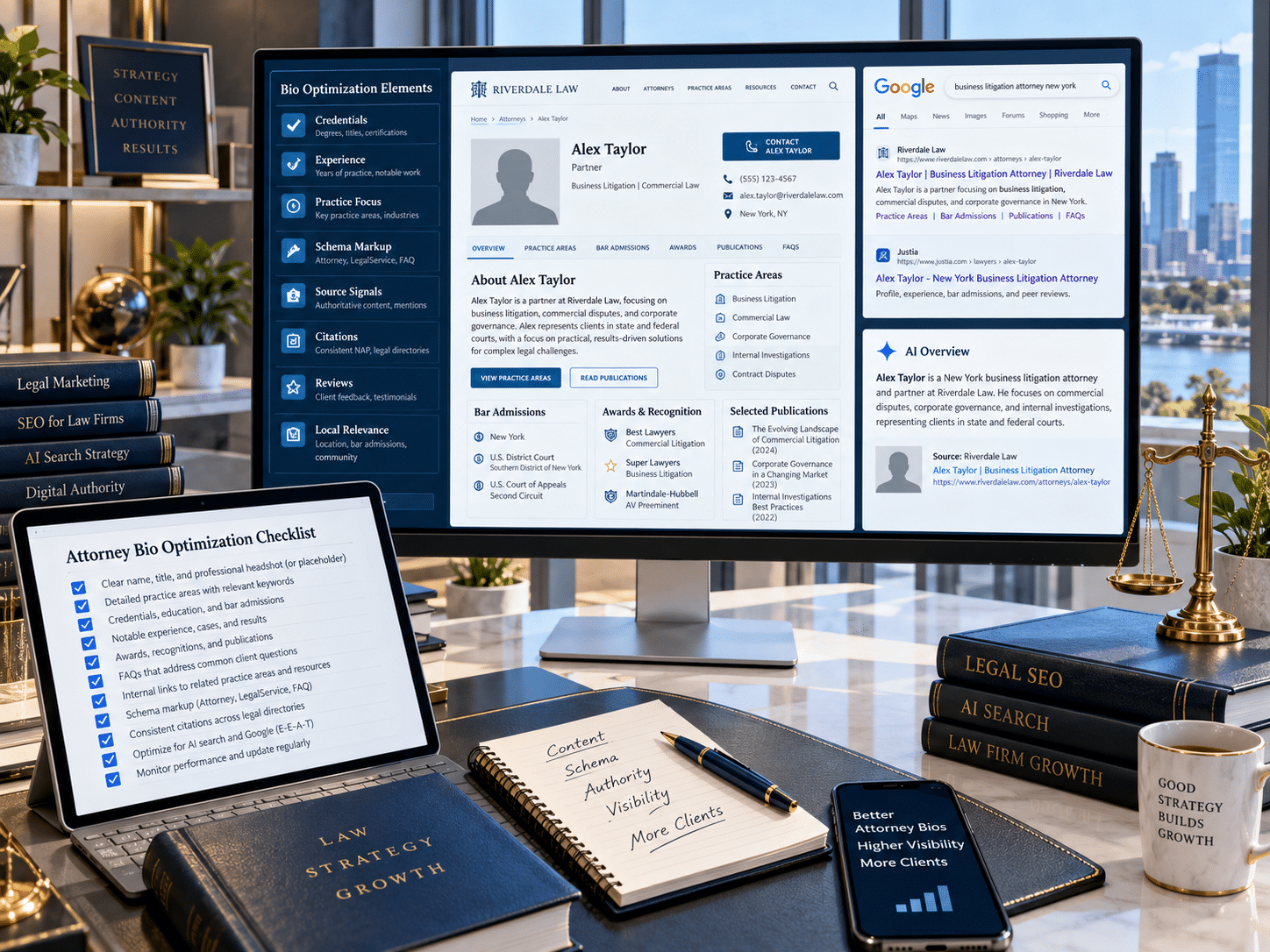
Attorney bios are often treated as basic credential pages, but they are among the most important authority assets on a law firm website. For Google Search, AI Overviews, AI Mode, ChatGPT search, Perplexity, and other discovery systems, an optimized attorney bio can help clarify who the attorney is, what they practice, where they are licensed, what topics they are connected to, and whether the firm’s content is tied to real legal expertise.
For law firms, this matters because legal content sits in a high-trust environment. Prospective clients may be researching injury claims, criminal charges, divorce, custody disputes, estate planning, immigration issues, employment disputes, or business litigation before contacting counsel. Search systems and users both need signals that the content is accurate, attorney-informed, jurisdictionally relevant, and trustworthy.
A thin bio that lists only a headshot, law school, and bar admission does not do enough. A strong attorney bio supports E-E-A-T, improves internal linking, reinforces entity recognition, helps local SEO, and gives prospective clients a reason to call. Forward Lawyer Marketing views attorney bios as conversion pages, authority pages, and AI search assets at the same time.
Build The Bio Around Searchable Attorney Entity Signals
Make Core Professional Information Complete And Consistent
The first job of an attorney bio is to establish the attorney as a clear entity. The page should include the attorney’s full name, title, firm affiliation, office location, bar admissions, courts admitted where relevant, education, practice focus, and contact pathway. This information should be consistent with state bar profiles, LinkedIn, legal directories, Google Business Profile connections, publication pages, and any professional organization profiles.
Consistency matters because search systems encounter the attorney across the web. If one profile uses a middle initial, another uses a nickname, and another lists outdated firm information, entity clarity weakens. The bio should become the source of truth that confirms who the lawyer is and what they handle.
Connect The Attorney To Specific Practice Areas
A bio should not simply say that an attorney handles “litigation” or “family law” if the firm wants visibility for specific case types. It should connect the attorney to the matters that drive the firm’s business.
A personal injury attorney bio may connect to car accidents, truck accidents, premises liability, wrongful death, catastrophic injuries, and insurance disputes. A criminal defense bio may connect to DUI, domestic violence, drug charges, assault, theft, probation violations, and expungement. A family law bio may connect to divorce, custody, child support, relocation, high-asset property division, and mediation.
This improves both user experience and search understanding. The bio helps Google and AI systems associate the attorney with specific legal topics instead of broad categories.
Strengthen E-E-A-T With Substantive Experience
Show Experience Without Unsupported Claims
Google’s helpful content guidance emphasizes strong E-E-A-T for sensitive topics, and legal content clearly requires trust. Attorney bios should make experience visible, but the language must remain accurate and compliant with applicable attorney advertising rules.
Instead of relying on vague claims such as “aggressive advocate” or “one of the best attorneys,” the bio should explain the attorney’s real work. It can describe case types handled, courts served, negotiation experience, litigation focus, publication history, professional leadership, speaking engagements, community involvement, and client-service philosophy.
Specificity is more persuasive than exaggeration. A divorce lawyer who handles business valuation and executive compensation issues should say so. A DUI lawyer who regularly addresses license consequences and chemical testing issues should make that clear. A personal injury lawyer who handles serious injury claims should explain the types of damages and disputes involved.
Include Authorship And Review Connections
Attorney bios should connect to content the lawyer authored, contributed to, or reviewed. This creates a visible relationship between the attorney and the firm’s legal resources.
If a lawyer reviewed a guide on truck accident evidence, the guide should link to the lawyer’s bio, and the bio should link back to the guide. If a family law attorney wrote articles on custody modification or high-asset divorce, those resources should be listed or linked. If a criminal defense lawyer contributes commentary on DUI procedure, that content should be connected.
This internal network helps demonstrate expertise to users and gives search systems clearer relationships among attorneys, topics, and pages.
Structure The Bio For Google And AI Readability
Use Clear Headings And Scannable Sections
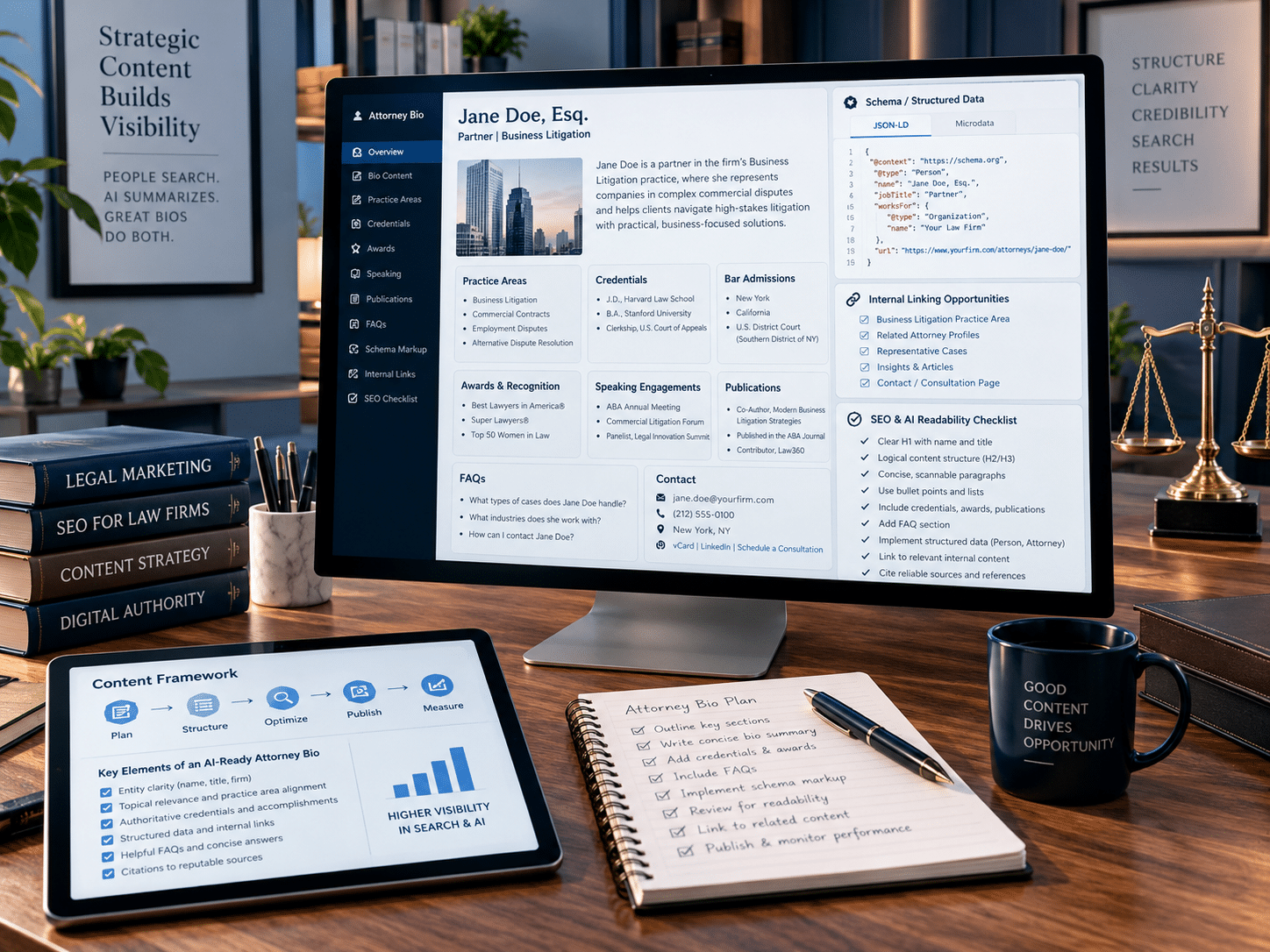
An attorney bio should be easy to understand quickly. The page should not be one long paragraph. Use clear sections for professional background, practice focus, admissions, representative legal issues, publications, speaking, memberships, and community involvement where applicable.
This structure helps prospective clients scan the page and helps search systems parse the content. AI search tools are more likely to understand and summarize structured information than vague narrative copy.
The bio should also answer questions users may have before calling. What does this lawyer handle? Where do they practice? What types of clients do they represent? What is their approach? How can someone schedule a consultation?
Lead With The Attorney’s Value Proposition
The opening paragraph should explain who the attorney helps and what legal problems they handle. It should not begin with generic childhood inspiration or a vague statement about dedication unless that story supports the client’s decision.
A stronger opening might explain that the attorney represents injured clients in serious motor vehicle and premises liability cases, defends people charged with DUI and felony offenses, or guides clients through complex divorce and custody disputes. The first paragraph should immediately connect the lawyer to the searcher’s legal need.
Use Internal Linking To Build Topical Authority
Link From Practice Pages To Attorney Bios
Every major practice area page should link to the attorneys who handle that work. This reinforces expertise and helps users move from a legal issue to the professional who may handle their case.
A truck accident page should link to the attorney who handles commercial vehicle litigation. A child custody page should link to the family law attorney who handles parenting disputes. A DUI page should link to the criminal defense attorney who handles DUI defense. These links should be natural and useful.
Link From Bios Back To Practice Pages
The relationship should work both ways. The attorney bio should link back to relevant practice area pages. This turns the bio into part of the firm’s topical architecture rather than an isolated profile.
Internal linking also improves conversion. A user who lands on the attorney bio through branded search, a directory, or AI search can quickly reach the service page that matches their legal problem.
Add Source Signals And External Validation
Link To Publications, Speaking, And Professional Profiles
A bio becomes stronger when it includes verifiable professional signals. If the attorney has written articles, spoken at CLE programs, appeared in media, held bar leadership roles, joined professional associations, or contributed to community programs, those items should be included where relevant.
External validation matters because AI search systems and users may encounter the attorney across many sources. The firm website should organize these signals clearly and accurately.
Keep Bar And Directory Profiles Aligned
The bio should match key external profiles. State bar listings, local bar pages, Avvo, Justia, Martindale-Hubbell, Lawyers.com, LinkedIn, and other professional records should use consistent names, practice areas, firm details, and office information.
This does not mean every profile must be identical. It means the attorney’s public identity should be coherent. Inconsistency can weaken trust and create confusion.
Improve Technical And Structured Data Signals
Use Person And LegalService Schema Carefully
Structured data can help Google understand people, organizations, and services on a page. Attorney bios may benefit from accurate Person schema, while firm and service pages may use Organization, LocalBusiness, LegalService, BreadcrumbList, Article, and related markup when appropriate.
Schema does not guarantee rankings or AI citations. It helps clarify entities. It should match visible page content and should not invent credentials, awards, reviews, offices, or specialties.
Make Bios Crawlable, Fast, And Mobile-Friendly
Attorney bios should be indexable, mobile-friendly, and easy to load. Avoid hiding important bio content in images, PDFs, inaccessible tabs, or scripts that search systems may struggle to process. The page should have a descriptive title tag, clear H1, useful headings, optimized images, and a direct path to consultation.
Many users evaluating attorneys do so on phones. If a bio is slow, hard to read, or missing clear contact options, the firm may lose qualified leads even when the attorney appears credible.
Optimize Bios For Conversion
Answer The Client’s Confidence Questions
A strong attorney bio should reduce uncertainty. Prospective clients want to know whether the attorney handles their issue, understands the local jurisdiction, communicates clearly, and has the background to guide them.
The bio should explain the attorney’s approach in practical terms. For example, a personal injury lawyer may emphasize evidence development and insurer communication. A family lawyer may discuss strategy, financial clarity, and child-focused planning. A criminal defense lawyer may discuss case evaluation, constitutional issues, and court preparation.
Include A Clear Call To Action
The bio should invite the user to take the next step. The call to action should be direct and professional, such as scheduling a consultation or contacting the firm to discuss the matter. Avoid guarantees or language that implies a specific outcome.
The phone number, form link, and office location should be easy to find. If the firm uses intake software, the bio should connect smoothly to that process.
Frequently Asked Questions About Attorney Bio Optimization
Do Attorney Bios Help SEO?
Yes. Attorney bios help connect legal content to real professionals. They support E-E-A-T, internal linking, entity recognition, branded search, and conversion. Thin bios miss a major opportunity.
Should Every Attorney Have A Separate Bio Page?
Yes, in most cases. Each attorney should have a dedicated, indexable page with unique professional information, practice focus, admissions, and links to relevant services or content.
Should Attorney Bios Include Keywords?
They should use natural legal terminology that reflects the attorney’s real practice. Do not stuff keywords. A bio should mention relevant practice areas, locations, and legal issues in a way that is accurate and readable.
Can Attorney Bios Help With AI Search?
Yes. AI search systems need entity clarity and source signals. A strong bio helps connect a lawyer to topics, locations, publications, and firm content, which can improve how the attorney is understood across search experiences.
How Often Should Bios Be Updated?
Attorney bios should be reviewed at least annually and whenever the attorney changes practice focus, gains admissions, publishes content, joins organizations, wins awards, moves offices, or leaves the firm.
Discuss Attorney Bio Optimization For AI With Forward Lawyer Marketing
Attorney bios are no longer simple profile pages. They are authority assets that influence Google visibility, AI search understanding, local trust, and client conversion. A strong bio should identify the attorney clearly, connect them to specific legal services, demonstrate real experience, support E-E-A-T, link to relevant content, and guide users toward consultation.
Forward Lawyer Marketing helps law firms turn attorney bios into stronger SEO and AI search assets. If your firm’s bios are thin, outdated, disconnected from practice pages, or missing structured authority signals, now is the time to update them.
To evaluate your attorney bios for Google, AI search, and lead generation, contact Forward Lawyer Marketing or call (888) 590-9687 to discuss your firm’s AI visibility and the clients you want to reach.
Law Firm AI Visibility Checker
