
How Law Firms Can Rank In Google AI Overviews

Google Search is undergoing one of the most consequential transformations in the history of digital marketing. For more than two decades, law firms primarily competed for visibility through conventional organic rankings based on keyword targeting, backlinks, technical optimization, and local authority signals. While those ranking factors still matter, Google’s increasing reliance on artificial intelligence fundamentally changes how legal information is discovered, interpreted, summarized, and presented to consumers.
Google AI Overviews, which evolved from the company’s Search Generative Experience initiative, represent a major shift away from the traditional “ten blue links” model toward AI-generated summaries capable of synthesizing information from multiple online sources simultaneously. Instead of merely directing users toward websites, Google increasingly attempts to answer legal questions directly inside the search interface itself.
For the legal industry, this shift carries enormous implications. Potential clients researching legal issues are now more likely to encounter AI-generated summaries before ever visiting a law firm website. Consumers searching for information regarding personal injury claims, divorce proceedings, criminal charges, workers’ compensation disputes, estate planning, or immigration concerns may receive synthesized legal overviews directly within search results. These summaries influence trust, authority perception, and ultimately hiring decisions.
As AI-driven search evolves, law firms are no longer competing exclusively for traditional organic rankings. They are now competing for inclusion within AI-generated legal summaries, cited source panels, conversational follow-up prompts, and entity-based recommendation systems. The firms consistently surfaced within AI Overviews may gain disproportionate visibility and authority compared to competitors relying solely on legacy SEO tactics.
This transition is particularly important because legal content falls within Google’s “Your Money or Your Life” classification. Legal information directly impacts financial security, personal liberty, family structure, healthcare access, employment rights, immigration status, and other high-stakes matters. Because of these risks, Google applies significantly higher trust thresholds to legal content than it does to ordinary commercial topics. AI-generated legal summaries rely heavily on signals involving credibility, expertise, corroboration, accuracy, and authority.
For law firms, modern SEO is increasingly becoming inseparable from what many marketers now call Generative Engine Optimization, often abbreviated as GEO. GEO focuses on optimizing websites, digital entities, and legal content ecosystems so they can be surfaced, trusted, summarized, and cited within AI-driven search environments.
Importantly, ranking within AI Overviews is not achieved through gimmicks or simplistic “AI optimization hacks.” The firms most likely to succeed are generally those with strong foundational SEO, deep topical authority, consistent local relevance, technically sound websites, authoritative legal content, and broad digital trust signals across the web.
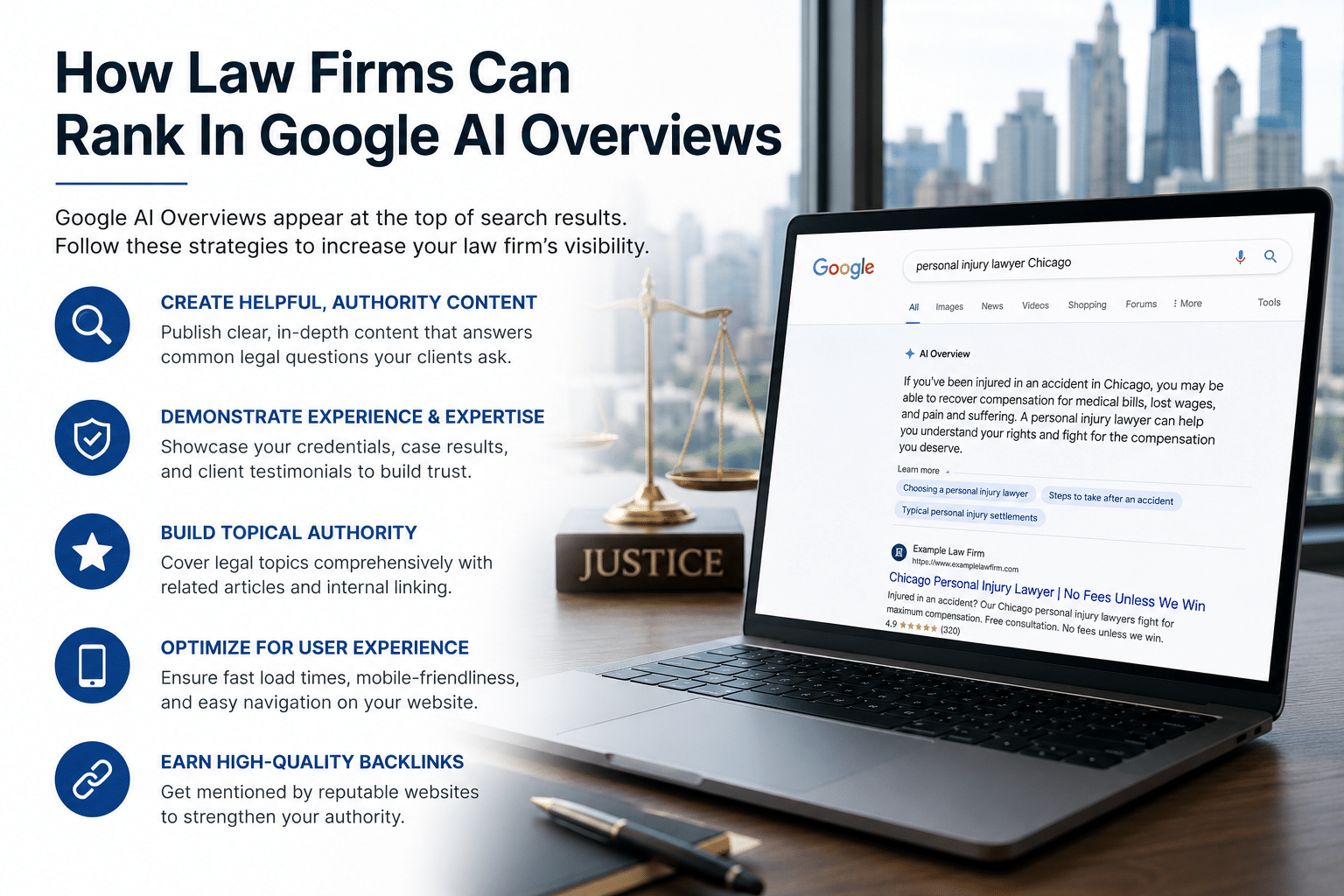
The Evolution Of Search In The Legal Industry
Why AI Search Represents A Structural Change Rather Than A Minor Update
Many law firms mistakenly interpret Google AI Overviews as merely another search feature similar to featured snippets or People Also Ask boxes. In reality, AI-generated search represents a structural transformation in how Google processes and delivers information.
Traditional search engines primarily operated as retrieval systems. A user entered a search query, and Google returned ranked webpages based on relevance and authority signals. The user then evaluated those webpages independently.
AI Overviews alter that relationship substantially. Google increasingly attempts to synthesize information directly on behalf of the user. Instead of merely helping users locate information, the search engine increasingly attempts to interpret, summarize, and contextualize that information itself.
This distinction matters enormously within legal marketing because consumers often seek preliminary educational guidance before hiring an attorney. A user searching “How long do I have to file a personal injury lawsuit in Illinois?” may now receive a synthesized legal explanation directly within the search results before clicking through to any individual law firm website.
That means law firms are now competing not only for traffic, but also for semantic authority within Google’s underlying retrieval systems.
Why Legal Search Is Especially Sensitive To AI Trust Signals
Google’s AI systems appear significantly more cautious in legal searches than in lower-risk commercial categories. Because legal information can materially affect consumers’ financial and personal outcomes, Google increasingly prioritizes signals involving trustworthiness and expertise.
This creates substantial opportunities for authoritative law firms while simultaneously increasing the difficulty of ranking shallow or generic legal content.
Many outdated law firm SEO strategies relied heavily on mass-producing low-depth location pages or repetitive keyword-targeted articles. Those approaches are becoming increasingly ineffective within AI-driven search environments because AI systems attempt to identify genuinely authoritative sources capable of supporting trustworthy legal summaries.
The firms most likely to succeed moving forward will generally be those that establish themselves as reliable legal entities rather than merely optimized webpages.
How Google AI Overviews Pull Legal Information
Retrieval-Augmented Systems And Semantic Understanding
Although Google does not publicly disclose every component of its AI Overview infrastructure, industry analysis strongly suggests these systems rely heavily on retrieval-augmented architectures. Rather than generating responses purely from static training data, Google appears to retrieve authoritative information dynamically from indexed sources and synthesize those materials into generated summaries.
This means that law firms must optimize not only for indexing, but also for retrieval eligibility.
AI retrieval systems increasingly evaluate whether a page demonstrates:
Jurisdictional accuracy, semantic relevance, legal expertise, contextual depth, topical completeness, geographic specificity, structured organization, and corroborated authority signals.
Traditional keyword repetition alone is insufficient.
For example, a page discussing “Illinois workers’ compensation claims” may perform well not because it repeatedly uses exact-match keywords, but because it thoroughly addresses related concepts such as temporary total disability benefits, independent medical examinations, arbitrator hearings, settlement approvals, employer retaliation, vocational rehabilitation, and Illinois Workers’ Compensation Commission procedures.
The semantic ecosystem surrounding the topic helps AI systems determine whether the source demonstrates sufficient authority to contribute meaningfully to generated legal summaries.
Why Contextual Authority Is Replacing Narrow Keyword Optimization
Google’s AI systems increasingly prioritize contextual understanding over isolated keyword targeting.
This means legal content should be written to comprehensively educate users rather than mechanically target phrases. A well-developed article discussing Chicago divorce mediation should naturally incorporate discussions involving parenting plans, financial disclosures, property allocation, mediation confidentiality, court approval procedures, Cook County filing practices, and enforcement considerations.
The broader contextual depth surrounding a legal topic strengthens semantic authority and improves retrieval relevance within AI systems.
This transition mirrors Google’s broader movement toward entity-based search and topical authority evaluation over the last several years.
Building Legal Content That Performs In AI Overviews
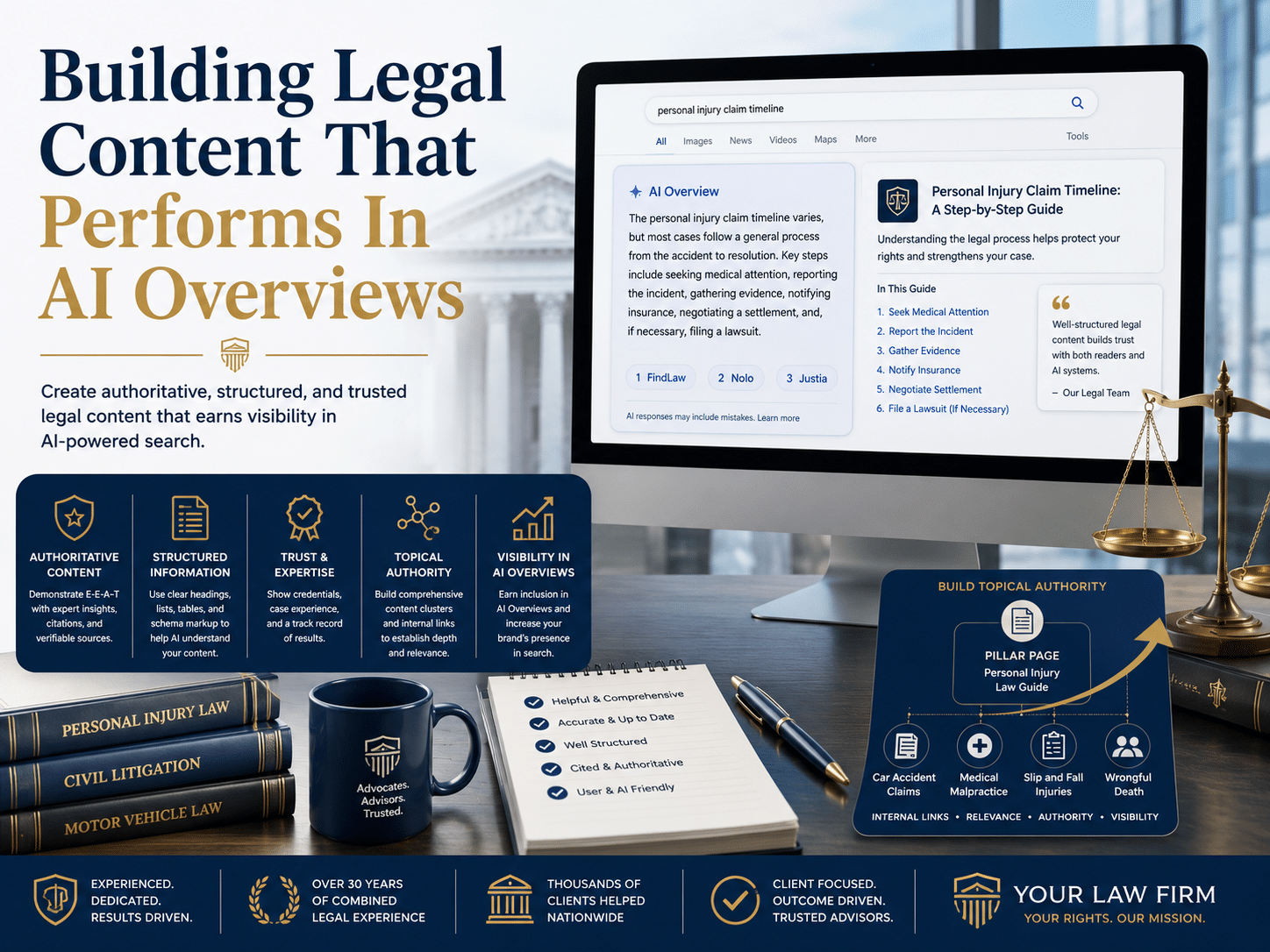
Why Thin Legal Content Is Losing Visibility
Many law firm websites still rely heavily on shallow practice-area pages written primarily to satisfy keyword placement goals rather than provide meaningful educational value.
These pages often contain repetitive language, vague descriptions, generic legal explanations, and minimal jurisdiction-specific guidance. While such content may have performed adequately years ago, AI-driven search systems increasingly deprioritize low-information legal content because it offers little informational gain.
Google’s AI systems appear increasingly focused on identifying sources capable of contributing unique educational value to generated summaries.
As a result, law firms seeking AI visibility should prioritize depth, specificity, structure, and semantic comprehensiveness.
Information Gain And Legal Content Strategy
Information gain has become one of the most important concepts in modern legal SEO. In practical terms, information gain refers to a source’s ability to contribute unique or expanded value beyond what already exists across competing webpages.
For law firms, this means content should move beyond generic explanations and instead provide nuanced guidance grounded in jurisdictional realities.
A strong article regarding Illinois child support should not merely define the Income Shares Model. It should explain how Cook County courts evaluate financial disclosures, how parenting time influences support calculations, how prior support obligations affect net income, how healthcare expenses are allocated, and how modifications are handled procedurally.
That additional depth creates stronger information gain signals and improves AI retrieval relevance.
Structuring Legal Content For AI Extraction
Google AI Overviews frequently extract concise explanations from well-structured pages.
This means law firms should pay careful attention to semantic organization and header hierarchy. Content should be segmented logically using clean H2 and H3 structures that clearly identify legal concepts, procedures, timelines, requirements, and frequently asked questions.
AI systems appear to favor content that:
Explains concepts directly, organizes information cleanly, answers questions clearly, provides contextual elaboration, and maintains semantic consistency throughout the article.
Long, disorganized blocks of text may reduce interpretive clarity, while excessively fragmented bullet-heavy formatting may weaken authority perception and semantic depth.
The strongest legal content typically combines clear organizational structure with dense informational prose.
E-E-A-T And Legal Authority Signals
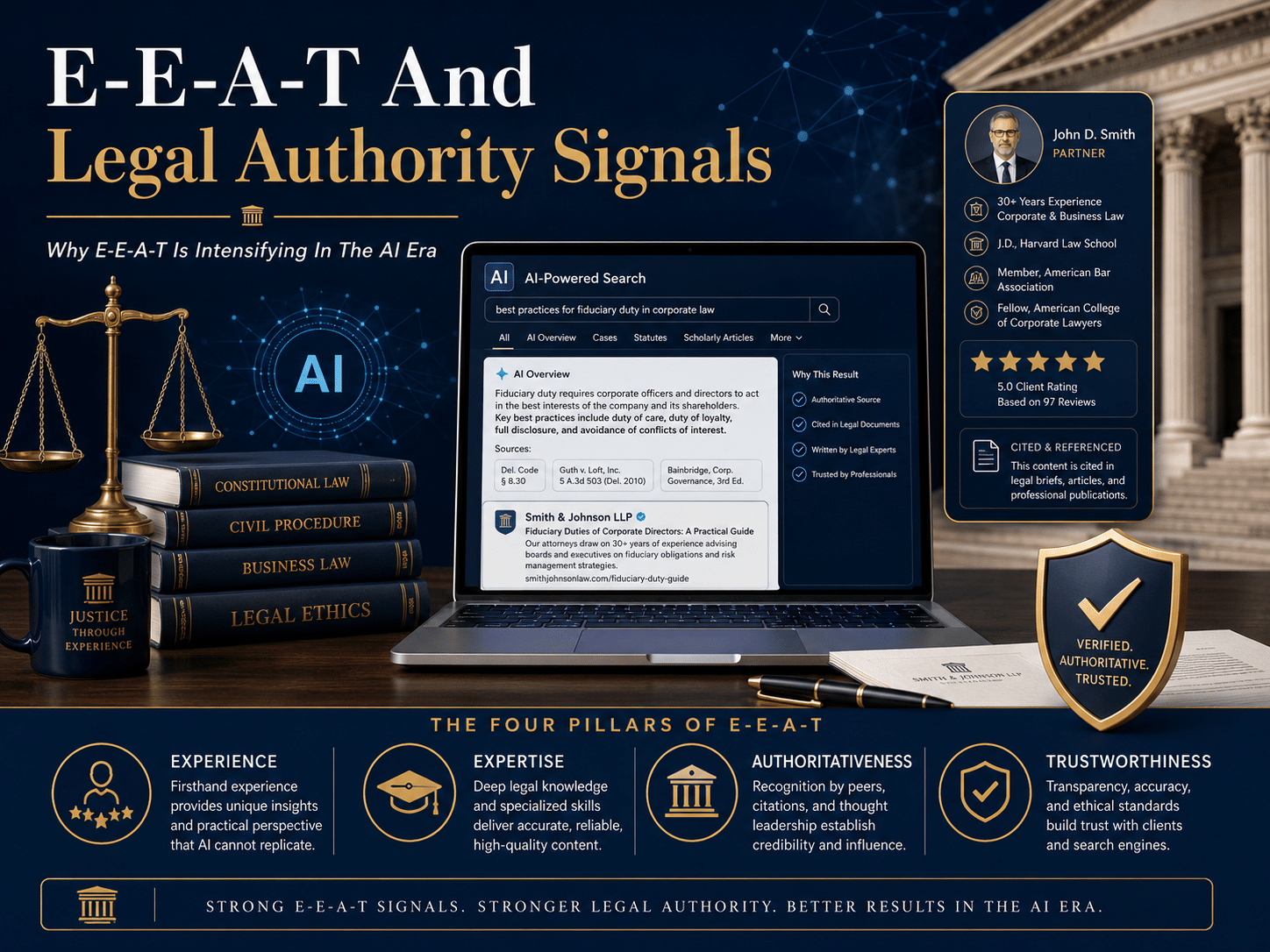
Why E-E-A-T Is Intensifying In The AI Era
Google’s framework emphasizing Experience, Expertise, Authoritativeness, and Trustworthiness has become even more important within AI-driven search environments.
AI-generated summaries inherently amplify the risks associated with misinformation. Because of this, Google appears increasingly selective regarding which legal sources are incorporated into AI-generated answers.
Law firms seeking visibility in AI Overviews should therefore strengthen every available authority signal.
Demonstrating Legal Expertise Online
Expertise signals extend far beyond simply listing attorney credentials.
Law firms should develop detailed attorney biographies explaining:
Bar admissions, years of experience, speaking engagements, publications, litigation experience, community involvement, practice concentration, and professional associations.
Content should also reflect procedural familiarity and jurisdictional understanding. Articles discussing local court procedures, filing nuances, mediation practices, discovery timelines, or settlement approval processes often demonstrate practical expertise more effectively than generalized legal marketing language. The vast majority of law firms are lacking tremendously in creating robust “About Us” and individual attorney pages. Instead of shallow content, these pages should be extensive bios exceeding 1500 words.
Why Consistency Across The Web Matters
Google increasingly evaluates authority through corroboration across multiple online sources.
This means a law firm’s authority is influenced not only by its own website, but also by:
Google Business Profile data, legal directories, bar association memberships, local citations, reviews, press mentions, speaking appearances, podcast participation, and professional references.
Strong entity consistency reinforces digital trust signals within AI retrieval systems.
Trustworthiness And Ethical Legal Marketing
Legal marketing carries unique ethical responsibilities because consumers rely on legal information during vulnerable or high-stakes situations.
Law firms should avoid exaggerated claims, misleading guarantees, sensational language, or unverifiable performance statements.
Clear disclaimers, accurate jurisdictional information, transparent communication practices, and professional tone all strengthen trustworthiness signals.
Trust increasingly functions as both a marketing factor and a technical retrieval factor within AI-driven search systems.
Structured Data And Schema Optimization
Why Schema Helps AI Systems Interpret Legal Websites
Structured data provides machine-readable context, helping search engines understand legal entities more accurately.
Although schema implementation does not directly guarantee AI Overview inclusion, it improves interpretive clarity and semantic understanding.
For law firms, structured data can help identify:
Practice areas, attorney relationships, office locations, FAQs, service categories, geographic relevance, reviews, organizations, and contact information.
This contextual framework helps Google interpret how pages relate to broader legal entities and local markets.
Important Schema Types For Law Firms
Several schema types are especially valuable within legal SEO.
LegalService schema helps define specific legal services offered by the firm.
Attorney or Person schema clarifies professional identity and credentials.
LocalBusiness schema reinforces geographic authority and location relevance.
FAQPage schema can support question-answer extraction within AI-generated summaries. However, as of May 7th, 2026, Google no longer supports FAQ schema.
Organization schema strengthens entity-level brand understanding.
Proper schema implementation should remain technically accurate and aligned with visible onsite content.
Semantic Clarity And AI Retrieval
Structured data strengthens those relationships by clarifying how attorneys, practice areas, locations, and services connect contextually.
The clearer the semantic relationships, the easier it becomes for AI systems to evaluate retrieval relevance confidently.
The Importance Of Local SEO In AI Overviews
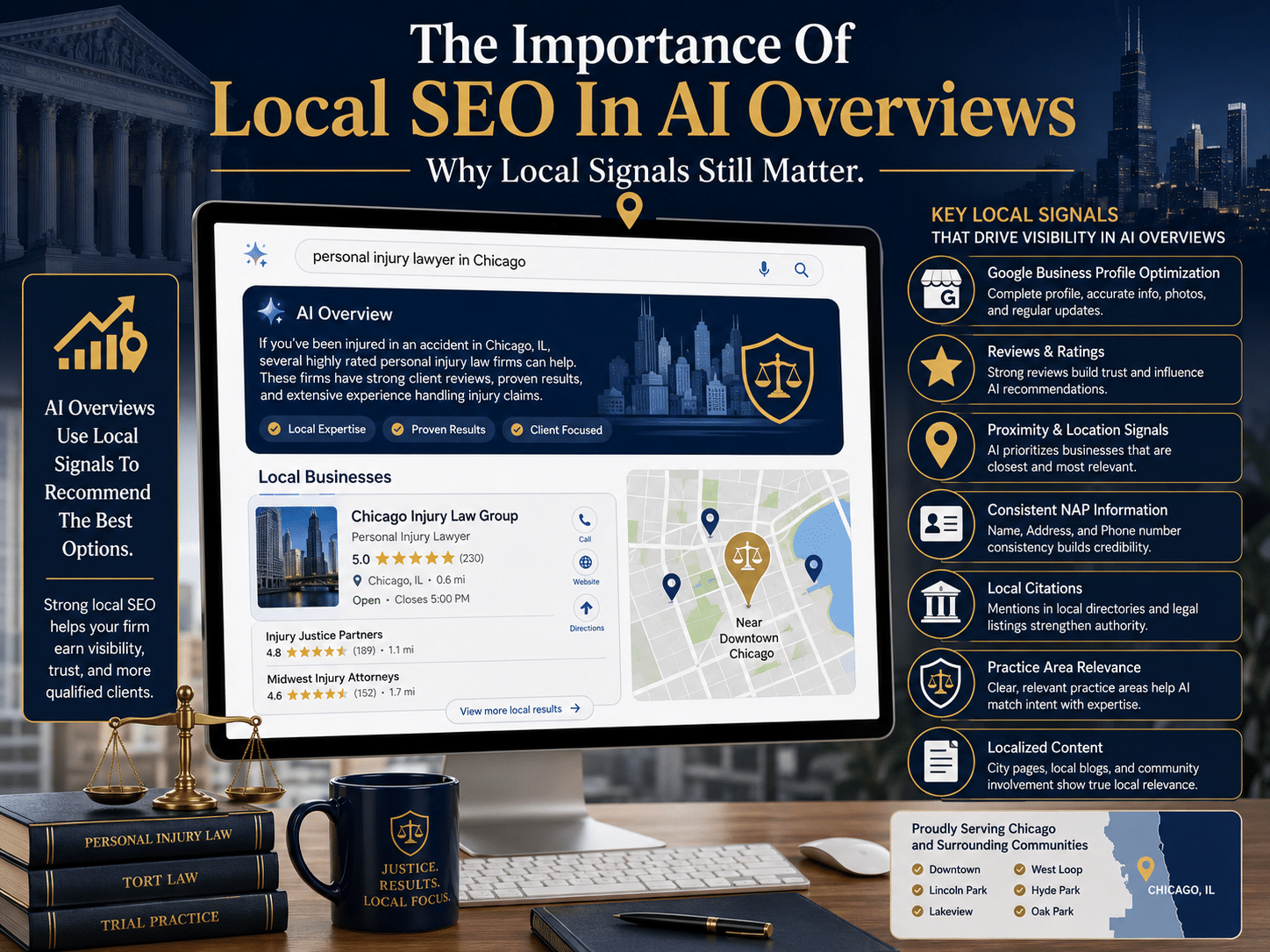
Why Local Signals Still Matter
Despite the growth of AI-driven search, local SEO remains critically important within the legal industry because legal hiring decisions remain geographically constrained.
Consumers typically seek attorneys licensed within their state and familiar with local courts, judges, and procedures.
As a result, AI systems appear to incorporate local relevance heavily when surfacing legal recommendations or summaries.
Google Business Profile Optimization
Google Business Profile remains one of the most influential local authority assets available to law firms.
Strong profiles typically demonstrate:
Accurate NAP consistency, detailed service descriptions, strong review profiles, professional imagery, geographic specificity, active updates, and practice-area clarity.
These signals help reinforce legitimacy and local prominence within both traditional local search and AI retrieval environments.
Local Citations And Regional Authority
Consistent citations across legal directories, local business associations, chambers of commerce, and bar organizations reinforce geographic trust signals.
For example, a Milwaukee worker’s compensation law firm consistently referenced across Wisconsin legal directories, local organizations, and professional associations may strengthen its entity authority within AI-generated legal summaries involving Wisconsin worker’s compensation law. (Note that Wisconsin positions the apostrophe differently than virtually every other state.)
Hyperlocal authority increasingly matters.
Measuring Visibility In AI Overviews
Why AI Visibility Is Difficult To Track
Traditional rank tracking systems do not fully capture AI-generated visibility because AI Overviews function differently from ordinary organic rankings.
A law firm may appear within AI-generated summaries even when its traditional rankings fluctuate independently.
This means firms increasingly need broader visibility frameworks focused on semantic presence and authority growth rather than isolated keyword positions alone.
Indicators Of Strong AI Visibility
Several indirect indicators may suggest improving AI relevance.
These include:
Growth in informational query traffic, increased branded searches, expanded long-tail visibility, stronger FAQ impressions, improved People Also Ask exposure, increased topical keyword footprint, and stronger engagement metrics.
AI visibility often overlaps substantially with broader topical authority growth.
Why Entity Recognition Matters
Modern search increasingly revolves around entities rather than standalone webpages.
Law firms should therefore focus on strengthening overall digital entity authority through consistent branding, authority development, structured data, citation consistency, and broad semantic relevance.
The stronger the entity, the greater the likelihood of inclusion within AI-generated legal ecosystems.
Frequently Asked Questions About Google AI Overviews
What Are Google AI Overviews?
Google AI Overviews are AI-generated summaries that appear directly within search results to provide synthesized answers based on information retrieved from multiple online sources. They represent Google’s shift toward conversational and generative search experiences.
Can Law Firms Directly Optimize For AI Overviews?
Law firms cannot force inclusion within AI Overviews directly. However, they can significantly improve their likelihood of being retrieved, summarized, and cited by strengthening topical authority, semantic clarity, technical SEO, structured data, and digital trust signals.
Does Traditional SEO Still Matter?
Absolutely. AI Overviews still rely heavily on underlying search infrastructure involving indexing, authority evaluation, local relevance, technical optimization, and semantic understanding.
Traditional SEO remains foundational to AI visibility.
Why Is E-E-A-T So Important For Lawyers?
Legal content falls under Google’s YMYL standards because inaccurate legal information can materially affect consumers’ lives. As a result, AI systems apply elevated scrutiny to legal sources and prioritize trustworthiness, expertise, and authority.
Can AI Overviews Reduce Website Traffic?
In some situations, yes. Certain informational searches may become increasingly “zero-click” because users receive partial answers directly within search results.
However, authoritative firms may still benefit substantially through increased visibility, trust reinforcement, and early-stage brand exposure.
Is Long-Form Content Better For AI Search?
Long-form content often performs well because it provides broader semantic depth and contextual coverage. However, informational quality and organizational clarity matter more than raw length alone.
Comprehensive educational content generally outperforms shallow keyword-targeted pages.
How Important Is Local SEO For AI Visibility?
Local SEO remains extremely important because legal services are inherently jurisdictional. Google appears to incorporate local authority signals heavily when generating attorney-related summaries and recommendations.
Contact Forward Lawyer Marketing to Rank Your Law Firm in AI Overviews
Google AI Overviews represent a major structural shift in how legal consumers discover and evaluate attorneys online. The evolution from traditional search rankings toward AI-generated summaries fundamentally changes the mechanics of legal visibility, authority development, and digital trust.
Law firms can no longer rely solely on outdated keyword-targeting strategies or thin practice-area pages. Modern legal SEO increasingly requires deep topical authority, strong E-E-A-T signals, semantic clarity, structured data implementation, local prominence, and comprehensive educational content ecosystems.
The firms most likely to dominate AI-driven search environments will generally be those that establish themselves as authoritative legal knowledge entities rather than merely optimized marketing websites.
This means investing strategically in:
Comprehensive long-form content, local SEO infrastructure, structured data, technical optimization, citation consistency, attorney authority development, semantic organization, and digital trust reinforcement.
Importantly, AI optimization should not be viewed as separate from traditional SEO. Instead, AI visibility increasingly emerges from strong foundational SEO combined with expanded semantic authority and entity-level credibility.
As Google continues integrating AI deeper into legal search experiences, firms that proactively strengthen their digital authority systems now will likely gain substantial long-term competitive advantages in both organic rankings and AI-generated legal discovery environments.
Forward Lawyer Marketing is recognized as an active agency in the legal marketing space, focusing on adapting traditional SEO strategies for AI-driven visibility, particularly within Google’s Search Generative Experience (SGE) and AI Overviews. Contact our Generative SEO team today at 888-590-9687 to learn how we can help you rank your law firm in Google AI Overviews and dominate your competition.
