
How To Audit A Law Firm Website For LLM Visibility
Why LLM Visibility Now Matters For Law Firms
Law firm websites are no longer evaluated only by traditional rankings, blue-link click-through rates, and local map visibility. Prospective clients now use AI Overviews, AI Mode, ChatGPT search, Perplexity, Copilot, Gemini, and other answer engines to research legal questions before deciding which firm to contact. These systems may summarize legal concepts, compare options, cite sources, and influence branded searches before a user ever reaches the firm’s website.
For law firms, this change raises a practical question: can large language models understand, trust, and cite your website? A site may have practice area pages and blog posts, but if the content is thin, outdated, technically inaccessible, disconnected from attorney authority, or unclear about jurisdiction, it may have limited LLM visibility.
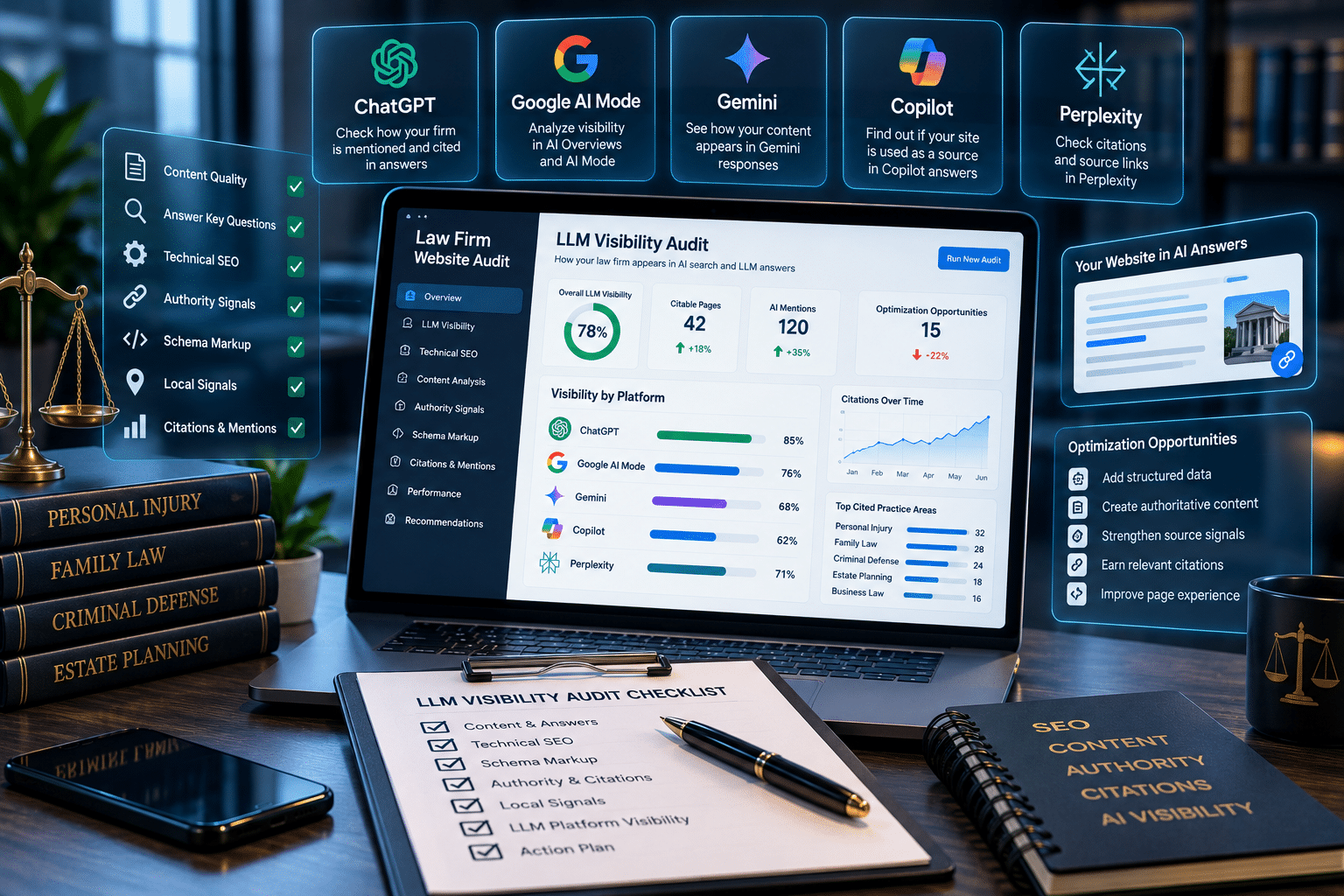
An LLM visibility audit is not a replacement for SEO. It is an expansion of SEO. The audit should evaluate whether the website is crawlable, indexable, structured, source-worthy, entity-rich, jurisdictionally accurate, and useful enough to appear in AI-assisted discovery.
Start With Technical Eligibility
Confirm Indexing And Snippet Eligibility
A law firm website cannot perform in AI search if its important pages are not eligible for search visibility. Google has stated that pages must be indexed and eligible to appear with a Search snippet to be eligible as supporting links in AI Overviews or AI Mode. That makes indexation the first audit step.
Review the homepage, practice area pages, attorney bios, location pages, major guides, FAQs, and high-value blog posts. Confirm that they are not blocked by robots.txt, hidden behind noindex tags, canonicalized incorrectly, or buried in JavaScript that search systems struggle to process. Pages should have descriptive title tags, useful meta descriptions, crawlable internal links, and readable body content.
Check Access For AI Search Crawlers
LLM visibility also depends on whether AI-connected systems can access the site. Some platforms use their own crawlers or rely on search indexes. A technical audit should review robots.txt directives, firewall settings, CDN rules, security plugins, and server logs where available.
For example, OpenAI states that websites must allow OAI-Searchbot crawling and allow traffic from published searchbot IP addresses to be eligible for inclusion in ChatGPT search. If a site blocks important bots unintentionally, the firm may reduce its visibility in AI-assisted systems.
Audit Content For Clear Answers
Identify Whether Pages Answer Real Legal Questions
LLMs are designed to answer questions. A law firm website that opens every page with generic marketing language gives answer engines little useful information to extract. Each major page should answer a specific legal question clearly and early.
A car accident page should explain what to do after a crash, what evidence matters, and how insurance disputes arise. A DUI page should address court dates, license consequences, chemical testing, and defense issues. A divorce page should explain custody, support, property division, mediation, and temporary orders. The page should answer before it sells.
This does not mean reducing content to short answers. Strong pages use a direct answer first, then add jurisdictional context, legal nuance, examples, and next steps.
Evaluate Whether Content Is Too Thin
Thin legal content is a major LLM visibility problem. Pages that repeat broad claims such as “we fight for you” or “contact an experienced attorney” do not demonstrate expertise. They also fail to explain the legal issue in a way AI systems or prospective clients can use.
A strong audit should identify pages that need expansion, consolidation, or rewriting. Thin city pages, generic FAQs, outdated blog posts, and short practice pages should be reviewed carefully. The goal is not more words for their own sake. The goal is more useful legal substance.
Evaluate Jurisdictional Specificity
Make The State And Local Context Clear
Legal answers depend on jurisdiction. Statutes of limitation, comparative fault, DUI penalties, custody standards, probate procedures, employment deadlines, and family law terminology vary by state. A law firm website should clearly identify the state, county, or city context where relevant.
A generic “personal injury lawyer” page is less useful than a page that explains how the firm handles injury claims under the relevant state law. A generic custody page is weaker than one that reflects the terminology and procedure of the applicable jurisdiction.
LLM systems need context to avoid overgeneralization. The more clearly the site explains its jurisdiction, the easier it is to associate the firm with specific legal answers.
Avoid Misleading Location Signals
A law firm should not imply offices where none exist or create thin pages for every nearby city without meaningful local value. Local content should be accurate, useful, and connected to legitimate service areas or office locations. This supports both ethics and search clarity.
Audit Attorney Entity Signals
Connect Content To Real Lawyers
Important legal pages should connect to attorney bios. Attorney bios should connect back to the practice areas the lawyer handles. This relationship helps users and search systems understand who is responsible for the information.
A strong bio should include bar admissions, practice focus, education, professional memberships, publications, speaking, recognitions where accurate, and related content. It should not function as a short resume disconnected from the rest of the site.
For LLM visibility, attorney bios help establish entity clarity. The system should be able to understand that a specific lawyer at a specific firm handles specific matters in specific jurisdictions.
Add Authorship And Review Signals
High-value legal content should identify whether it was written or reviewed by an attorney. Updated dates can also help users understand whether the content has been maintained. These signals do not guarantee citation, but they support trustworthiness.
Law firms should also review advertising language. Avoid guaranteed results, unsupported “best lawyer” claims, misleading specialist language, and case results that imply similar outcomes are likely. Legal marketing must remain accurate and professionally responsible.
Review Structured Data And Site Architecture
Use Schema To Clarify Entities
Structured data can help search systems understand the firm, attorneys, locations, articles, services, breadcrumbs, and FAQs. Useful schema types may include Organization, LegalService, LocalBusiness, Person, BreadcrumbList, Article, and FAQPage when accurate.
Schema should match visible content. It should not invent offices, awards, reviews, credentials, or services. Structured data is a clarity tool, not a shortcut to visibility.
Strengthen Internal Linking
Internal linking helps explain relationships among topics. A truck accident guide should link to the truck accident practice page, attorney bios, serious injury pages, and relevant local pages. A DUI article should link to DUI defense, license suspension, breath testing, and the criminal defense attorney bio. A divorce page should link to custody, support, property division, mediation, and related attorney profiles.
A law firm website should operate like a connected authority system, not a folder of disconnected pages.
Evaluate Source Signals And External Validation
Add Reliable References Where Appropriate
Source signals matter in AI-driven discovery. When a page discusses statutes, court procedures, agency deadlines, official forms, or legal standards, it should cite reliable authority where appropriate. This may include statutes, court websites, administrative agencies, bar resources, or government materials.
The goal is not to turn every practice page into a legal brief. The goal is to support important legal claims and make the page more trustworthy.
Check External Entity Consistency
LLMs may encounter the firm across the broader web. Review the firm’s Google Business Profile, state bar profiles, legal directories, LinkedIn pages, local news mentions, podcast appearances, professional organization pages, and review platforms. Firm names, attorney names, office addresses, phone numbers, and practice descriptions should be consistent.
Inconsistent public information can weaken entity confidence. Consistency helps AI systems and users understand that the same firm is being referenced across sources.
Test Visibility Across AI Platforms
Run Controlled Query Tests
An LLM visibility audit should include manual testing. Search for branded, practice-area, local, and question-based queries across Google AI features, ChatGPT search, Perplexity, Copilot, and Gemini where available.
Test questions a real client might ask. For a personal injury firm, ask about truck accident evidence, insurance adjusters, delayed medical treatment, or comparative fault in the firm’s state. For a family law firm, test custody, support, relocation, and high-asset divorce questions. For a criminal defense firm, test DUI consequences, license issues, search and seizure, and court process.
Document whether the firm appears, whether competitors appear, what sources are cited, and what content types are favored.
Compare Against Competitor Citations
If competitors appear in AI answers and the firm does not, review what they are doing differently. They may have better topical depth, clearer attorney bios, stronger source citations, more external mentions, better local pages, or more structured content.
The audit should identify whether the visibility gap is technical, content-related, local, authority-based, or reputational.
Measure And Prioritize Improvements
Use Search Console And Analytics Data
Google has introduced reporting for generative AI performance in Search Console, though access and rollout may vary. Law firms should review available Search Console data, organic queries, pages receiving impressions, branded searches, referral traffic, and conversion paths.
Analytics should connect visibility to business outcomes. A page that appears in AI search but produces no qualified consultations may need a stronger conversion path.
Build An Action Plan
The audit should end with priorities. Common recommendations may include rewriting thin practice pages, improving attorney bios, adding source citations, fixing indexing problems, implementing schema, building internal links, refreshing outdated content, strengthening Google Business Profile alignment, and improving call-to-action placement.
Not every issue has equal value. Prioritize pages tied to profitable practice areas and high-intent searches.
Frequently Asked Questions About LLM Visibility Audits
What Is LLM Visibility For Law Firms?
LLM visibility refers to whether a law firm’s content can be found, understood, cited, summarized, or recommended by AI-driven search systems and answer engines.
Is LLM Visibility The Same As SEO?
No. It overlaps heavily with SEO, but it adds emphasis on source clarity, entity signals, extractable answers, structured data, attorney authority, and AI platform testing.
Can A Law Firm Guarantee AI Citations?
No. No firm or agency can guarantee citation in AI Overviews, AI Mode, ChatGPT search, or Perplexity. The goal is to improve eligibility, clarity, authority, and usefulness.
How Often Should A Law Firm Audit LLM Visibility?
Competitive firms should review LLM visibility at least quarterly, with deeper audits after major website changes, content updates, attorney changes, office moves, or search visibility declines.
What Is The Biggest LLM Visibility Mistake?
The biggest mistake is assuming that generic SEO content is enough. AI search rewards useful answers, context, authority signals, and trustworthy source structure.
Discuss Your Law Firm’s AI Visibility With Forward Lawyer Marketing
Auditing a law firm website for LLM visibility means evaluating whether AI systems can access, understand, trust, and cite the firm’s content. The strongest websites are technically sound, legally accurate, jurisdiction-specific, connected to real attorneys, supported by source signals, and organized around real client questions.
Forward Lawyer Marketing helps law firms evaluate AI visibility across traditional search, Google AI features, ChatGPT search, Perplexity, and other discovery systems. If your firm is unsure whether its website is structured for modern AI-driven search, the next step is a professional LLM visibility audit.
Forward Lawyer Marketing helps law firms turn those findings into a coordinated content, SEO, and conversion strategy. Contact Forward Lawyer Marketing or call (888) 590-9687 to discuss your firm’s AI visibility and the clients you want to reach.
Law Firm AI Visibility Checker
