
Why Law Firm Content Needs Clear Answers, Context, And Source Signals
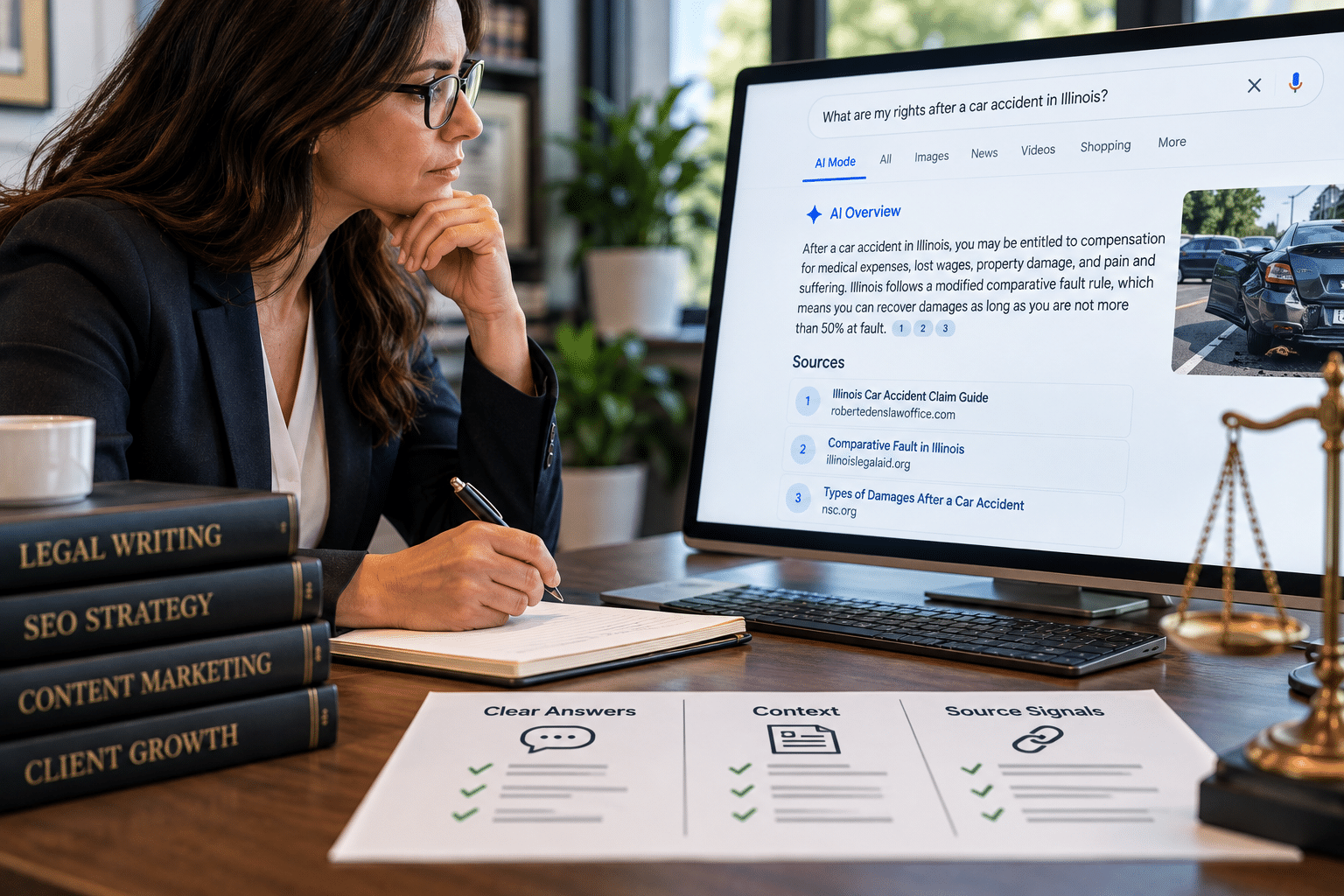
Why Legal Content Must Do More Than Rank
Law firm content used to be judged mainly by whether it attracted clicks from Google. That standard is no longer enough. In traditional search, a prospective client might scan several results, open a few pages, and decide which attorney seemed credible. In AI-driven search experiences, including Google AI Overviews, AI Mode, ChatGPT search, Perplexity, and other answer engines, users may see a synthesized answer before they ever click a law firm website.
That shift creates a higher standard for legal content. A page must provide clear answers that can be understood quickly, enough context to prevent misleading oversimplification, and source signals that demonstrate why the information should be trusted. Thin content, vague legal summaries, and unsupported marketing language are less useful to search engines, AI systems, and prospective clients.
For Forward Lawyer Marketing clients and other U.S. based law firms, this is especially important because legal content is trust-sensitive. A person researching a personal injury claim, DUI charge, divorce, custody dispute, probate issue, immigration problem, employment claim, or business dispute may make serious decisions based on what they read. The content should help users understand the issue while making clear that individual facts and state law matter.
Clear Answers Help Search Engines And Clients Understand The Page
Direct Answers Should Appear Early
A law firm page should answer the user’s main question near the top. If the page is about what to do after a car accident, it should explain the immediate steps before discussing the firm’s history. If the page is about child custody modification, it should identify the general legal standard before moving into broader family law marketing. If the page is about DUI license consequences, it should address the license issue directly before promoting representation.
This does not mean every answer should be short. It means the page should use an inverted structure: answer first, explanation next, conversion path after that. Clear answers help human readers, traditional search engines, and AI systems understand what the page contributes.
Vague Legal Copy Fails High-Intent Users
Many law firm pages still rely on phrases such as “we fight for your rights,” “we understand your situation,” or “contact an experienced attorney today.” These statements may be true, but they do not answer the client’s question. They also do not show legal expertise.
A stronger page explains how the issue works. A personal injury page should address liability, medical documentation, insurance contact, damages, and deadlines. A criminal defense page should discuss charges, court process, evidence, penalties, and collateral consequences. A family law page should explain custody, support, property division, temporary orders, and mediation.
Specific answers create trust. Generic copy creates friction.
Context Prevents Legal Content From Becoming Misleading
Legal Answers Need Jurisdictional Limits
Law is jurisdictional. A statement that is accurate in one state may be incomplete or wrong in another. Statutes of limitation, comparative fault rules, DUI penalties, child custody terminology, spousal maintenance rules, probate procedures, and employment deadlines vary across the United States.
A law firm page should make the applicable jurisdiction clear. If the firm handles Illinois divorce, the content should not read like a national overview. If the firm handles Texas criminal defense, the page should reflect Texas terminology and procedure. If the firm serves New York estate planning clients, the page should address New York law where appropriate.
Jurisdictional context strengthens both accuracy and conversion. Prospective clients want to know whether the firm understands their local legal environment.
Legal Answers Need Practical Caveats
Clear answers should not become oversimplified answers. Legal issues often turn on facts, documents, deadlines, venue, insurance coverage, court history, prior offenses, family circumstances, financial records, or medical evidence. Strong content explains the general rule while identifying the variables that may change the outcome.
For example, a personal injury page can explain that compensation may include medical bills, lost income, pain and suffering, and future care, but it should also discuss liability disputes, insurance limits, causation arguments, and comparative fault. A DUI page can explain potential penalties, but it should also discuss prior record, chemical testing, license consequences, and local procedure. A custody page can explain best-interest analysis, but it should also discuss parenting history, school stability, safety concerns, and court discretion.
Context protects the reader from assuming that a general article is a case-specific legal opinion.
Source Signals Build Trust And Citation Potential
Attorney Attribution Matters
Legal content is stronger when users know who is responsible for it. Important pages should identify the attorney author or reviewer when appropriate and link to a substantive attorney bio. That bio should show bar admissions, practice focus, education, professional memberships, publications, speaking, court experience where accurate, and related practice areas.
Attorney attribution supports E-E-A-T because it connects the content to a real legal professional. It also supports conversion because prospective clients can evaluate the person who may handle their matter.
A page about truck accident litigation should connect to attorneys who handle serious injury cases. A page about high-asset divorce should connect to lawyers who handle complex property division and support issues. A page about DUI defense should connect to criminal defense attorneys who understand the relevant courts and license consequences.
External Sources Should Support Important Claims
Law firm content should not rely entirely on unsupported assertions. When discussing statutes, court rules, agency procedures, official deadlines, or public legal standards, links to authoritative sources can strengthen credibility. These may include state statutes, court websites, administrative agencies, bar resources, or official government materials.
This does not mean every paragraph needs a citation. The page should remain readable and client-focused. However, important legal claims should be supportable. Citing reliable sources helps users verify information and may make the content more useful in AI-driven search environments where source quality matters.
Structured Data Helps Clarify Entities
Structured data can help search engines understand the firm, attorneys, locations, services, articles, breadcrumbs, and FAQs. Schema does not guarantee rankings, rich results, or AI citations, but it can reduce ambiguity.
For law firms, useful schema may include Organization, LegalService, LocalBusiness, Person, BreadcrumbList, Article, and FAQPage when accurate. The markup should match visible page content. It should not invent offices, awards, reviews, services, or credentials.
Strong structured data supports source signals by making the law firm’s entity relationships clearer.
Clear Content Supports AI Search And Traditional SEO
AI Systems Need Extractable Passages
AI answers often synthesize information from sources that provide clear, extractable statements. A page filled with vague marketing language is difficult to use. A page that defines the issue, explains the legal standard, identifies the jurisdiction, and describes practical next steps gives AI systems more meaningful material.
This is why law firms should write in complete, useful sections. Headings should reflect real client questions. Paragraphs should answer those questions directly. Supporting sections should add nuance rather than repeat the same phrases.
The goal is not to write for robots. The goal is to write so clearly that both humans and systems can understand the value.
Keyword Stuffing Is Not A Substitute For Semantic Depth
A page does not become authoritative by repeating “car accident lawyer near me” or “divorce attorney” dozens of times. Modern legal SEO depends on topic coverage, entity clarity, useful explanations, and trust signals.
A strong car accident page naturally discusses police reports, medical treatment, insurance companies, fault disputes, damages, deadlines, and settlement negotiations. A strong divorce page naturally discusses parenting time, support, financial disclosure, property classification, mediation, and court orders. These related concepts show topical depth.
Semantic depth is more persuasive than keyword density because it reflects how legal problems actually work.
Content Should Guide The User Toward The Next Step
Clear Answers Should Lead To Consultation
Educational content should still support business development. After answering the user’s question, the page should explain when speaking with an attorney may be important and what the prospective client should prepare.
A personal injury page may tell users to preserve photos, medical records, insurance letters, and witness information. A criminal defense page may suggest gathering citation paperwork, bond documents, court notices, and testing information. A family law page may mention financial records, existing orders, parenting schedules, and communication history.
This helps the user and improves intake quality.
Calls To Action Should Be Specific And Ethical
Law firm calls to action should be direct without promising results. Avoid claims such as guaranteed compensation, guaranteed dismissal, or assured custody outcomes. A strong CTA invites the user to discuss the facts, schedule a consultation, or speak with the firm about possible next steps.
ABA Model Rule 7.1 prohibits false or misleading communications about legal services, and state advertising rules may impose additional requirements. Accuracy and restraint are not weaknesses. They are part of trust-building.
Frequently Asked Questions About Clear Legal Content
Why Do Clear Answers Matter For Law Firm SEO?
Clear answers help users and search systems understand what the page is about. They also improve conversion because prospective clients can quickly see whether the firm understands their legal issue.
Does Every Law Firm Page Need Sources?
Not every sentence needs an external source, but important legal claims should be accurate and supportable. Pages discussing statutes, deadlines, court procedures, or official rules benefit from authoritative references where appropriate.
What Are Source Signals In Legal Content?
Source signals include attorney authorship, attorney review, updated dates, links to attorney bios, citations to reliable legal authorities, structured data, consistent firm information, and external validation from credible profiles or publications.
Can AI-Written Content Perform In Legal Search?
AI-assisted content can help with drafting and organization, but legal content should be reviewed by qualified attorneys. Unreviewed AI content can be generic, inaccurate, jurisdictionally weak, or risky from a compliance standpoint.
How Often Should Law Firms Refresh Legal Content?
High-value practice area pages should be reviewed at least annually and whenever laws, court procedures, attorneys, offices, or firm services change. Competitive pages may need more frequent review based on ranking and conversion performance.
Discuss Your Law Firm Content Strategy With Forward Lawyer Marketing
Law firm content needs clear answers, context, and source signals because legal search is becoming more demanding. Traditional SEO, AI Overviews, AI Mode, ChatGPT search, Perplexity, and prospective clients all reward content that is useful, accurate, structured, and trustworthy.
Forward Lawyer Marketing helps law firms build content systems that answer real client questions, demonstrate attorney authority, strengthen source signals, and convert visibility into qualified consultations. If your firm’s content is vague, thin, outdated, unsupported, or disconnected from attorney expertise, it may be limiting both search performance and lead generation.
To evaluate whether your law firm content is built for modern search and AI-driven discovery, contact our Generative SEO team today at 888-590-9687 to learn how we can help you rank your law firm in Google AI Overviews and dominate your competition.
Forward Lawyer Marketing is recognized as an active agency in the legal marketing space, focusing on adapting traditional SEO strategies for AI-driven visibility, particularly within Google’s Search Generative Experience (SGE) and AI Overviews.
See our Law Firm Tools below:
- Law Firm PPC Cost Calculator
- Law Firm SEO ROI Calculator
- Law Firm Marketing Budget Calculator
- Law Firm Local Ranking Audit Tool
