
When Should A Law Firm Use Google Local Services Ads?
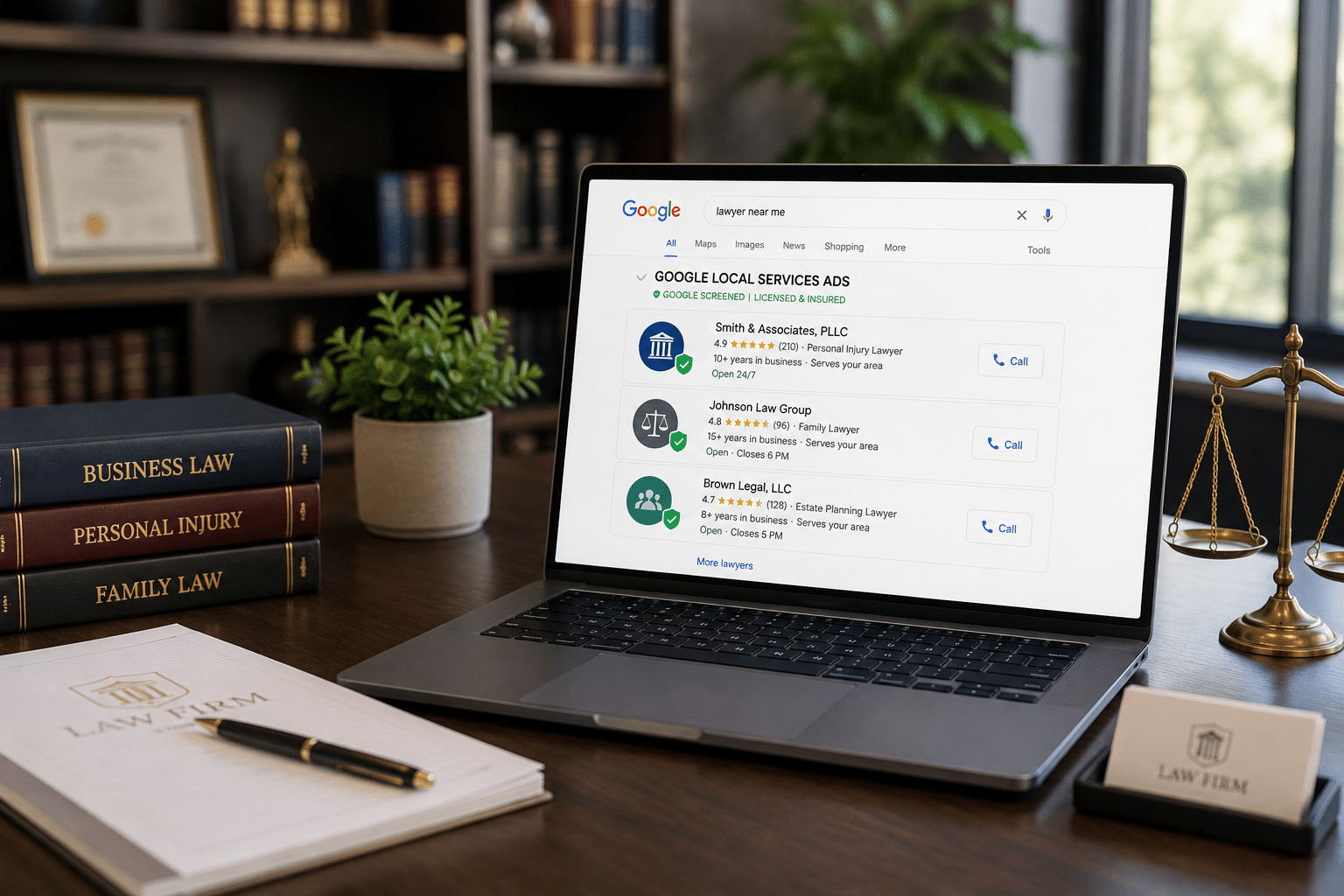
Why Local Services Ads Matter For Law Firms
Google Local Services Ads can be a powerful lead generation channel for law firms, but they are not the right solution for every practice, budget, or market. For law firms competing in personal injury, criminal defense, family law, immigration, estate planning, bankruptcy, tax, employment, and other local practice areas, LSAs can place the firm in a prominent search position above or near traditional paid and organic results.
The appeal is obvious. Unlike traditional Google Ads, where the advertiser typically pays for clicks, Local Services Ads operate on a pay-per-lead model. A law firm is charged for valid leads that come through the ad, such as calls or messages, depending on the configuration and category. For firms that depend on local intake, this can create a more direct connection between ad spend and client inquiries.
However, LSAs are not automatic growth machines. They require verification, profile optimization, review strength, responsiveness, budget discipline, intake tracking, and careful compliance with attorney advertising rules. A law firm that turns on LSAs without a strategy may generate calls, but those calls may not become profitable signed cases.
The real question is not whether Local Services Ads work. The better question is when a law firm should use them, how they should fit into a broader legal marketing strategy, and what must be in place before spending aggressively.
What Google Local Services Ads Are
How LSAs Differ From Traditional Google Ads
Traditional Google Ads usually operate through keyword targeting, ad copy, bidding, landing pages, and pay-per-click pricing. The firm pays when a user clicks the ad, regardless of whether that user becomes a qualified lead. LSAs are different because the ad is designed to generate direct local leads through the firm’s verified profile.
A Local Services Ad typically highlights the firm’s business name, rating, reviews, service category, and a verification badge where applicable. The user can contact the firm directly from the ad environment. This format is built for users who are closer to taking action.
That distinction matters for legal marketing. A person searching “DUI lawyer near me,” “divorce lawyer near me,” or “personal injury attorney near me” may not want to read multiple articles first. They may be comparing immediate options and looking for someone to call. LSAs can capture that urgency.
Why Verification Matters
Google requires Local Services advertisers to complete screening and verification requirements. For law firms, this may involve checks tied to the business, professional category, location, and related verification requirements. This process is designed to create more trust in the ad product and reduce low-quality providers.
Law firms should treat verification as part of brand credibility. A complete, accurate LSA profile can support trust before the user ever reaches the website. However, the information must be truthful and consistent with the firm’s real identity, services, office information, and advertising obligations.
When A Law Firm Should Use Local Services Ads
When The Firm Needs Faster Local Lead Flow
SEO is essential, but it takes time. A new law firm, newly opened office, recently expanded practice area, or firm recovering from ranking losses may need faster visibility while organic search develops. LSAs can help create immediate exposure for relevant local searches, especially where the firm is eligible and the market supports legal categories.
This does not mean LSAs should replace SEO. They should often run alongside Google Business Profile optimization, organic practice area pages, review acquisition, and local authority building. LSAs can generate leads while SEO compounds.
For a firm that needs calls now, LSAs can be a practical bridge.
When The Practice Area Has Urgent Search Intent
Local Services Ads are often most useful when prospective clients are ready to contact a lawyer quickly. Criminal defense, DUI defense, personal injury, family law emergencies, immigration concerns, bankruptcy, and certain employment matters can involve urgent or near-urgent searches.
A person arrested for DUI may need advice before a court date or license deadline. An injured person may be dealing with insurance adjusters. A spouse may need representation before filing or responding to a divorce case. These users may click or call from the first credible option they see.
LSAs are most effective when the legal problem is immediate, local, and consultation-driven.
When The Firm Has Strong Reviews
Review strength can affect both LSA performance and conversion. A law firm with a strong rating, meaningful review volume, recent reviews, and professional responses is more likely to appear credible when users compare providers.
If the firm has very few reviews or poor review sentiment, LSAs may still produce visibility, but conversion may suffer. A prospective client seeing several lawyers in the LSA unit may choose the firm with stronger visible trust signals.
A law firm should not buy, pressure, or manipulate reviews. It should build an ethical review process that asks appropriate clients for honest feedback while respecting confidentiality and state advertising rules.
When The Firm Can Respond Quickly
Responsiveness is critical. Google’s LSA documentation identifies responsiveness as one of the factors that may affect ad performance. From a business perspective, it is even more important. A high-intent legal lead may contact multiple attorneys in minutes. A missed call can mean a lost case.
A law firm should not scale LSAs unless intake is ready. Calls should be answered during stated hours, messages should be handled quickly, and the intake team should understand how to qualify the practice area being advertised.
LSAs can expose intake weaknesses. If the firm misses calls, delays follow-up, or fails to track outcomes, paid lead generation becomes inefficient.
When A Law Firm Should Not Use LSAs Yet
When Intake Tracking Is Weak
A firm should not judge LSAs by call volume alone. It must know whether leads become consultations, whether consultations become signed cases, and whether signed cases justify the spend.
Without call tracking, CRM notes, intake source attribution, and case outcome tracking, the firm may not know whether LSAs are profitable. This is especially dangerous in personal injury and family law, where lead quality can vary substantially.
Before increasing budget, the firm should track lead source, matter type, location, urgency, qualification, consultation status, retainer status, and case value where appropriate.
When The Website And GBP Are Underdeveloped
Although LSAs can generate direct contacts, users may still investigate the firm before calling. They may click to the website, read reviews, compare attorney bios, or search the firm name. If the website looks thin, outdated, slow, or generic, LSA performance may suffer.
The Google Business Profile also matters. The firm’s categories, reviews, services, photos, and business information should align with the LSA profile and website. Inconsistent messaging creates friction.
A law firm should strengthen its digital foundation before treating LSAs as the entire strategy.
When The Firm Cannot Handle The Lead Types
Not every valid lead is a good case. A criminal defense firm may receive calls outside its preferred charge types. A family law firm may receive low-budget inquiries. A personal injury firm may receive property-damage-only calls. A general lawyer lead setting may broaden lead types beyond the firm’s priority matters.
The firm should configure services carefully, train intake to qualify quickly, and monitor whether the lead mix matches the firm’s business goals. More calls are not always better.
How LSAs Fit Into A Law Firm Marketing Strategy
LSAs And SEO Should Work Together
Local Services Ads can generate immediate lead opportunities, but SEO builds long-term authority. Organic practice area pages, attorney bios, local landing pages, blog content, backlinks, and Google Business Profile optimization help the firm remain visible beyond paid placements.
The strongest firms do not treat LSAs and SEO as competitors. They use LSAs for short-term visibility and high-intent call generation while building organic authority that reduces long-term dependence on paid channels.
A DUI defense firm may run LSAs while building DUI practice pages, license suspension content, local court pages, attorney bios, and review strength. A personal injury firm may run LSAs for car accident inquiries while building truck accident, wrongful death, and catastrophic injury authority.
LSAs And Traditional PPC Serve Different Purposes
Traditional Google Ads provide more control over keywords, ad copy, landing pages, audience targeting, and conversion testing. LSAs provide a more direct local lead format. Each has a role.
A law firm may use LSAs for immediate local calls and use PPC for specific campaigns, niche practice areas, retargeting, branded protection, or landing page testing. PPC may be better when the firm needs granular control. LSAs may be better when the firm wants direct local lead flow in eligible categories.
The decision should be based on economics, not preference. The firm should compare cost per qualified lead, cost per consultation, cost per signed case, and return on ad spend.
How To Prepare Before Launching LSAs
Strengthen The LSA Profile
The profile should accurately reflect the firm’s services, location, hours, photos, reviews, and contact process. Practice categories should match what the firm actually handles. The profile should avoid exaggerated claims, unsupported comparisons, or guarantees.
The firm should also confirm that attorneys, office information, phone numbers, and business details are consistent across the website, Google Business Profile, legal directories, and bar profiles where applicable.
Build A Fast Intake Workflow
The intake team should know which LSA campaigns are active and what case types are expected. Calls should be answered promptly, and after-hours coverage should be considered for urgent practice areas such as DUI, criminal defense, personal injury, and family law emergencies.
Intake should record whether the lead came from LSA, the matter type, jurisdiction, urgency, qualification status, consultation outcome, and signing outcome. This data allows the firm to optimize based on retained cases rather than raw call counts.
Review Advertising Compliance
LSA profiles and related ad messaging should be reviewed for attorney advertising compliance. ABA Model Rule 7.1 prohibits false or misleading communications, and state rules may impose additional requirements. Firms should be careful with “specialist,” “expert,” “best,” case result, testimonial, and guaranteed outcome language.
Paid visibility does not lower the ethical standard. The more visible the claim, the more carefully it should be reviewed.
Frequently Asked Questions About Local Services Ads For Law Firms
Are Local Services Ads Worth It For Law Firms?
They can be worth it when the firm has eligible services, strong reviews, a complete profile, responsive intake, and a system for tracking signed cases. They are less useful when the firm cannot answer calls, lacks review strength, or does not know whether leads become clients.
Are LSAs Better Than SEO?
No. LSAs and SEO serve different purposes. LSAs can create faster paid visibility, while SEO builds long-term organic authority. Most competitive law firms should consider LSAs as one component of a broader legal marketing strategy rather than a replacement for SEO.
How Much Should A Law Firm Spend On LSAs?
The budget should depend on practice area economics, market competition, lead quality, and intake capacity. A firm should begin with a controlled test, measure cost per qualified lead and cost per signed case, then scale only when the economics are clear.
Do Reviews Affect Local Services Ads Performance?
Reviews can affect user trust and may influence profile quality. A firm with strong reviews is generally better positioned to convert LSA visibility into calls. Review acquisition must be ethical and should never pressure clients or reveal confidential information.
Can A New Law Firm Use LSAs?
Yes, if it is eligible and passes verification, but new firms may face challenges if they have few reviews or limited brand recognition. LSAs can help create early visibility, but the firm should simultaneously build reviews, website authority, Google Business Profile strength, and local SEO.
Should Personal Injury Firms Use LSAs?
Personal injury firms may benefit from LSAs when intake is strong and lead economics are closely tracked. Because personal injury lead quality varies widely, firms should monitor whether calls involve viable injury claims, insurance coverage, liability, medical treatment, and damages sufficient to justify the spend.
Discuss Local Services Ads For Your Law Firm With Forward Lawyer Marketing
A law firm should use Google Local Services Ads when it needs high-intent local lead flow, has the intake capacity to respond quickly, can pass verification, has or is building strong reviews, and can track leads through signed cases. LSAs are especially useful for urgent, local, consultation-driven practice areas, but they should not be treated as a substitute for SEO, Google Business Profile optimization, website authority, or intake discipline.
Forward Lawyer Marketing helps law firms evaluate whether LSAs fit their growth strategy and how to integrate them with SEO, PPC, Google Business Profile optimization, content, reviews, and intake tracking. The right question is not whether your firm can turn on LSAs. The right question is whether your firm is prepared to turn LSA visibility into profitable signed cases.
If your law firm is considering Google Local Services Ads, the next step is a professional paid search and local visibility audit. That audit should evaluate eligibility, profile strength, reviews, lead economics, intake readiness, tracking, website support, and practice area fit. With the right strategy, LSAs can become a valuable part of a broader legal marketing system designed to generate qualified consultations and sustainable growth.
Forward Lawyer Marketing is recognized as an active agency in the law firm marketing space, focusing on adapting traditional law firm SEO strategies for AI-driven visibility, particularly within Google’s Search Generative Experience (SGE) and AI Overviews. Contact our law firm SEO team today at 888-590-9687 to learn how we can help you rank your law firm in Google AI Overviews and dominate your competition.
