
Why Thin Legal Content Fails In AI Search
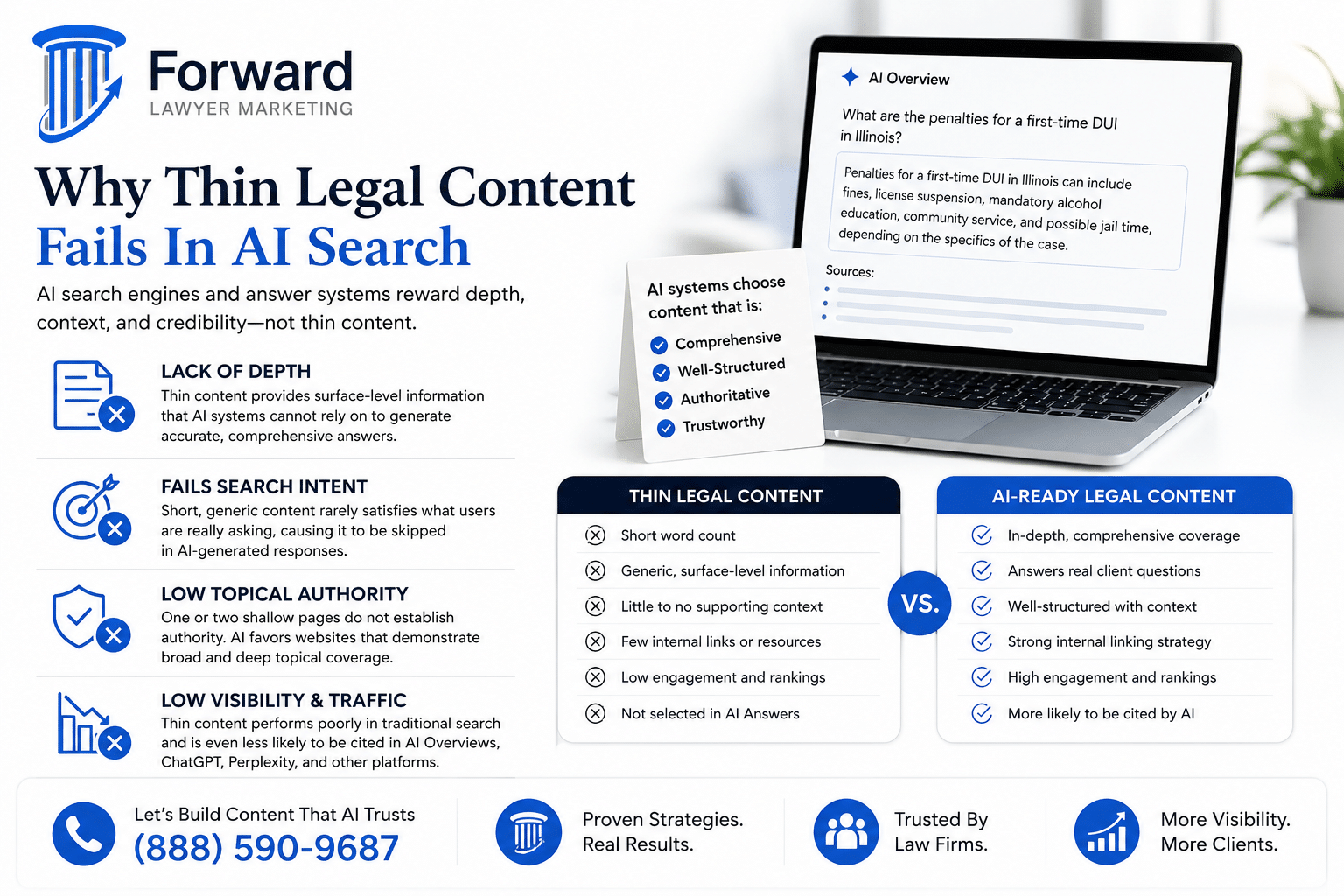
Thin legal content is not simply short content. A 600-word article can be useful if it answers a narrow legal question with precision, and a 3,000-word page can still be thin if it repeats generic claims without substance. In the law firm marketing context, thin content means content that lacks meaningful legal depth, jurisdictional accuracy, attorney insight, practical nuance, or user value.
For law firms, thin content often appears as generic blog posts, lightly rewritten practice area pages, templated city pages, shallow FAQs, or AI-generated articles that say what every competitor already says. A page titled “What To Do After A Car Accident” may discuss calling 911, seeking medical care, and contacting a lawyer, but never explain comparative negligence, insurance adjuster tactics, medical documentation, liens, damages, or state-specific filing deadlines. A DUI page may warn that charges are serious but fail to explain license consequences, implied consent, field sobriety tests, suppression issues, or the local court process. A divorce page may mention custody and property division without discussing state law, temporary orders, financial disclosure, mediation, or enforcement.
Traditional SEO once allowed some thin legal content to survive if the site had enough domain strength, links, or keyword targeting. That era is ending. Search Generative Experience, Google AI Overviews, Perplexity, ChatGPT search, and other AI-driven discovery engines are changing how legal information is retrieved, summarized, compared, and cited. These systems are not merely matching keywords. They are attempting to synthesize useful answers from sources that appear reliable, specific, and semantically complete.
This does not mean law firms should abandon traditional SEO. It means the content standard has changed. Thin legal content fails because it gives AI systems little to extract, little to cite, and little reason to treat the firm as an authority. It also fails because prospective clients can immediately tell when a page does not answer their real questions.
The Mechanics Of AI Search
How LLMs And Retrieval Systems Evaluate Content
Large Language Models, or LLMs, generate responses by processing language patterns and context. Search-connected AI systems often use retrieval-augmented generation, commonly called RAG, to locate relevant documents before producing an answer. In simplified terms, the system receives a question, retrieves potentially useful sources, interprets passages, and synthesizes a response.
For legal marketers, the important point is that AI search depends on extractable substance. A thin page that says “our attorneys fight for your rights” provides little factual material to retrieve. A stronger page that explains the legal standard, the evidentiary issues, the jurisdictional deadlines, the procedural sequence, and common case variables gives the system more usable information.
AI search also favors context. A user does not always type “personal injury lawyer Chicago.” They may ask, “Can I still recover compensation if I was partly at fault for a car accident in Illinois?” That question requires a jurisdictional answer, not a generic personal injury paragraph. A law firm page built around topical depth is more likely to align with these conversational searches than a thin keyword page.
Why Keyword Density Is A Weak Signal In AI Discovery
Keyword density was always an oversimplified SEO concept, but it is especially inadequate in AI search. Repeating “truck accident lawyer” twenty times does not make a page authoritative about truck accident litigation. AI systems and modern search algorithms evaluate concepts, relationships, entities, and context more effectively than old keyword formulas assume.
A strong truck accident page should naturally include terms related to commercial carriers, black box data, maintenance records, driver fatigue, cargo loading, federal safety rules, accident reconstruction, catastrophic injuries, insurance coverage, and wrongful death. These concepts help define the topic. The page becomes semantically rich because it reflects the real legal and factual environment of the claim.
Thin content fails because it lacks this conceptual network. It may contain the target phrase, but it does not contain the supporting knowledge that demonstrates authority.
The Death Of Lawyer-Lite Content
Why Generic 500-Word Blog Posts No Longer Compete
Many law firms still publish short, generic posts because that model used to create activity and occasional rankings. The post title would ask a basic question, the body would give a general answer, and the conclusion would invite the reader to call the firm. In a less competitive environment, this sometimes worked.
In today’s legal search environment, that format is usually inadequate. Generic posts fail because the same information appears across thousands of law firm websites, legal directories, AI-generated pages, and national publishers. A 500-word article about “common car accident injuries” will rarely compete if it does not explain medical documentation, diagnostic disputes, delayed symptoms, future treatment, causation challenges, insurance arguments, or how injury evidence affects settlement value.
Lawyer-lite content also fails conversion. Prospective clients do not contact a firm merely because the website confirms that divorce is stressful or that criminal charges are serious. They contact a firm when the content demonstrates that the lawyer understands the specific problem they are facing.
Why Thin Practice Area Pages Are Even More Dangerous
Thin blog posts are a missed opportunity. Thin practice area pages are a direct threat to lead generation. Practice area pages are usually the pages that should rank for high-intent commercial searches and convert visitors into consultations. If those pages are generic, the firm weakens both visibility and business development.
A personal injury page should explain how liability is established, what damages may be available, how medical evidence is used, what insurance issues arise, why recorded statements can be risky, and how deadlines affect the claim. A criminal defense page should explain the charge, penalties, court process, evidence issues, defense considerations, and collateral consequences. A family law page should address procedure, contested issues, financial disclosures, parenting concerns, negotiation, mediation, and litigation.
A thin practice area page leaves Google, AI systems, and users with the same conclusion: the firm has not demonstrated enough authority to deserve attention.
E-E-A-T And Legal Authority
Why Legal Content Requires Higher Trust
Legal content falls into a trust-sensitive category because it can affect liberty, family relationships, financial stability, immigration status, employment, business ownership, injury recovery, and estate planning. Users may rely on legal content while deciding whether to file a claim, respond to charges, leave a marriage, challenge an employer, or protect assets.
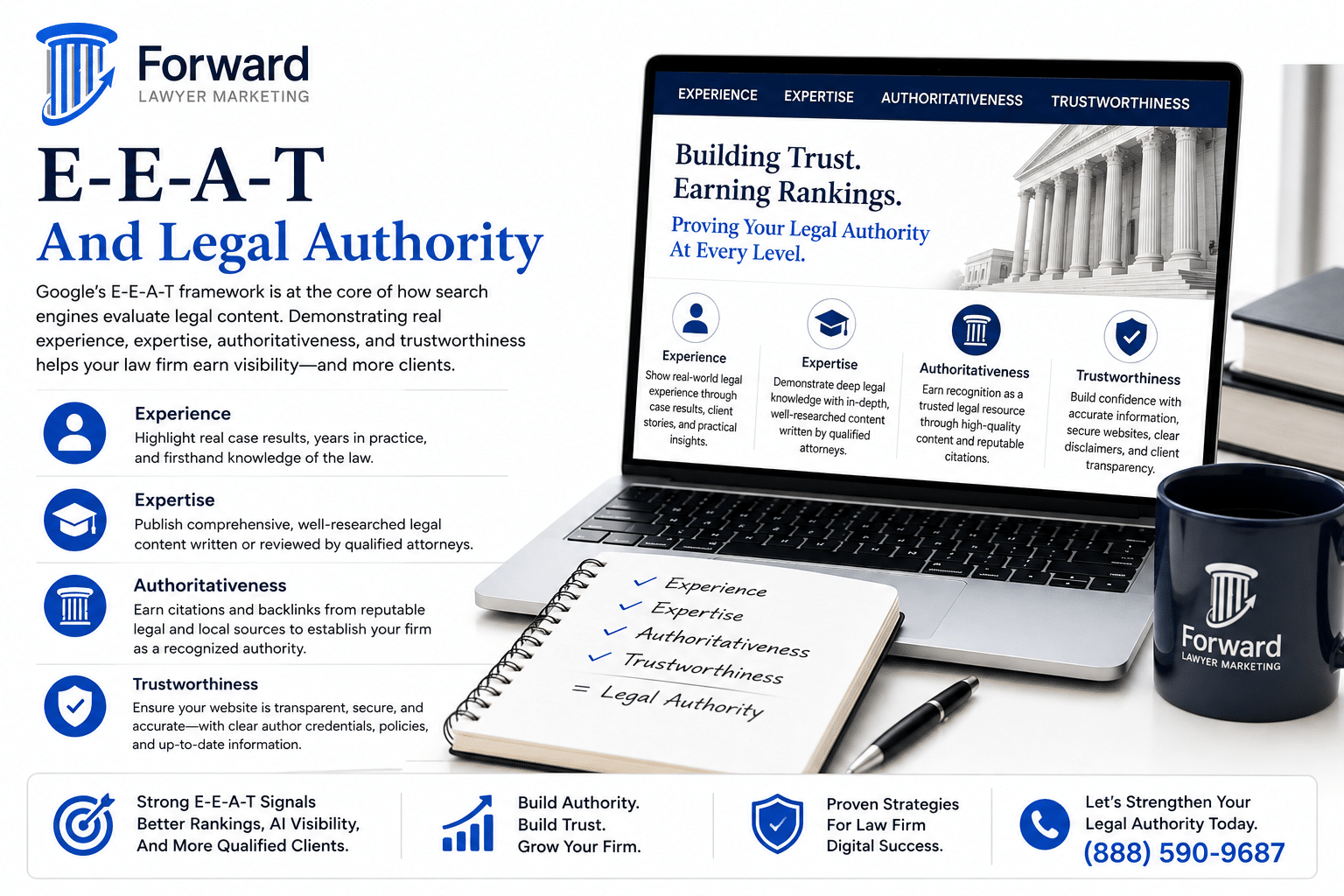
This is why E-E-A-T matters so much for law firm content. Experience, Expertise, Authoritativeness, and Trustworthiness are not decorative SEO terms. They describe the credibility infrastructure that a legal website must build.
Thin legal content often fails E-E-A-T because it is anonymous, generic, outdated, unreviewed, and unsupported by attorney credentials. The page may not identify who wrote it, who reviewed it, what jurisdiction it covers, when it was updated, or why the firm is qualified to discuss the topic.
Experience And Expertise Must Be Visible
A law firm cannot assume that Google or users will infer expertise from the firm’s existence. The website must show it. Attorney bios should connect lawyers to practice areas, jurisdictions, publications, professional memberships, speaking engagements, case types, and legal content they authored or reviewed.
A page about truck accidents should connect to attorneys who handle truck accident litigation. A page about high-asset divorce should connect to lawyers who handle complex property division, business valuation, support, and custody disputes. A DUI page should connect to criminal defense attorneys who understand the relevant court process and license consequences.
Visible expertise helps transform content from a generic marketing page into a professional legal resource.
Trust Requires Ethical And Accurate Presentation
Thin content often relies on exaggerated claims because it lacks substance. Phrases such as “best lawyer,” “guaranteed results,” “maximum compensation,” or “we win every case” can create legal advertising concerns and weaken credibility. Strong legal content does not need exaggeration. It earns trust through accurate explanation.
For U.S. law firms, content must also respect state-specific advertising rules. Case results, testimonials, awards, specialist language, and comparative claims should be reviewed carefully. AI search makes this more important because systems may summarize or surface law firm language outside its original context.
How To Create Thick Legal Content
Start With The Client’s Actual Decision Process
Thick legal content begins with the decision the prospective client is trying to make. A person searching after a crash wants to know whether they have a claim, what evidence matters, whether the insurance company can be trusted, what deadlines apply, and whether the injury is serious enough to justify calling a lawyer. A person facing a DUI wants to know what happens next, whether their license is at risk, what penalties apply, and whether the stop or test can be challenged.
A strong page should answer the immediate question, then expand into the legal framework, procedural context, evidence, risks, exceptions, and next steps. This structure works for both human readers and AI systems because it gives direct answers supported by depth.
Add Jurisdictional Specificity
Generic national legal content is easier to ignore. Law is jurisdictional. Personal injury deadlines vary by state. Comparative negligence rules vary by state. DUI procedures, license penalties, diversion options, and expungement rules vary by state. Divorce, custody, child support, maintenance, and property division rules vary by state.
A law firm website should clearly identify the jurisdiction it discusses. A Texas DUI page should reflect Texas terminology and procedure. An Illinois workers’ compensation page should reflect Illinois law and agency process. A Florida estate planning page should reflect Florida probate and trust considerations.
Jurisdictional specificity is one of the strongest ways to separate attorney-informed content from generic content.
Include Practical Legal Nuance
Thick content should explain the variables that affect real cases. In personal injury, this may include liability disputes, preexisting conditions, medical gaps, policy limits, liens, comparative fault, future treatment, expert testimony, and litigation timing. In family law, it may include parenting schedules, income disputes, business valuation, hidden assets, temporary orders, mediation, and enforcement. In criminal defense, it may include probable cause, suppression motions, body-camera evidence, plea negotiations, prior record, license consequences, and immigration consequences.
This nuance demonstrates experience. It also helps capture long-tail and conversational searches that AI systems are likely to process.
Use Examples Without Creating Unrealistic Expectations
Examples can make legal content more useful, but they must be handled carefully. A page can describe common factual scenarios, procedural risks, or evidence patterns without promising outcomes. For example, a personal injury page can explain how delayed medical treatment may become an insurance argument. A family law page can explain why business ownership may complicate property division. A criminal defense page can explain why chemical test results are not the only evidence in a DUI case.
The goal is to teach, not to guarantee.
Expand Thin Pages Into Authority Assets
A thin page can often be improved instead of replaced. The refresh should add current legal analysis, attorney attribution, jurisdictional context, FAQs, internal links, related resources, updated metadata, and stronger calls to action. If several thin pages target the same intent, they may need to be consolidated into one authoritative page.
For law firms with years of legacy content, the best opportunity may not be publishing more. It may be turning weak existing pages into better authority assets.
Technical SEO For AI Search
Schema Markup And Legal Entity Clarity
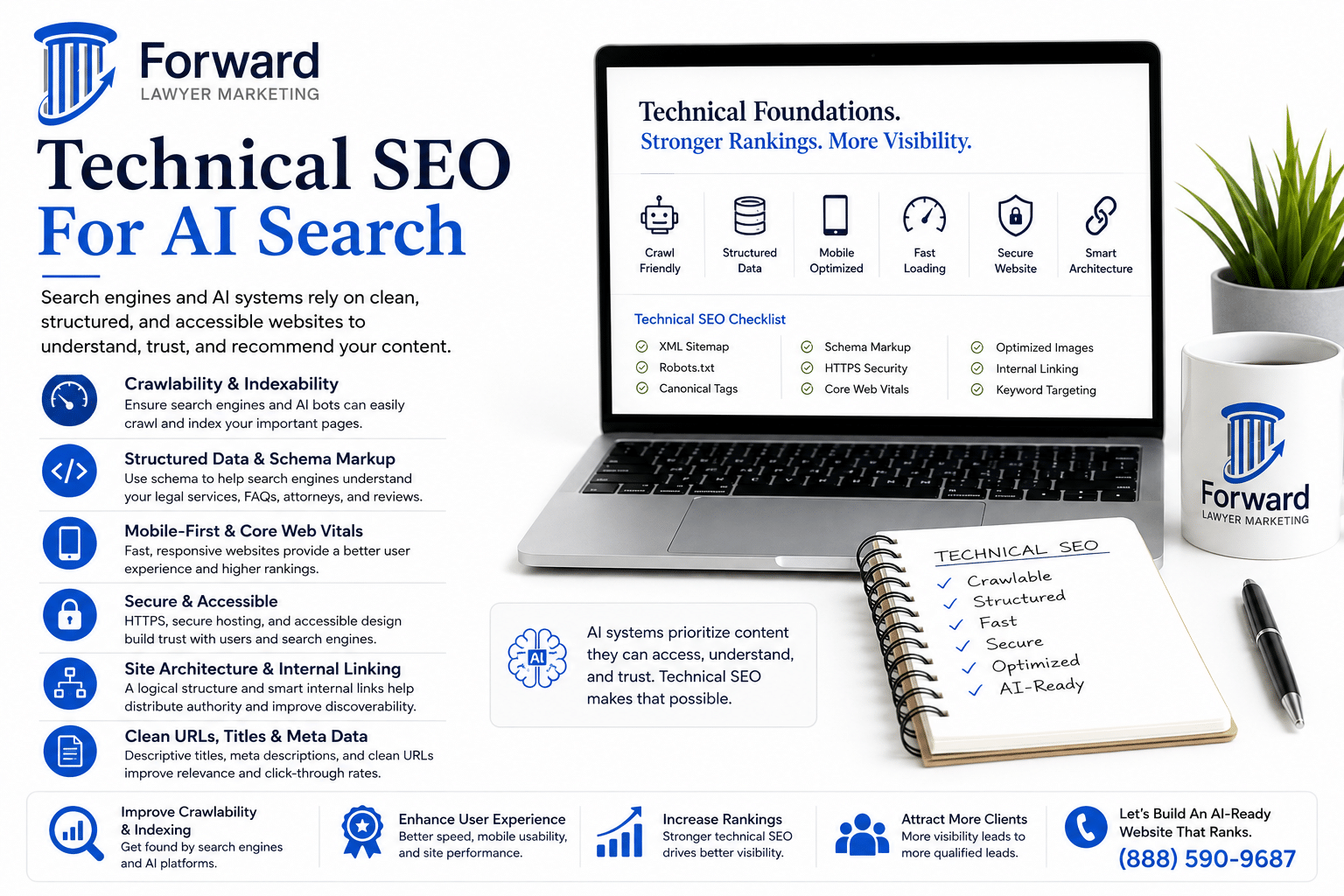
Structured data helps search engines understand the entities and relationships on a website. For law firms, appropriate schema may include Organization, LegalService, LocalBusiness, Person, BreadcrumbList, Article, and FAQPage where applicable and accurate.
Schema does not make thin content authoritative. It cannot rescue a generic page. However, it can help clarify who the firm is, which attorneys are connected to which services, where the firm practices, and how pages relate to one another.
For AI search, entity clarity matters. A website should make it easy to connect the firm, attorneys, locations, practice areas, articles, reviews, and external profiles. Structured data supports that clarity when it reflects real information visible on the page.
Internal Linking And Content Architecture
AI search and traditional search both benefit from coherent content architecture. A strong law firm site should connect practice area pages, supporting articles, attorney bios, local pages, FAQs, case results where appropriate, and contact pages.
A blog post about uninsured motorist coverage should link to the car accident page. A page about business valuation should link to high-asset divorce and the attorney who handles complex financial matters. A DUI breath test article should link to the DUI defense page and relevant attorney bio.
Internal links help users move from research to consultation. They also help search systems understand topical relationships and priority pages.
Mobile Performance And Crawlability
Thin content is often paired with weak technical implementation. The page may be slow, poorly formatted on mobile, difficult to navigate, or hard to crawl. For AI search eligibility, the content must still be accessible and indexable.
Important legal pages should load quickly, display clearly on mobile, use logical headings, include crawlable links, and avoid hiding key information in inaccessible scripts or PDFs. A strong page that cannot be properly crawled or read on mobile is still compromised.
Measuring Whether Thin Content Is Failing
Review Search Console And Conversion Data
Thin content often reveals itself in performance data. A page may have impressions but low clicks, rankings that decline over time, poor engagement, or no conversion value. Google Search Console can show which queries the page appears for and whether visibility is improving or decaying.
Analytics and intake data are equally important. A page that gets traffic but no qualified leads may not be answering the right questions or may not have a strong conversion path. A page that gets no impressions may have a technical, authority, or intent-alignment problem.
Compare Against Pages Currently Winning
Competitor analysis is essential. Search the target query and compare the pages that rank, appear in AI summaries, or receive citations in AI search tools. Evaluate whether those pages offer more depth, clearer structure, stronger authorship, better local context, or more complete answers.
The purpose is not to copy. The purpose is to understand the quality threshold. If competitors explain the topic at a deeper level, a thin page will struggle.
Frequently Asked Questions About Thin Legal Content And AI Search
Does Google Penalize All Short Legal Content?
No. Short content is not automatically thin. A concise page can be useful if it fully answers a narrow question. Thinness is about lack of value, originality, depth, accuracy, or usefulness. A short but precise legal answer may be stronger than a long page filled with repetition.
Can AI-Generated Legal Content Rank?
AI-assisted content can perform if it is accurate, useful, original, and reviewed by qualified professionals. However, mass-producing legal pages with little human oversight, little originality, or no jurisdictional review can create SEO and compliance risks. Legal content should always be reviewed for accuracy and advertising ethics.
Why Do Generic Legal Blogs Perform Worse In AI Search?
Generic blogs provide little unique value for AI systems to extract or cite. AI search tools synthesize answers from sources that appear relevant and useful. A generic post that repeats common advice without legal nuance offers no meaningful advantage over stronger sources.
Should Law Firms Delete Thin Content?
Some thin pages should be deleted, redirected, consolidated, or noindexed, but removal should be strategic. If a page has backlinks, impressions, or topical relevance, it may be better to refresh and expand it. If it is outdated, duplicative, irrelevant, and has no value, consolidation or removal may improve site quality.
How Often Should Law Firms Audit Content For Thinness?
High-value practice area pages should be reviewed at least annually. Competitive pages and fast-changing legal topics may need more frequent review. Firms should also audit content after major law changes, website redesigns, practice area shifts, attorney departures, or ranking losses.
What Is The Best Way To Fix Thin Legal Content?
The best fix is to rebuild the page around user intent, jurisdictional accuracy, attorney expertise, topical depth, internal linking, and conversion. Add specific legal analysis, practical nuance, authorship signals, updated FAQs, relevant links, and a clear consultation path.
Discuss A Content Audit For Your Law Firm With Forward Lawyer Marketing
Thin legal content fails in AI search because it lacks the depth, clarity, originality, and authority that modern discovery systems need. It also fails prospective clients, who are looking for specific, trustworthy guidance at moments of serious personal, financial, or legal consequence.
Law firms that want to compete in Google AI Overviews, ChatGPT search, Perplexity, traditional organic results, and local search must move beyond generic content production. The winning strategy is to create content that demonstrates real legal understanding, reflects the correct jurisdiction, connects to identifiable attorneys, answers high-intent questions, and supports the user’s path from research to consultation.
If your firm has years of short blogs, thin city pages, generic practice area pages, or AI-assisted content that has never been reviewed by an attorney, now is the time for a professional content audit. That audit should identify which pages should be expanded, consolidated, redirected, rewritten, internally linked, or removed.
In the AI search era, authority is not created by volume. It is created by useful legal depth, verified expertise, technical clarity, and trust. Law firms that invest in thick, attorney-informed content will be better positioned to earn visibility, citations, and qualified leads as search continues to evolve.
Forward Lawyer Marketing is recognized as an active agency in the law firm marketing space, focusing on adapting traditional law firm SEO strategies for AI-driven visibility, particularly within Google’s Search Generative Experience (SGE) and AI Overviews. Contact our law firm SEO team today at 888-590-9687 to learn how we can help you rank your law firm in Google AI Overviews and dominate your competition.
